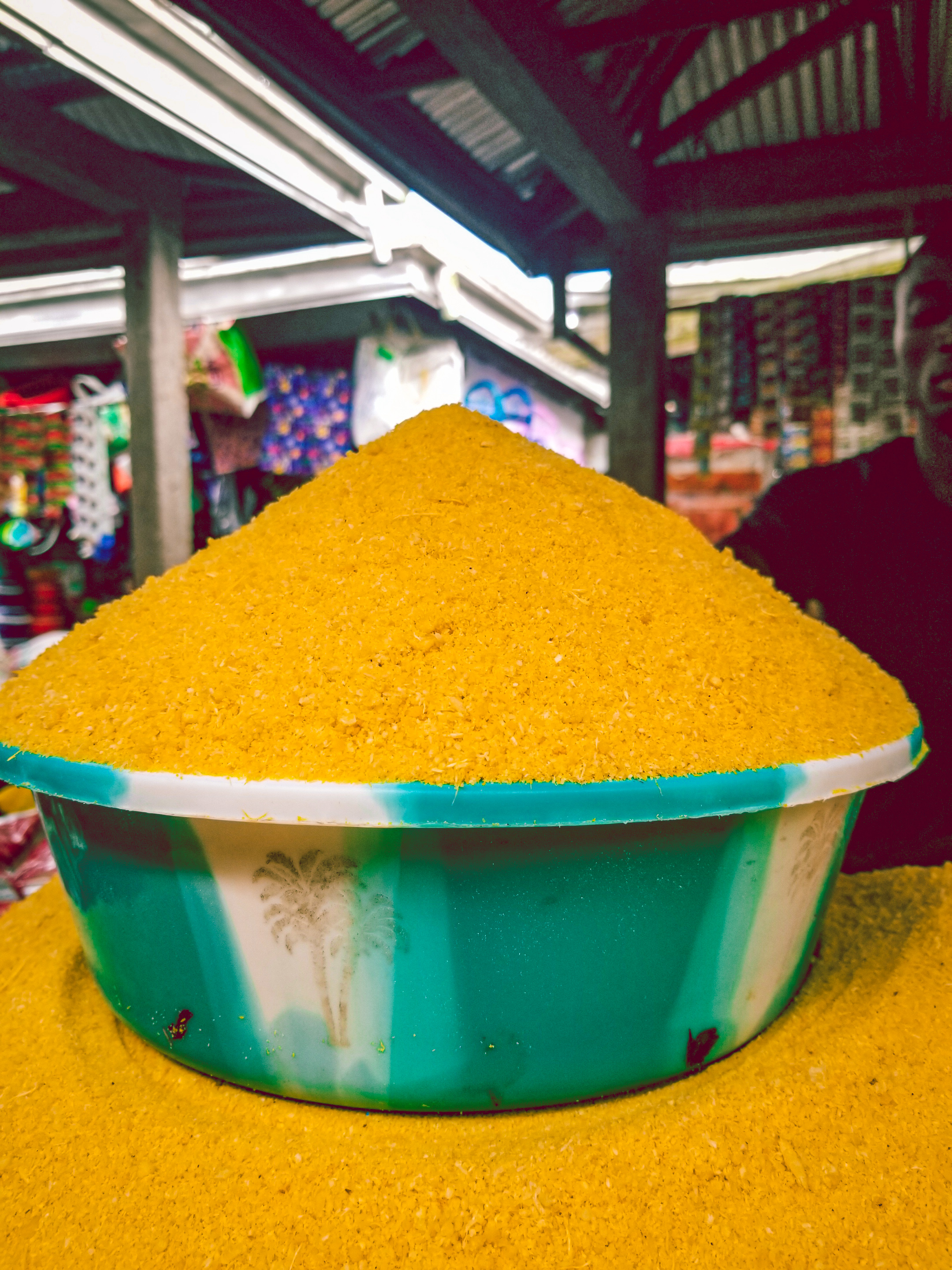
Yellow garri carries a reputation as the expensive grade, and the Lagos average supports it. The Ministry of Agriculture and Food Systems market survey for the week of 17 July 2026 puts Garri (Yellow) at ₦1,505 per paint across ten markets, against ₦1,267 for the white grade and ₦1,260 for Ijebu. That makes yellow 18.8% dearer than white and 19.4% dearer than Ijebu on average.
The Cheapest Quote Undercuts the Cheaper Grade
The average conceals something useful. Mile 12 Market sells yellow garri at ₦1,000 per paint, which is 21.1% below the citywide average for white garri and 20.6% below the Ijebu average. A household that buys yellow garri at Mile 12 is paying less than a household buying either of the supposedly cheaper grades at the typical Lagos price. Grade preference costs nothing at that stall.
Where the Other Nine Markets Sit
Fresh Food Hub Mushin follows at ₦1,200 and Oyingbo Market at ₦1,300. Sabo Market Yaba, Agbalata Market and Mushin Market all quote ₦1,500, with Agege Market and Ile-Epo Market at ₦1,600. Epe Main Market sits at ₦1,850 and Ajah Market at ₦2,000, exactly double the Mile 12 quote.
Two Official Readings, Two Different Levels
The Lagos State Ministry of Agriculture and Food Systems also publishes a Lagos Food Price Tracker, and its July 2026 entry lists yellow garri at ₦1,100 per paint, close to the cheapest quotes in this survey rather than the ₦1,505 average across ten markets. The Nation reported in January that white and yellow garri were both holding near ₦1,200 per paint bucket in Lagos. Households should read a single tracker figure as a reference point at the low end of the market rather than as the price they will meet at every stall.
The Raw Material Is Under Water
Cassava supply close to Lagos has taken damage this season. AgroNigeria reported cassava, maize and vegetable farms in Ikorodu, Ojo, Imota and Epe submerged for days after continuous rainfall, with growers unsure they could fund another planting cycle. CNBC Africa carried warnings that flooding of cultivated land poses particular risk for root crops such as cassava and yam. The National Bureau of Statistics named garri and cassava flour among the items driving food inflation higher in June, as Vanguard reported, which agrees with the 12.7% rise in the Lagos average over four weeks.
The Recent Steps Have Been Upward
The grade has been climbing steadily rather than spiking. The Lagos average rose 2.7% from ₦1,465 in the prior survey, and over four weeks it is up 12.7% from ₦1,335. Three consecutive readings in the same direction make the monthly figure the live signal for households, because a 12.7% rise on a weekly purchase compounds across a budget in a way that a single week's move does not.
The Longer View and the Household Maths
Against 9 January the average is 23.8% lower, down from ₦1,975, so the grade remains far cheaper than it was at the start of the year despite the recent climb. Ajah Market is the only market on the Ajah and Lekki axis reporting yellow garri, and its ₦2,000 sits 38% above the mainland average of ₦1,450. Buying at Mile 12 rather than Ajah saves ₦1,000 per paint, or 1.4% of a ₦70,000 monthly minimum wage, rising to ₦4,000 a month for a household buying four paints.
FoodPrices Nigeria tracks all three garri grades side by side each survey week. Live prices: foodprices.ng/real-time-prices