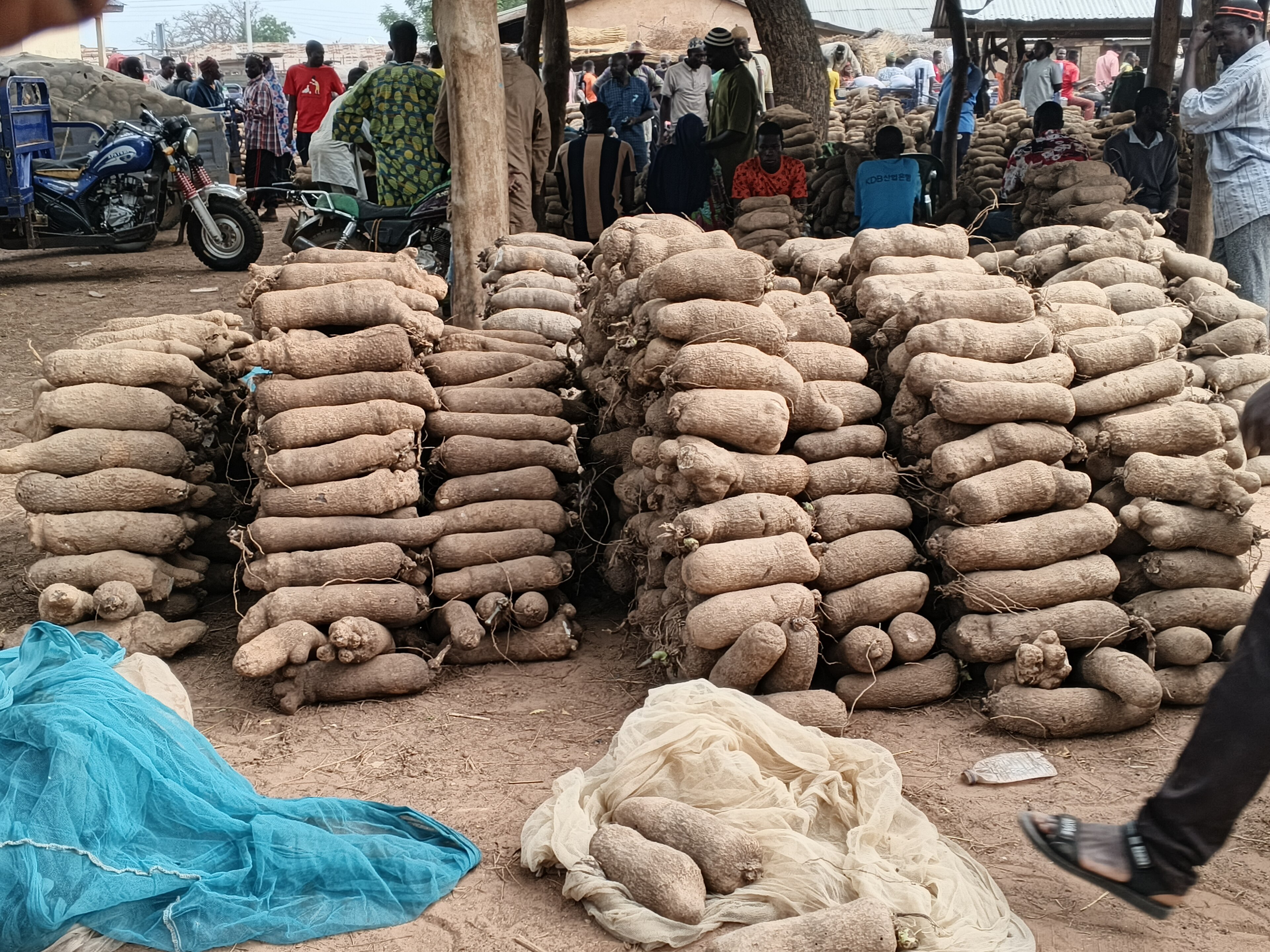
In most Lagos staples the wholesale hubs set the floor and the outlying markets set the ceiling. Yam does the opposite this week. The Ministry of Agriculture and Food Systems market survey for the week of 17 July 2026 records Medium Sized Yam at ₦5,000 per tuber at Ile-Epo Market and ₦2,300 at Epe Main Market, a margin of ₦2,700 or 117% on the same tuber.
The Trading Hubs Sit at the Top
Ile-Epo is 47.9% above the Lagos average of ₦3,380, and Mile 12 Market is second dearest at ₦3,900. Both are bulk trading points that anchor the cheapest quotes for other staples in the same survey week. On yam they are beaten by three ordinary retail markets, with Mushin Market, Sabo Market Yaba and Agege Market all quoting ₦2,800, and by Agbalata Market at ₦3,200. Oyingbo Market and Fresh Food Hub Mushin sit at ₦3,500 and Ajah Market at ₦4,000.
Why the Inversion Makes Sense for a Tuber
Yam does not behave like a bagged commodity. It is bulky, fragile, sold by the piece rather than by weight, and graded by eye, so a trading hub cannot standardise it the way it standardises a 50kg bag. Epe sits at the eastern edge of Lagos near farmland rather than at the end of a haulage chain, which puts it closer to supply than the western hubs are. The result is that the arbitrage runs east to west rather than the other way, and a trader moving tubers from Epe to Ile-Epo captures the widest margin in this week's survey before transport and spoilage.
A Price Climbing on Every Timeframe
The Lagos average rose 5.3% from ₦3,210 in the prior survey, stands 13.4% above the ₦2,980 of four weeks ago, and is 31.3% above the ₦2,575 recorded on 9 January. Reporting elsewhere corroborates the direction and the level. A News Agency of Nigeria market survey published by Premium Times and by Blueprint found medium tubers of old yam selling in Enugu for ₦3,000 to ₦5,000 in early July against ₦2,000 to ₦3,500 in May, a range that brackets the Lagos average closely.
One Official Reading Sits Well Below
The Lagos State Ministry of Agriculture and Food Systems Lagos Food Price Tracker lists a medium sized yam tuber at ₦2,000 in its July 2026 entry, which is below even the cheapest quote in the survey and 40.8% under the citywide average. The gap is wide enough to note rather than explain away, and households comparing the two should treat the tracker as a single reference point against an average drawn across ten markets.
The Calendar and the Fields
July is the thin end of the yam year, with old crop stock depleted and the new harvest still moving through its ceremonial gate. AgricNews Digest listed the Odi Ogori Ba Uge festival in Bayelsa running from 27 July to 2 August and communities in Ekiti opening their harvest earlier in the month. Traders in Enugu interviewed by Peoples Gazette pointed to insecurity keeping farmers off their land, while Vanguard reported flood warnings across about 17 states between 21 and 27 July.
What the Margin Survives
A ₦2,700 gross margin on a tuber bought at ₦2,300 is unusually generous, but yam is a difficult trade. Tubers bruise, rot and lose weight in transit, they cannot be stacked like bags, and grading disputes at the point of sale eat into the spread. The margin visible in the survey is therefore an upper bound on what a trader actually keeps, which is part of why the gap persists week after week rather than being competed away.
Ajah Market, the only market on the Ajah and Lekki axis reporting a price, sits 21% above the mainland average of ₦3,311. Nigeria's minimum wage is ₦70,000 a month, so the ₦2,700 margin equals 3.9% of that wage on a single tuber. FoodPrices Nigeria will track whether the new harvest closes the east to west gap. Live prices: foodprices.ng/real-time-prices