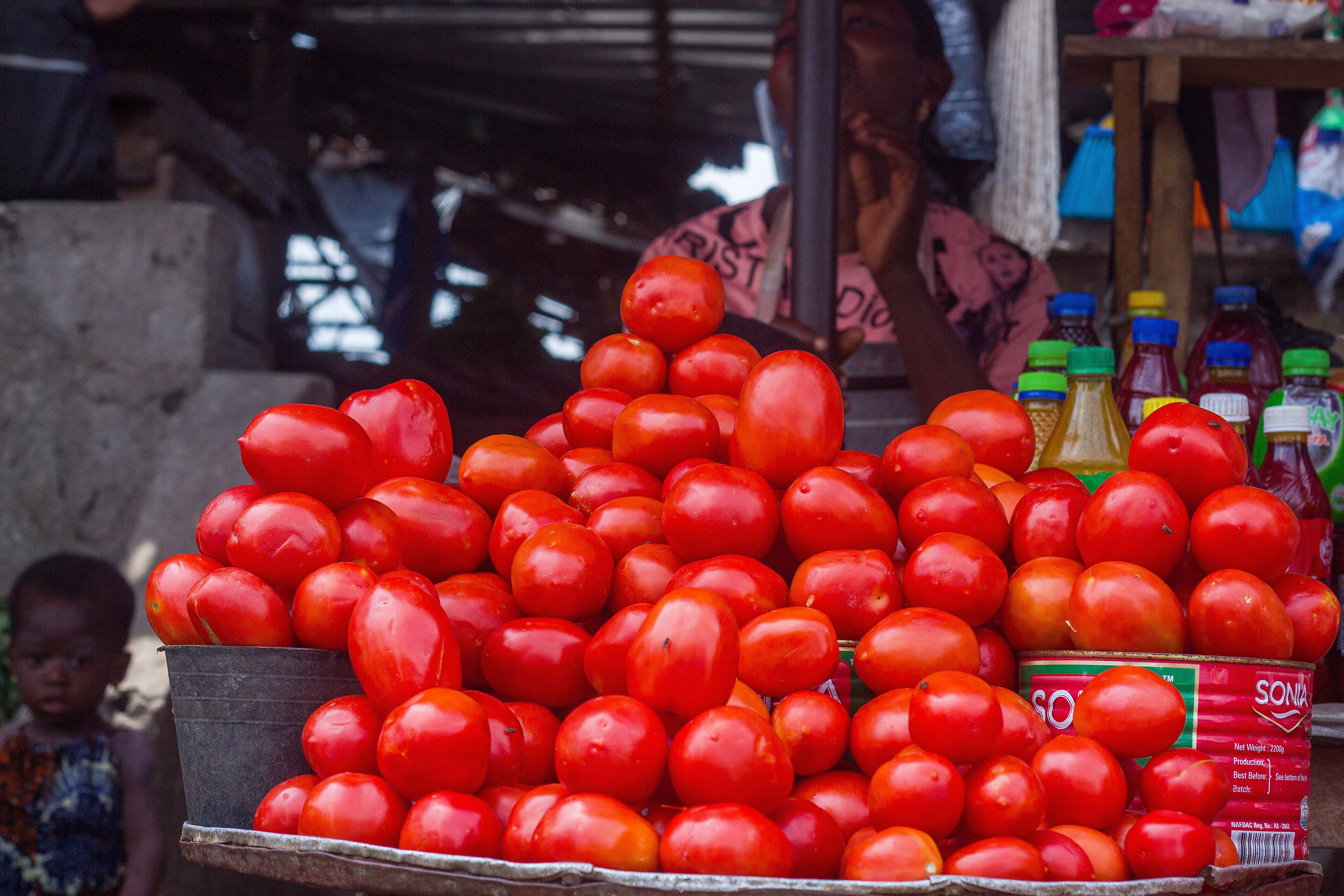
Tomatoes are not among the 21 product-and-unit lines tracked in the Ministry of Agriculture and Food Systems market survey for the week of 14 August 2026. That survey covers rice, beans, garri, yam and eggs. FoodPrices therefore has no mean price, no market range and no week-on-week movement for tomatoes, and nothing in this article should be read as one. Every figure below comes from an external outlet and is dated to when that outlet published it.
A Crop That Swings Harder Than Any Staple
Tomatoes move on a scale that rice and beans never approach. MSME Africa reported in January 2025 that a 50kg basket in Lagos had fallen to between ₦10,000 and ₦15,000 during the January to March harvest glut, against ₦140,000 to ₦150,000 in May 2024. BusinessDay reported in August 2024 that a small basket in Lagos cost ₦6,500 against ₦13,000 in January of that year, with the national chairman of the tomato growers association attributing the fall to a new harvest arriving and a break in the rain. A staple that swings by a factor of ten inside a year behaves differently from one that moves 4.4% in a week.
Rain and Pests Set the Rhythm
Two forces dominate. The first is the leaf-mining moth known locally as tomato Ebola. Nairametrics reported growers describing an infestation capable of causing total crop loss if uncontrolled, with the pest able to breed 10 to 12 generations a year. The second is rainfall and the transport it disrupts. Food Business Middle East and Africa reported in June 2026 that persistent rain and flooding across growing regions had cut yields and blocked transport routes, with production in Jos and Makurdi severely affected, and that many households were substituting tatashe and pepper to manage cost.
Why August Matters
The Whistler reported in June 2026 that traders expected prices to fall from August, which places the current week inside the window when new harvest volume normally reaches southern markets. Legit.ng reported in January 2026 that production had broken a twelve-year record and that the rise in the average price of a large basket in Lagos across 2025 was modest by the standards of previous years, pointing to a steadier market. Whether that steadiness held through the 2026 rains is precisely the kind of question a Lagos price series would answer, and precisely what FoodPrices cannot yet answer for this product.
What Would Change This
Adding tomatoes to the survey catalogue would put a Lagos mean, a market range and a weekly move behind the reporting above. Until then, tomato coverage on this platform stays in context form, clearly separated from the priced weekly roundup.
Live prices: foodprices.ng/real-time-prices