A kilogramme of wheat flour costs $1.36 in the countries that border Sudan. Inside Sudan, the same kilogramme costs $5.78.
It is not better flour. It is not a different measure. It is the same staple, recorded in the same way, in markets a few hundred kilometres apart. One side of the border is at peace and one side is not, and that fact alone is worth 4.24 times the price.
That gap is what this article calls a grocery tax. Nobody legislates it and no ministry collects it, but families pay it every week in the only currency that matters to them, which is the size of the shop they can afford.
The obvious next question is whether every war does this. It does not, and that exception is what this article is built around.
Only three countries actually charge the tax
Nine countries in conflict were priced against their peaceful neighbours, meaning the bordering states that appear in the same dataset, averaged together. Only staples both sides sell are compared, so like is matched with like.
Three countries diverge sharply. Sudan pays 5.47 times its neighbours across the staples they share. Yemen pays 4.94 times. South Sudan pays 2.49 times.
The other six do not diverge at all. The middle country of the nine, ranked from worst to mildest, pays 1.15 times neighbour prices. That is close enough to normal that it would disappear inside ordinary market noise.
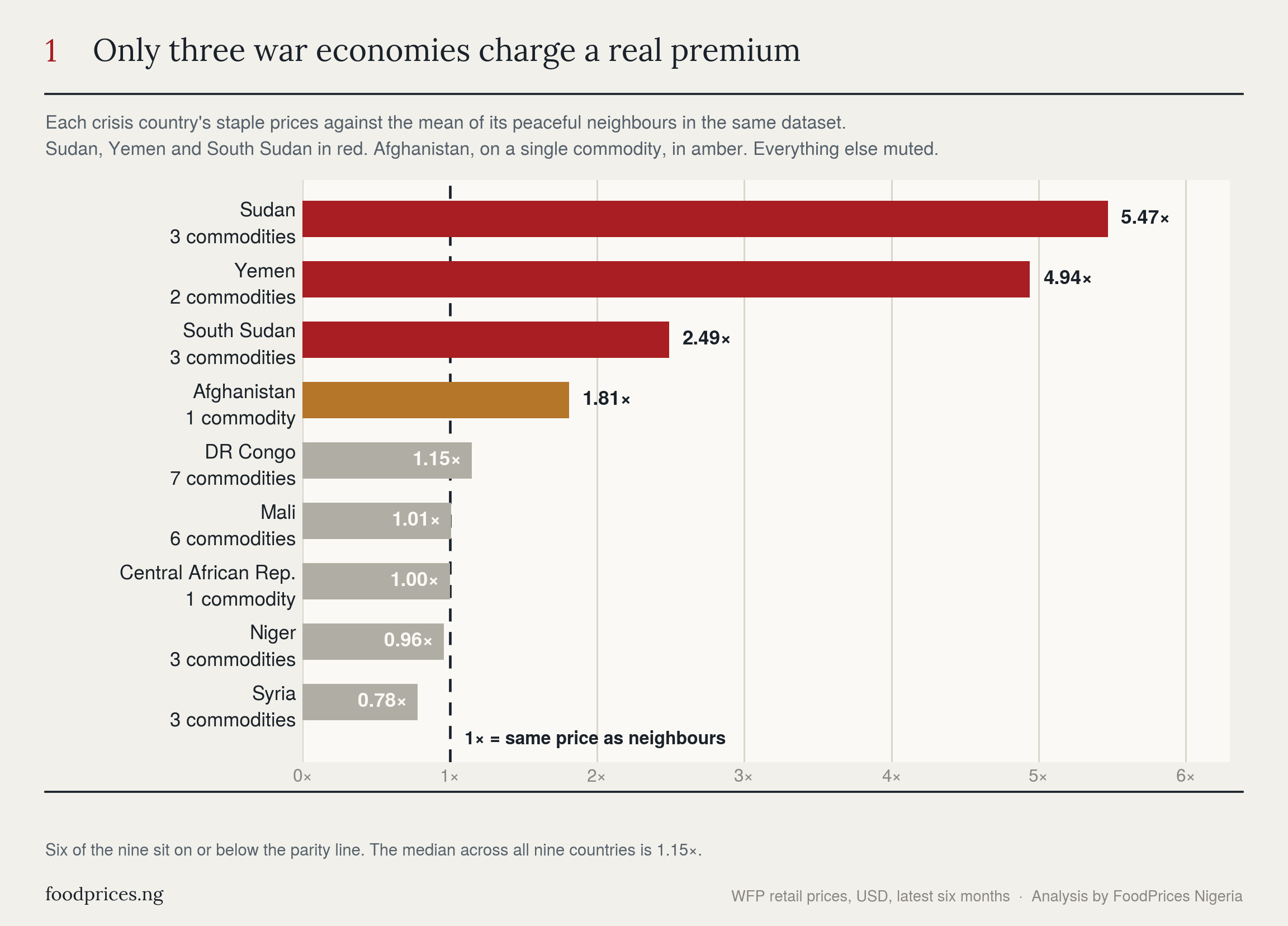
So the honest headline is not that war makes food expensive. It is that a particular kind of war makes food expensive, and most of the wars in this dataset are not that kind.
What separates the three is not how much fighting there is. It is whether the country can still receive goods. Sudan has been at war between the army and the Rapid Support Forces since April 2023, a war fought through sieges, road levies and blocked aid convoys as much as through battles. Yemen depends on imports for more than 90 percent of its food, moving through Red Sea ports whose handling capacity has been cut by repeated airstrikes and whose flour imports were banned outright by the authorities controlling them in January 2025. South Sudan is landlocked and its trade routes and oil pipelines both run through Sudan, so the neighbour's war became its own.
Three sieges, three price cliffs. The countries fighting without a closed border do not show the pattern.
What a three item shop costs in Khartoum
Take the barest possible survival basket. One kilogramme each of wheat flour, vegetable oil and sugar, three of the cheapest ways to keep a household fed.
In Sudan that basket costs $30.70. Across the border it costs $5.29. A Sudanese family buying those three items is handing over what nearly six families next door would pay.
Vegetable oil carries most of that weight. It runs at $18.20 per kilogramme inside Sudan against $2.67 among the neighbours, a multiple of 6.83. Sugar is $6.73 against $1.26. Nothing in this dataset is more expensive relative to its surroundings than cooking oil in Sudan.
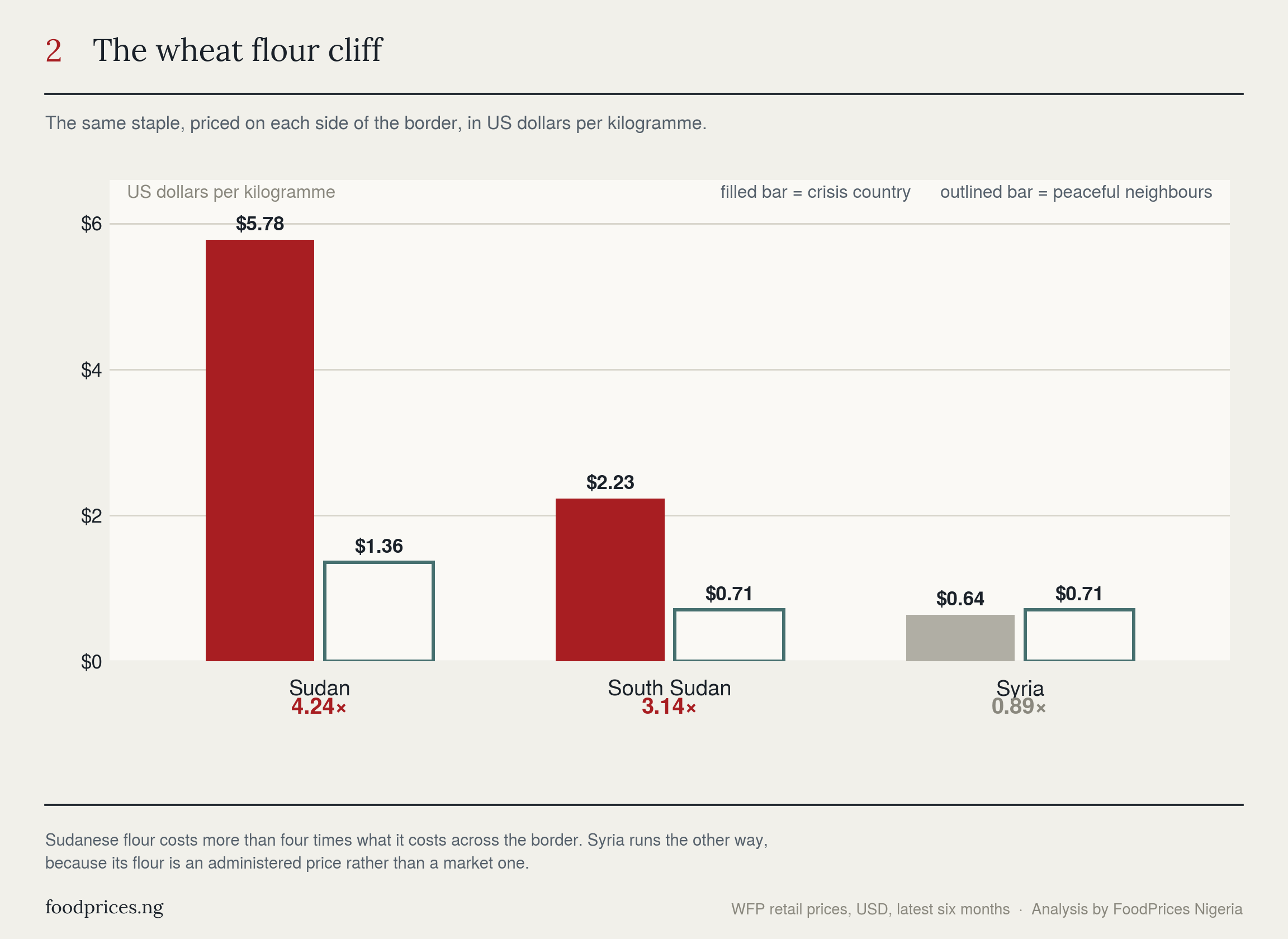
South Sudan tells a quieter version of the same story. Its wheat flour runs $2.23 against neighbours at $0.71, which is 3.14 times. Smaller than Sudan, and still a cliff.
War taxes what has to be shipped in
Sorting the same comparisons by food rather than by country is where the argument stops being a list of terrible places and starts being an explanation.
Four staples spike. Sugar averages 2.83 times neighbour prices across the five crisis pairings that stock it. Wheat flour averages 2.76 times. Vegetable oil averages 2.71 times. Imported rice averages 2.19 times.
Four staples barely move. Locally milled rice sits at 1.18 times. Maize sits at 1.10 times. Palm oil sits at 0.88 times and sorghum at 0.75 times, which is to say they are cheaper in the war zone than next door.
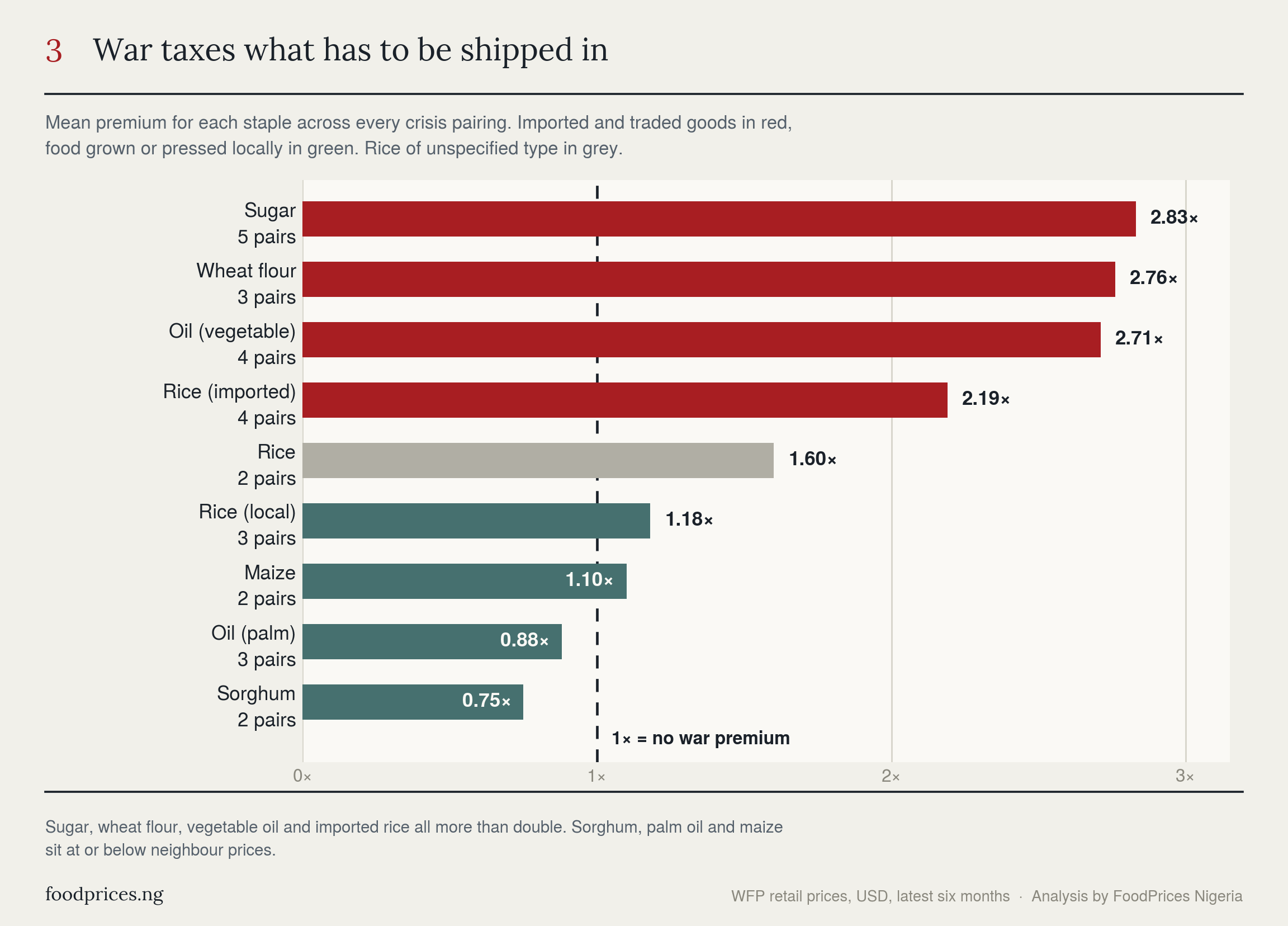
Look at what each group has in common. The first is everything that arrives by ship and truck. Sugar is refined and traded internationally, wheat flour is milled from imported grain almost everywhere it is eaten in these countries, vegetable oil is a global commodity, and imported rice announces itself in its own name. The second is everything grown, milled or pressed within a day's journey of where it is sold.
War does not raise the price of food. War raises the price of distance. It severs the ports, mines the roads, empties the fuel stations and puts armed men at checkpoints who take a cut, and every one of those costs lands on goods that must travel. Food that never leaves its district never pays any of it.
That is why the tax is invisible in the Sahel and unmissable in Khartoum. A conflict that makes farming dangerous raises prices modestly. A conflict that closes a seaport raises them by a multiple.
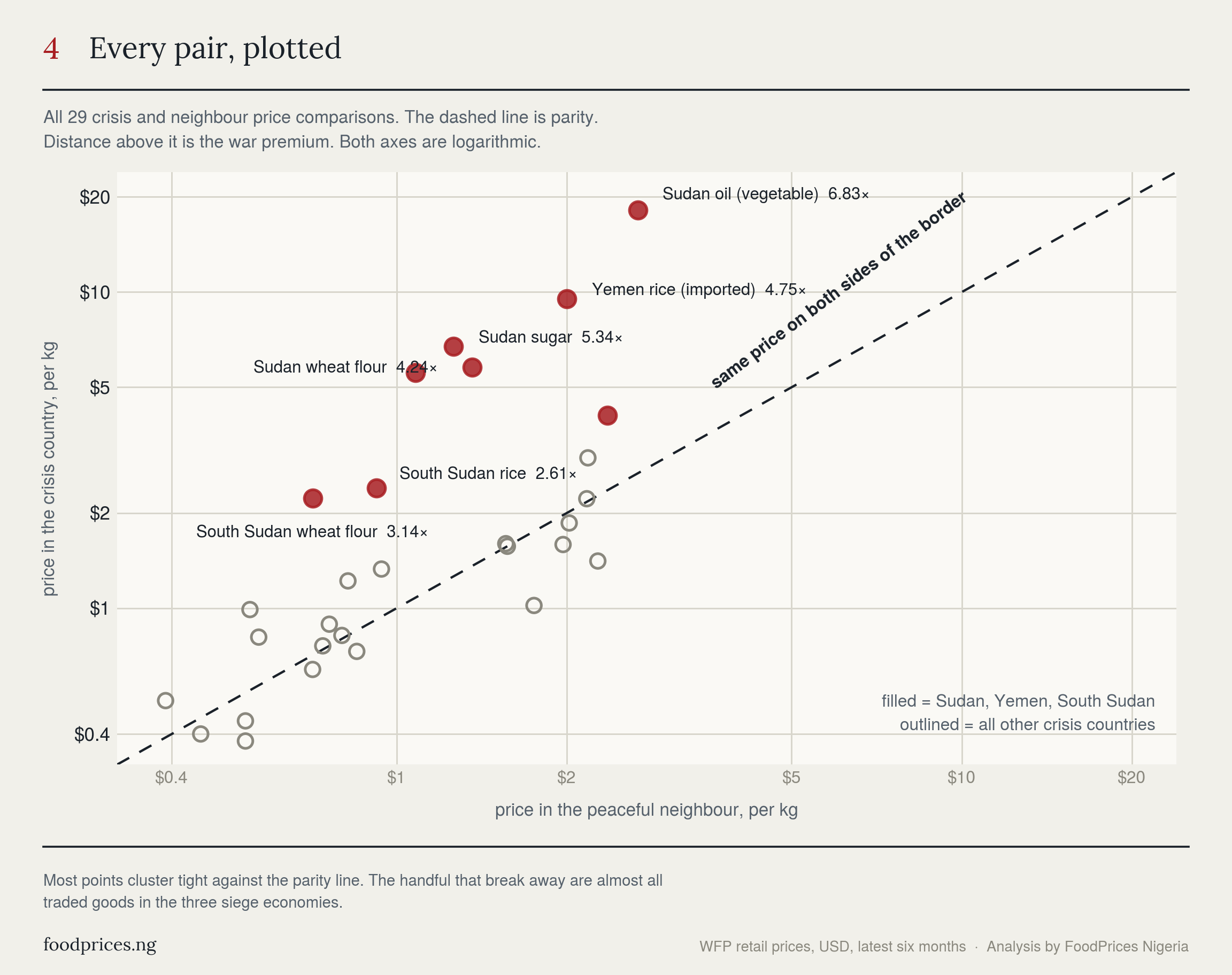
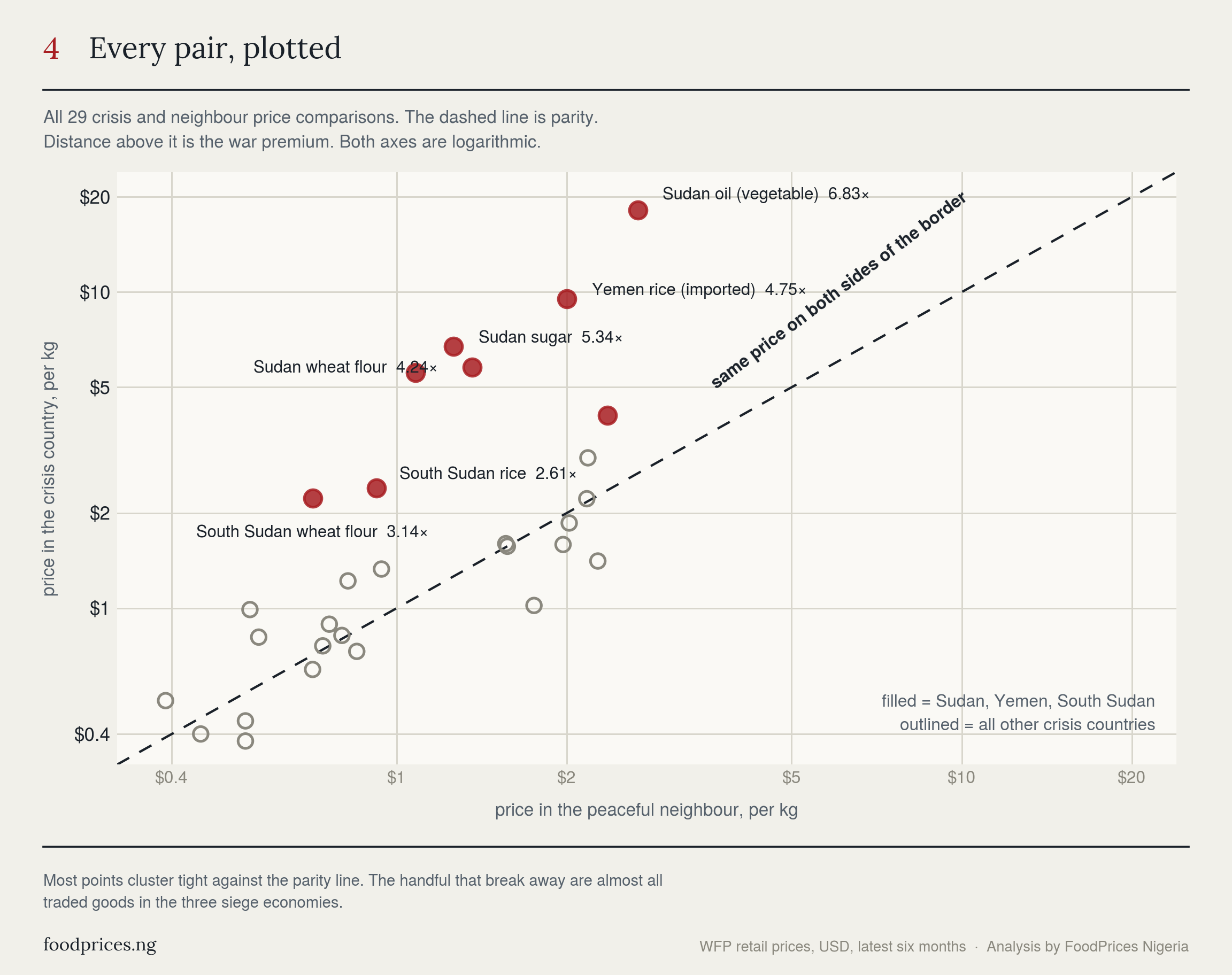
Plotted as individual pairs, nearly every comparison in the dataset sits tight against the parity line, meaning the war zone and the peaceful neighbour charge roughly the same. Only a handful break away, and almost all of them are traded goods in the three siege economies.
Where the pattern does not hold
Two groups of countries refuse to cooperate with the argument, and both deserve saying plainly rather than burying.
The first is the Sahel. Mali reads 1.01 times its neighbours. The Central African Republic reads 1.00. Niger reads 0.96, meaning marginally cheaper. These are countries with active insurgencies and real insecurity on the roads, and none shows a staple premium here. Mali's six priced commodities scatter on both sides of parity. Whatever those conflicts are doing to people, they are not doing this to prices.
The second exception is Syria, which reads 0.78 times, the lowest of all nine. Its wheat flour comes in at $0.64 against neighbours at $0.71, cheaper in the war zone than outside it.
That figure should not be read as evidence that the Syrian war was good for shoppers. Syrian bread and flour are administered goods rather than market ones, sold at prices set by whichever authority governs the area and topped up by subsidised flour programmes run with the World Food Programme. A controlled price records what the state charges, not what the food costs to obtain, and the queue is not in the dataset.
So the true claim is narrower than the headline number suggests, and better for being narrower. Blockade is a grocery tax. War in general is not.
The month the lines came apart
There is one more way to see it, which is to stop comparing places and start comparing time.
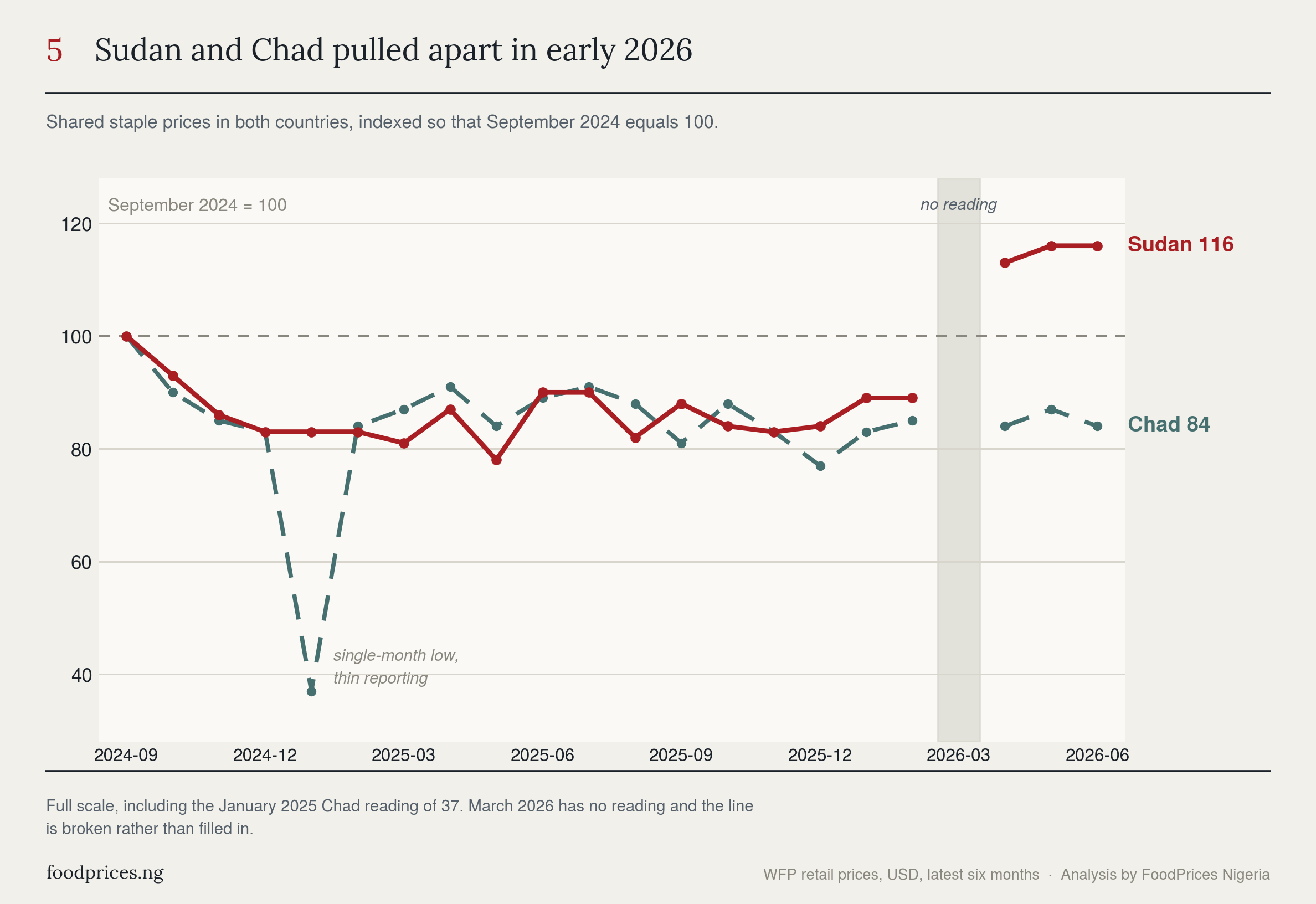
Indexing shared staple prices in Sudan and in neighbouring Chad so that September 2024 equals 100, the two move together for about eighteen months, both drifting down in dollar terms through 2025. Neither pulls away.
Then, in early 2026, Sudan jumps. By June 2026 the Sudan index stands at 116 against Chad at 84, a gap of roughly thirty index points opened in a matter of months. Chad, which absorbed the largest share of Sudanese refugees, did not follow it up.
Why this belongs on a Nigerian food price site
Because Nigeria is the control case, and it makes the distinction sharp.
FoodPrices Nigeria's own reporting on the naira found that the Lagos staples basket went from ₦5,111 in 2020 to ₦15,787 today while falling 21 percent in dollars. Nigerian food did not get scarcer. Nigerian money got weaker.
Sudan is the opposite diagnosis with the same symptom. Priced in the currency the world trades in, the food itself genuinely costs multiples of what it costs across the border. No exchange rate explains a $18.20 kilogramme of cooking oil.
Nigerians paying more for rice are paying a currency tax. Sudanese paying more for flour are paying a siege tax. Both hurt at the till, and they do not have the same cure. A currency problem responds to monetary and trade policy. A blockade responds only to the blockade ending.
There is still a warning in it for Nigeria. The staples that spike hardest in war are the traded ones, and Nigeria imports wheat along with much of its refined sugar and vegetable oil. Nigeria's exposure is not to war on its own soil. It is to the shipping lanes.
How we worked it out
Prices come from World Food Programme retail market monitoring, converted to US dollars, using the most recent six months of readings. Every country in conflict was matched to the countries bordering it that also appear in the dataset, and those neighbours were averaged into a single comparison price. A country's multiple is then the average across every staple both sides record, which is 29 country and commodity pairings in total across nine crisis countries and ten staples.
Three limits belong here rather than in a footnote.
The neighbour set is only as good as the dataset. If a country's most relevant border is with a state the World Food Programme does not price, that neighbour is absent from the average. The comparisons are real but not exhaustive.
Currency conversion in a collapsing economy is imprecise. Crisis prices are converted from local currencies at market rates, and those rates move fast and sometimes differ between regions of the same country. The Sudanese and Yemeni premiums are far too large to be conversion artefacts, but the second decimal place should not be trusted.
Some pairings rest on very little. Afghanistan's 1.81 comes from one commodity, sugar, and the Central African Republic's 1.00 from one commodity, palm oil. Both are reported for completeness and should not be read as country-level findings. Sudan rests on three staples, Yemen on two, and the Congolese figure on seven.
One reporting gap and one outlier are left visible rather than smoothed away. March 2026 has no reading in either country and the line is broken instead of filled in, because interpolating would invent a month nobody surveyed. A single Chadian reading in January 2025 falls far below everything around it and is almost certainly thin reporting rather than a real collapse.
Current Nigerian prices are live and checkable, market by market, at foodprices.ng. International historical prices are the World Food Programme's market data. Analysis by FoodPrices Nigeria.
Questions readers ask
Which country pays the most for food because of war? Sudan. Across the staples it shares with its neighbours, Sudanese retail prices average 5.47 times what those neighbours pay. A three item basket of wheat flour, vegetable oil and sugar costs $30.70 in Sudan against $5.29 across the border.
Does every war make food more expensive? No, and that is the central finding here. Of nine conflict countries measured, only Sudan, Yemen and South Sudan show a large premium. Mali, Niger and the Central African Republic show effectively none. The middle country of the nine pays 1.15 times neighbour prices.
Why do some staples spike and others do not? Because war raises the cost of moving things, not of growing them. Sugar, wheat flour, vegetable oil and imported rice all more than double, and all of them arrive by ship or truck. Sorghum, maize and palm oil are produced close to where they are eaten and stay near neighbour prices.
Why does Syria look cheaper than its neighbours? Because Syrian flour and bread are administered goods with state set prices and subsidy programmes attached, so the recorded figure reflects the official price rather than the true cost of obtaining the food. It is a measurement limitation, not a finding about the war.
What does this mean for food prices in Nigeria? Nigeria's food price problem is a currency problem rather than a blockade problem, and the two behave differently. The relevant warning is that the staples most punished by conflict are the imported ones, and Nigeria imports wheat along with much of its sugar and vegetable oil, so its exposure runs through the shipping lanes rather than the battlefield.