In 2020, rice, beans, garri and cooking oil together cost ₦5,111 in Lagos markets. Those four foods are what this article calls a basket. It is the same shopping list every year. Keeping the list the same is what makes it fair to compare one year against another, because we are always pricing the same food in the same amounts.
Today that same basket costs ₦15,787.
That single change explains almost everything else in this article. In 2020, ₦10,000 was enough to buy nearly two full baskets. Today, ₦10,000 does not fill even one. It buys about two-thirds of a basket.
There is another way to say the same thing. Today's ₦10,000 does the same job that ₦3,237 did in 2020. The note in your hand still reads ₦10,000, but it now reaches only about 32% as far as it once did.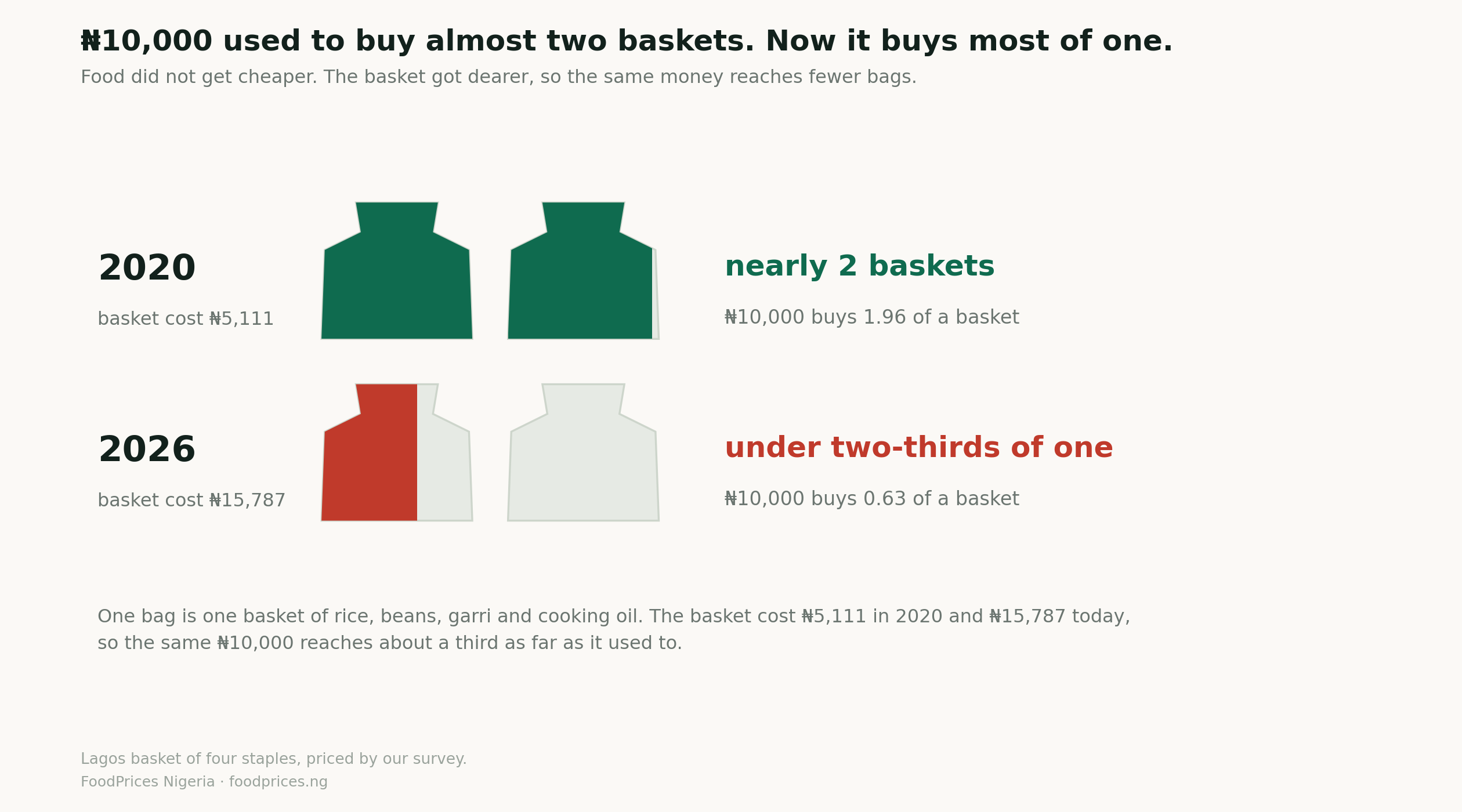 The older prices, and the prices from outside Lagos, come from the World Food Programme, a United Nations agency that records what food costs in markets around the world. It priced this basket across twelve Nigerian states up to 2022. The current Lagos prices come from the Lagos State Ministry of Agriculture and Food Systems weekly market survey, which FoodPrices Nigeria compiles and publishes. Anyone can check today's prices, market by market, at foodprices.ng.
A simple test that shows what really happened
When food prices go up, there are two very different reasons it can happen, and they are easy to mix up.
The first reason is that the food itself became harder to get. Maybe the harvest was poor, or war stopped the ships, so there is less food and everyone pays more for it.
The second reason is that the money became weaker. The food is just as plentiful as before, but the naira in your pocket is worth less, so you need more of them to buy the same thing.
From inside the market, both look identical. Prices go up either way. So how do you tell them apart?
Here is the test. Price the same food in US dollars, a currency that stayed fairly steady over these years. If the food costs more in dollars too, then the food really did get dearer. But if it costs the same or even less in dollars, then the food did not change at all. The naira did.
First, food really did get dearer
The squeeze did not start with the naira. Between 2020 and 2022, before Nigeria changed anything about its currency, the basket rose about 63% in naira across the country. In dollars, it rose 39%.
It went up in both currencies. By the test above, that is real food inflation. This was the COVID period, when supplies were disrupted everywhere, followed by the war in Ukraine, which pushed up the price of wheat and grain worldwide. Nigeria felt it the same way other countries did.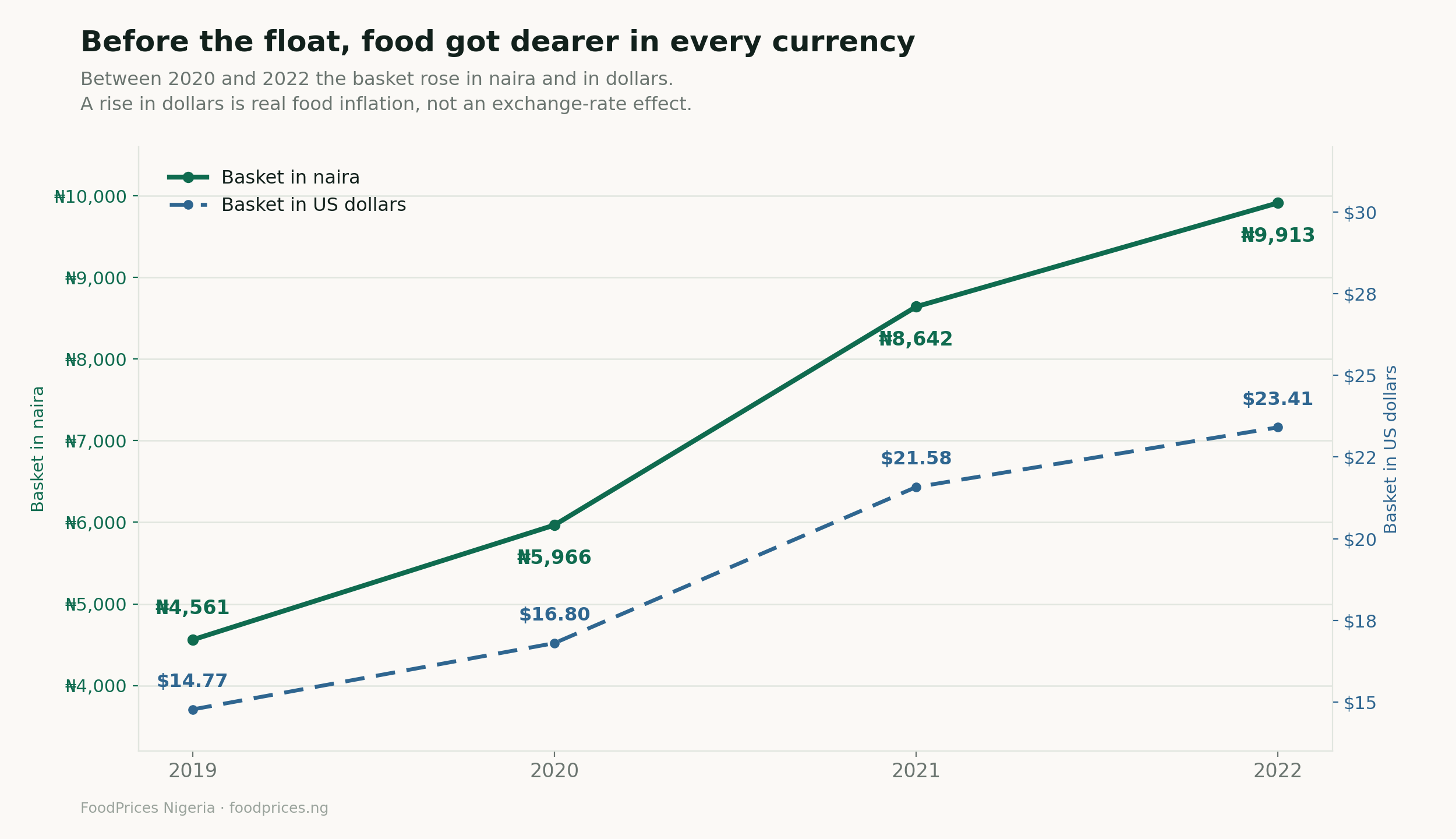 It reached nearly everywhere. Of the twelve states with data, every single one saw its basket climb, and the North felt it worst. Kebbi rose 96%, Jigawa 81%, Kano and Zamfara 71% each. Lagos rose the least at 45%, because it is a port city with food arriving constantly from many directions.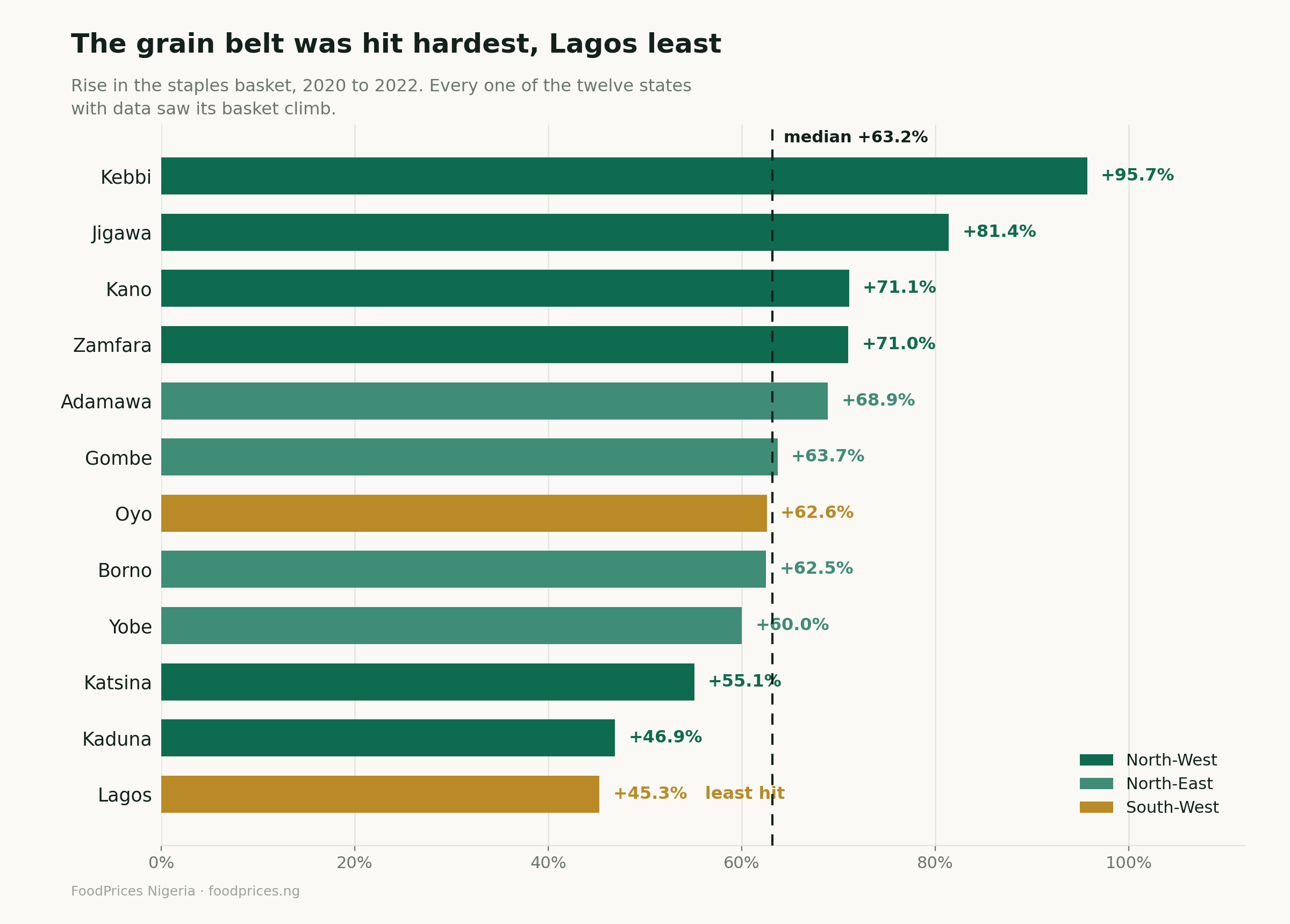
One food stands out. Beans rose 130%, more than doubling, while everything else merely climbed. That matters more than it might look, because beans is the protein of families who cannot afford meat. When beans doubles, those families have nowhere cheaper to go. Groundnuts rose 97% and cooking oil 96%. Rice, the food politicians talk about most, rose the least of the grains at 35%.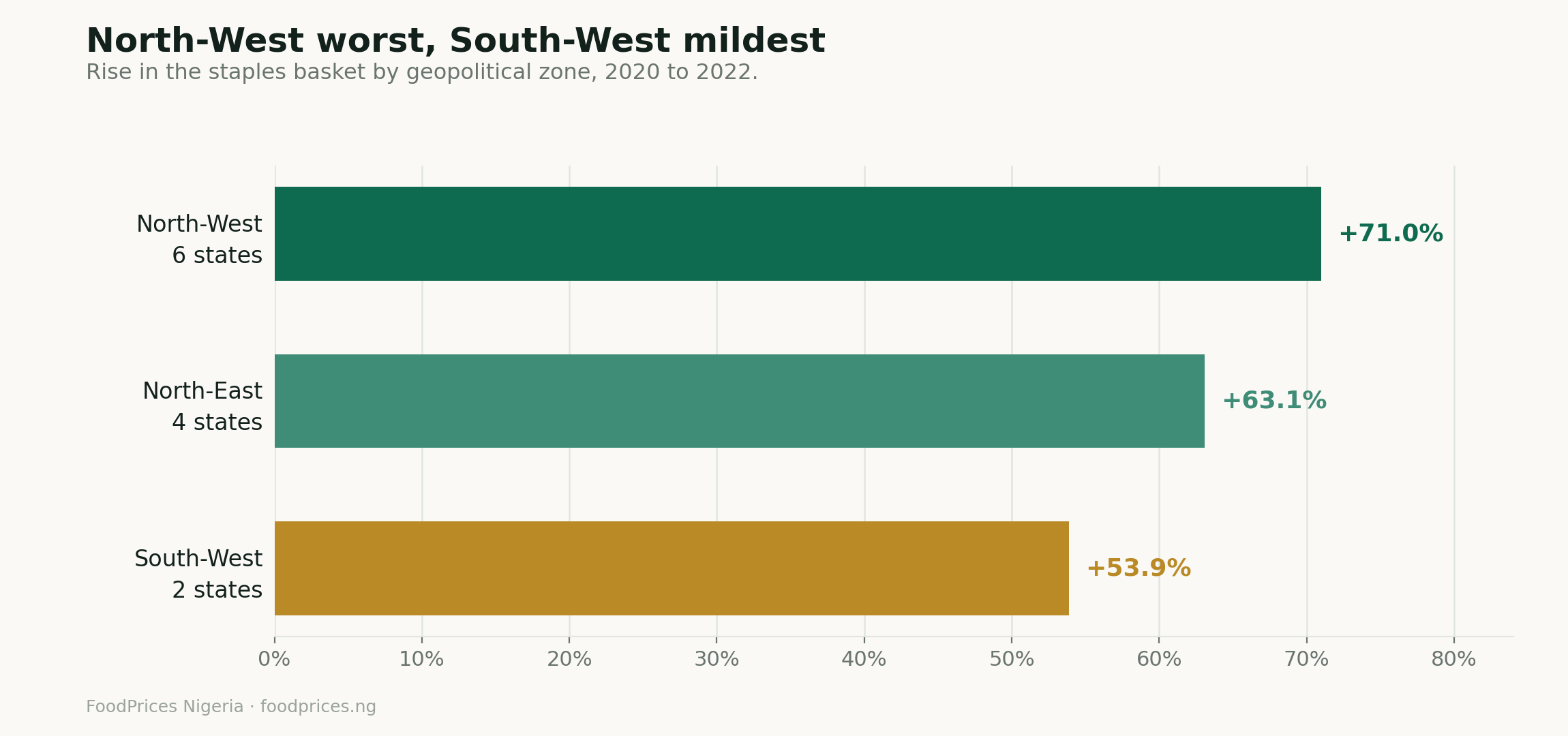
Then the naira lost its value
Until June 2023, the government decided the official price of the dollar and held it steady, near ₦370. In June 2023 it stopped doing that and let buyers and sellers set the price themselves. This is what people mean by floating the naira.
The rate moved quickly once it was released. It reached about ₦900 by the end of 2023, went past ₦1,500 in 2024, and stood near ₦1,400 in 2026. Across six years, the naira lost roughly three-quarters of its value against the dollar.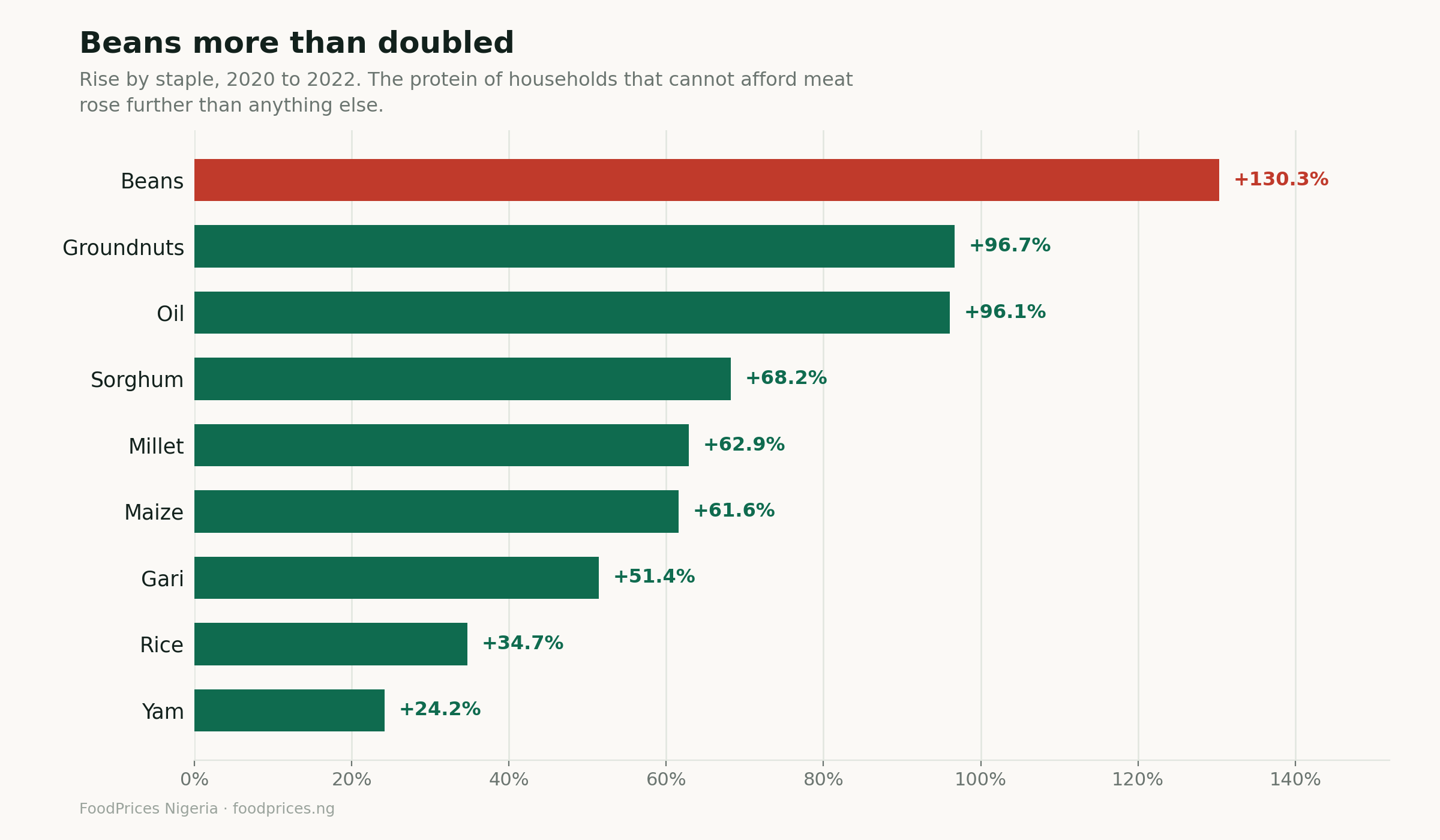 This is the turning point of the whole story. Nigerians earn in naira and spend in naira. When the naira falls that far, everything bought from outside the country, and everything moved with fuel bought from outside the country, becomes harder to afford, even when the food itself has not changed.
There is one detail here worth being honest about. Before 2023, the World Food Programme converted its Nigerian prices using the official government rate, the one being held artificially strong. That was not the rate ordinary traders were actually getting. So the 39% rise in dollars is probably an understatement of how weak the naira already was.
The proof that it is the naira
Put the two currencies side by side across the whole period and the argument finishes itself.
In naira, the Lagos basket went from ₦5,111 to ₦15,787. It tripled, a rise of 209%.
In dollars, across those exact same years, it went from $14.26 to $11.28. It fell 21%.
Think about what that means. If food had genuinely become scarce, it would cost more in every currency, because scarcity does not care what money you are holding. It did not. Measured in the currency the world trades in, Nigerian staples are cheaper today than in 2020. The entire painful difference that families feel, the tripling, comes from the naira.
Which parts of the country felt it most
Nigeria's states are grouped into six regions known as geopolitical zones. Sorted that way, the rise before the float was steepest in the North-West at 71%, then the North-East at 63%, then the South-West at 54%.
That result is surprising. Food is normally cheapest where it is grown, and the northern states are the grain belt. Under this shock the usual pattern bent, because insecurity on the roads and the rising cost of moving goods landed on top of ordinary inflation.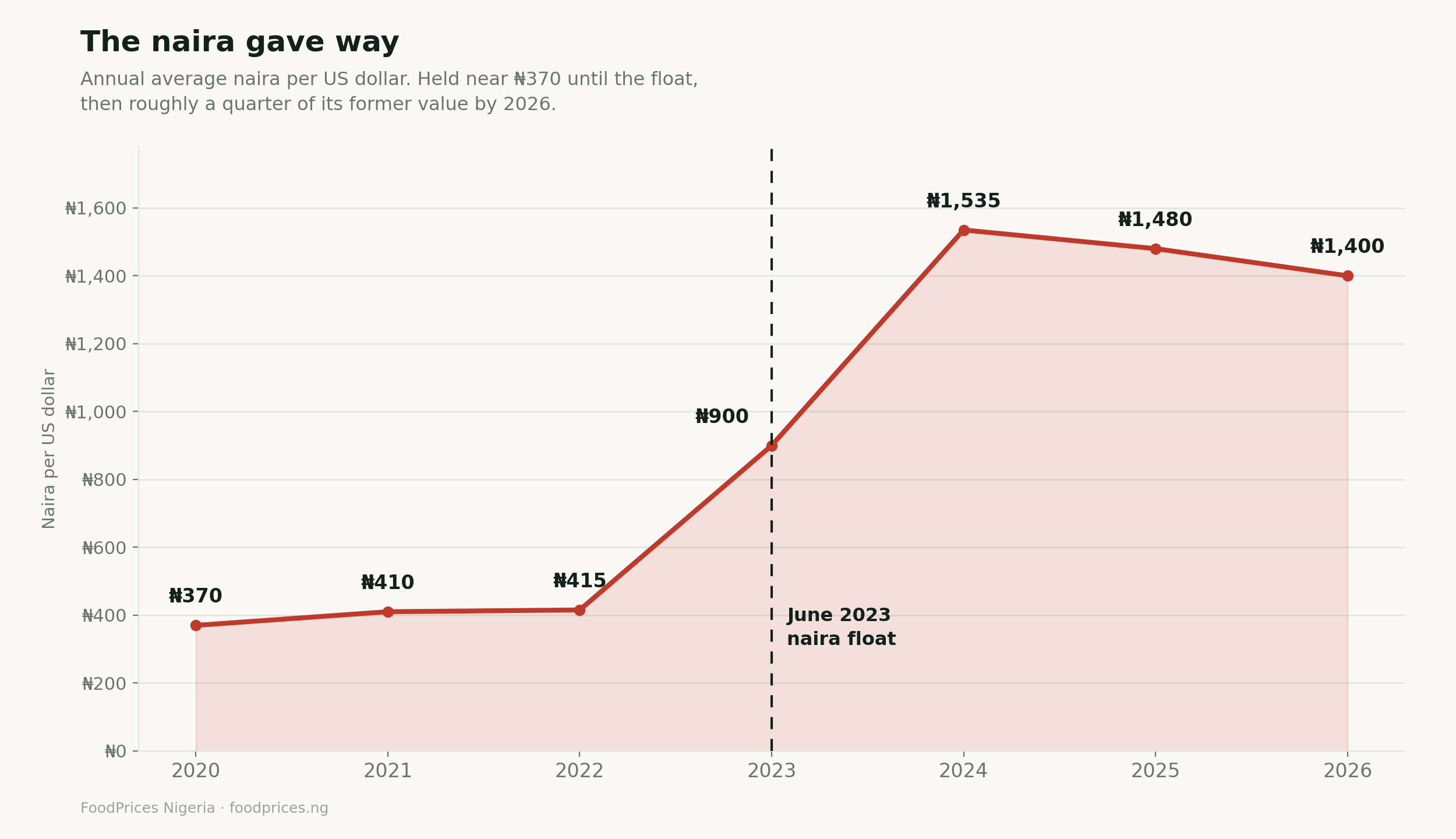 An honest limit belongs right here. The World Food Programme tracks far more northern states than southern ones. In the South, only Lagos, Oyo and Abia appear. So this regional picture is real and covers many states, but it leans North, and we would rather say so than present it as a complete map of the country.
What a month's wages buys
Set all this against a pay packet and it stops being abstract. In July 2024 Nigeria raised the minimum wage to ₦70,000, up from ₦30,000.
At today's Lagos prices, that entire month's wage buys about four and a half of these ₦15,787 baskets. That is rice, beans, garri and oil, and nothing else. No rent. No transport. No school fees. No electricity. Four foods, and the money is finished.
How we worked it out
We used the same shopping list of staples every year, so that nothing changes except the price.
Markets do not sell in neat amounts. The same rice might be sold by the paint, the derica, the sack or the bag, and those measures differ. So we converted every one of them into a price per kilogram. That way a bag bought in 2020 and a bag bought today are properly comparable.
The World Food Programme supplied the 2020 to 2022 prices for twelve states, in both naira and dollars. The Lagos figure for today is from our own current survey, matched on the four staples that both sources price clearly, and converted to dollars at today's rate.
Because this joins two different sources across a currency change, we treat the comparison between 2020 and today as a careful bridge rather than one unbroken record. The direction and the size are what the numbers support, and both are stark enough without stretching them.
Every current price here is live and checkable, market by market, at foodprices.ng. The older prices are the World Food Programme's Nigeria data, and the exchange rates come from the official record. Analysis by FoodPrices Nigeria.