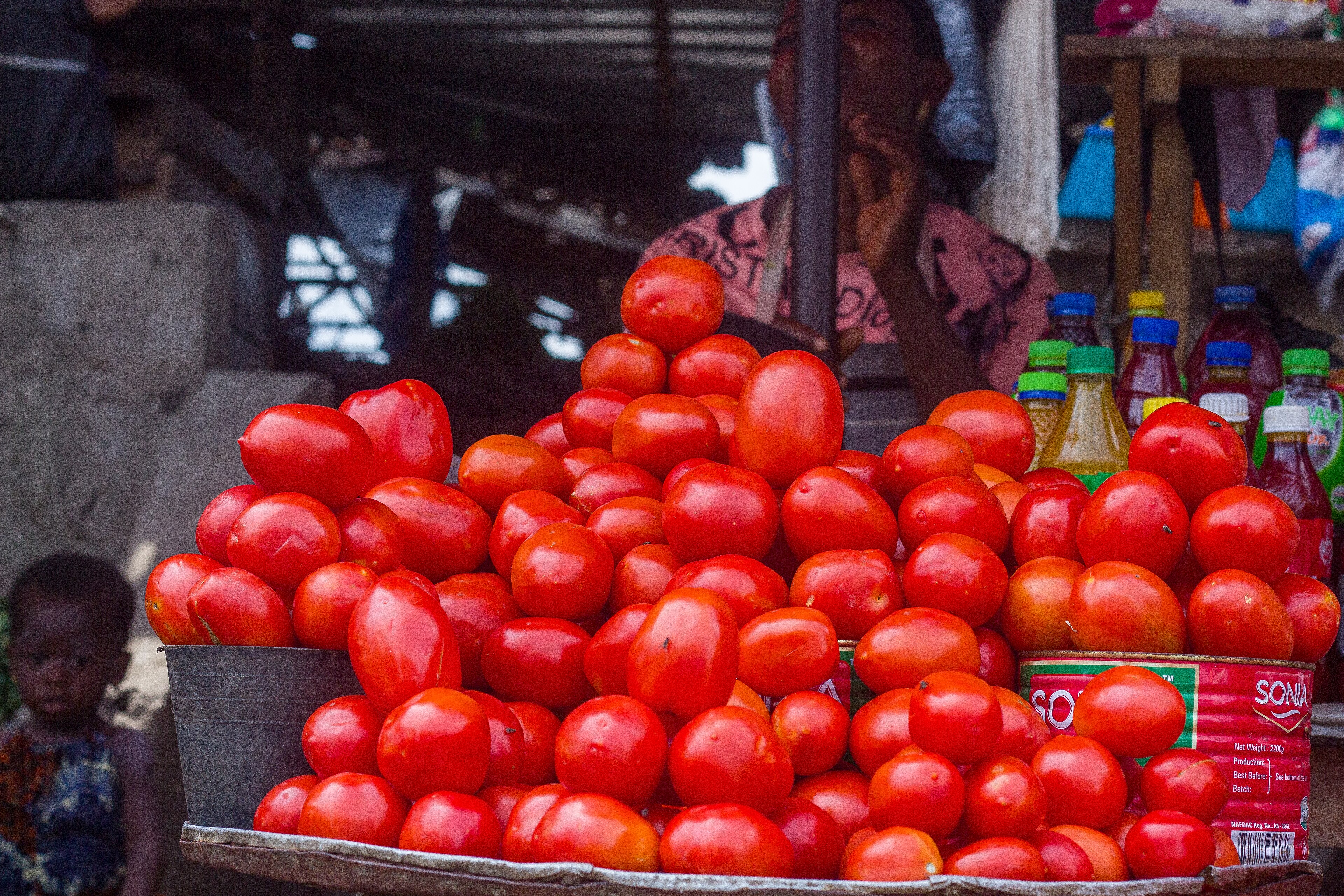
Tomatoes averaged ₦2,190 per kilogramme across all ten Lagos markets in the week to 14 August 2026, down from ₦2,360 a week earlier, a fall of 7.2%. It was the largest single weekly decline of any item FoodPrices Nigeria tracks in Lagos. The figures come from the Lagos State Ministry of Agriculture and Food Systems survey and are means across markets rather than shop prices.
Four Weeks of Falling
The weekly figure is the visible part of a longer move. Tomatoes peaked at ₦2,730 in the week of 24 July and have fallen in each of the three weeks since, through ₦2,490 and ₦2,360 to ₦2,190. That is a decline of 19.8% from the peak.
The direction reversed cleanly. Between 1 May and late July the Lagos mean climbed from ₦1,735 to ₦2,730, a rise of 57.3%. Even after four weeks of falls, tomatoes remain 26.2% above where they sat at the start of May, so the retreat has undone roughly a third of the increase rather than all of it. Note that the weekly series has a four week gap between 26 June and 24 July, so the climb into the peak is not continuously recorded.
The Harvest Traders Promised
The timing matches the forecast almost exactly. Vanguard reported in late June that the Tomatoes Growers and Processors Association of Nigeria expected the surge to last until the end of July, when wet season harvesting begins, with considerable declines from August as fresh supplies arrived. TheWhistler reported the same projection and noted that a 50kg basket had risen from between ₦18,000 and ₦20,000 in January to between ₦100,000 and ₦130,000 by late June depending on variety, with the association's Kaduna chairman crediting flood resistant varieties for bringing the harvest forward. AgroNigeria carried the same assurance. All three agree that the mechanism is seasonal supply, and the Lagos weekly means now measure it.
The National Average Still Lags
Leadership reported that the National Bureau of Statistics recorded food inflation at 20.31% year on year in July 2026, up from 17.52% in June, and named tomatoes among the items driving that increase. Lagos tomatoes were falling through most of that month, which is what happens when a monthly national comparison trails a seasonal supply shift already visible in weekly data.
A Fourfold Gap Between Markets
Agbalata Market records the cheapest mean at ₦1,000 per kilogramme against ₦4,000 at Oyingbo Market, which makes the Oyingbo kilogramme 300% more expensive. A household buying five kilogrammes weekly pays ₦5,000 at Agbalata and ₦20,000 at Oyingbo, a difference of ₦15,000 a week and roughly ₦60,000 across a month. For a food vendor buying in volume, that sourcing decision is worth more than most menu changes.
FoodPrices Nigeria will track whether the wet season crop keeps arriving.