The month Russia invaded Ukraine, the price of wheat flour on market stalls across 32 countries did not simply carry on rising. It stepped up to a new level, and the size of that step can be measured. FoodPrices Nigeria put the figure at 17.7 index points above where the pre-war trend said prices should have been, a break so large that the odds of it happening by chance are below one in a thousand.
That is the strong finding, and it holds. The complication arrives later in this article, and it is the reason this piece does not claim the war caused the food crisis of 2022 and 2023.
The analysis draws on the World Food Programme's global food-price database, published openly on the Humanitarian Data Exchange, covering 3.7 million observations across 98 countries. FoodPrices Nigeria used retail wheat flour priced per kilogram in US dollars, so that currency swings could not masquerade as price changes, and kept only countries with at least six months of 2021 data to anchor a fair baseline. That filter yields 32 countries, each rebased so its own 2021 average equals 100, with the global figure taken as the median country each month. The break at the invasion was estimated by segmented regression using Newey-West standard errors, a technique that corrects for the fact that one month's price is never independent of the last. Every price is an observed market reading, not a modelled estimate.
A jump you can date to the month
Through 2021 the index sat close to its base of 100. By February 2022 it had already climbed to 106, and that detail matters more than it looks. Food prices were rising before the first Russian tank crossed the border, pushed by energy, fertiliser and freight costs. The war did not arrive in a calm market.
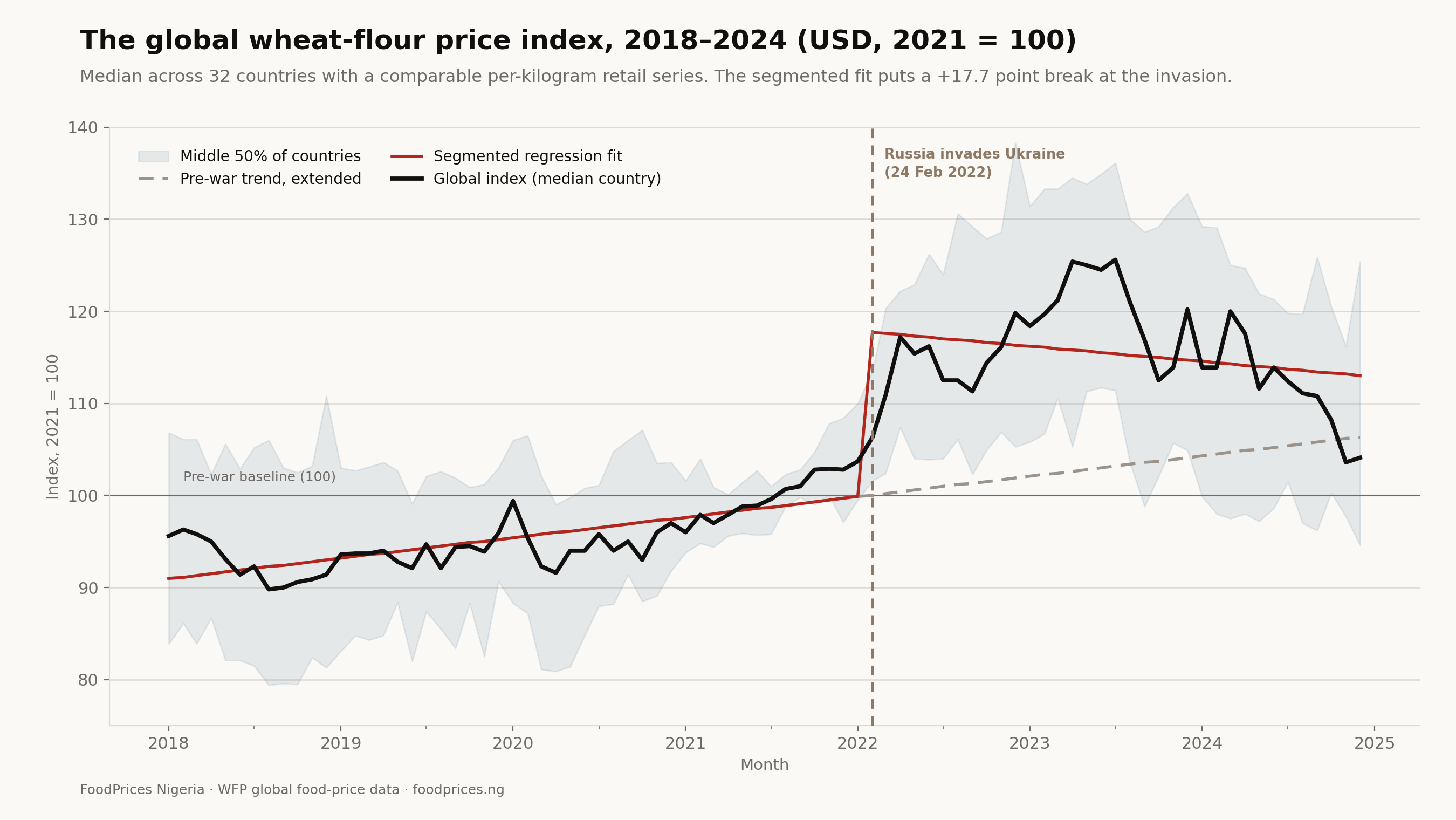 What the war did was move the whole level. Before the invasion the index drifted up by 0.19 points a month, a slow grind. At 24 February 2022 the model puts a step of 17.7 points, with a confidence interval running from 10 to 26. Afterwards the trend turned, changing by -0.32 points a month, which describes a high plateau slowly giving ground rather than a continued climb. The model accounts for 87% of everything that happened across those 84 months.
It happened almost everywhere
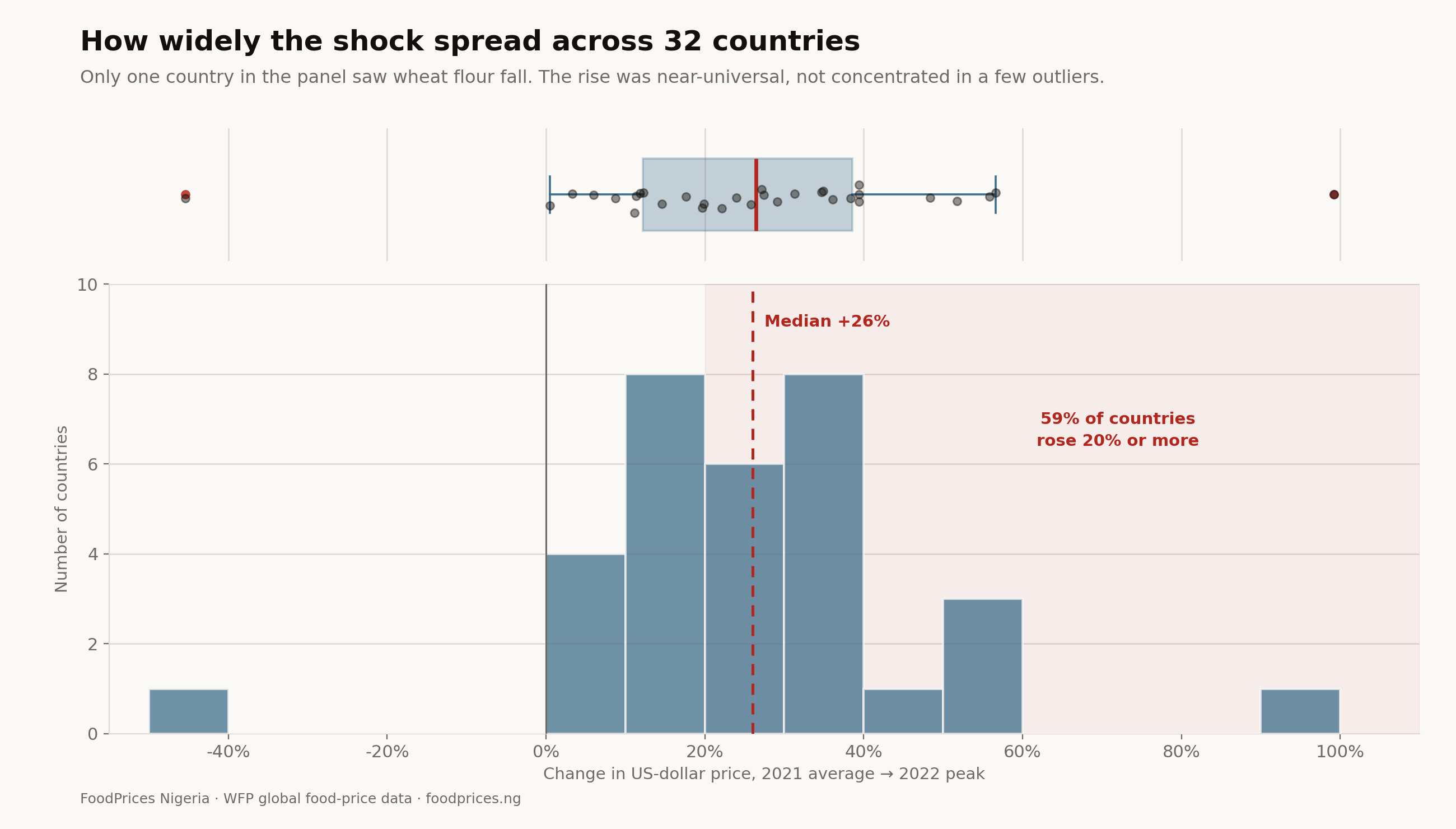
A global shock has to show up broadly, and this one did. The median country's wheat flour rose 26% from its 2021 average to its 2022 peak, and 59% of countries rose by 20% or more. Of the 32 countries measured, only one saw wheat flour fall.
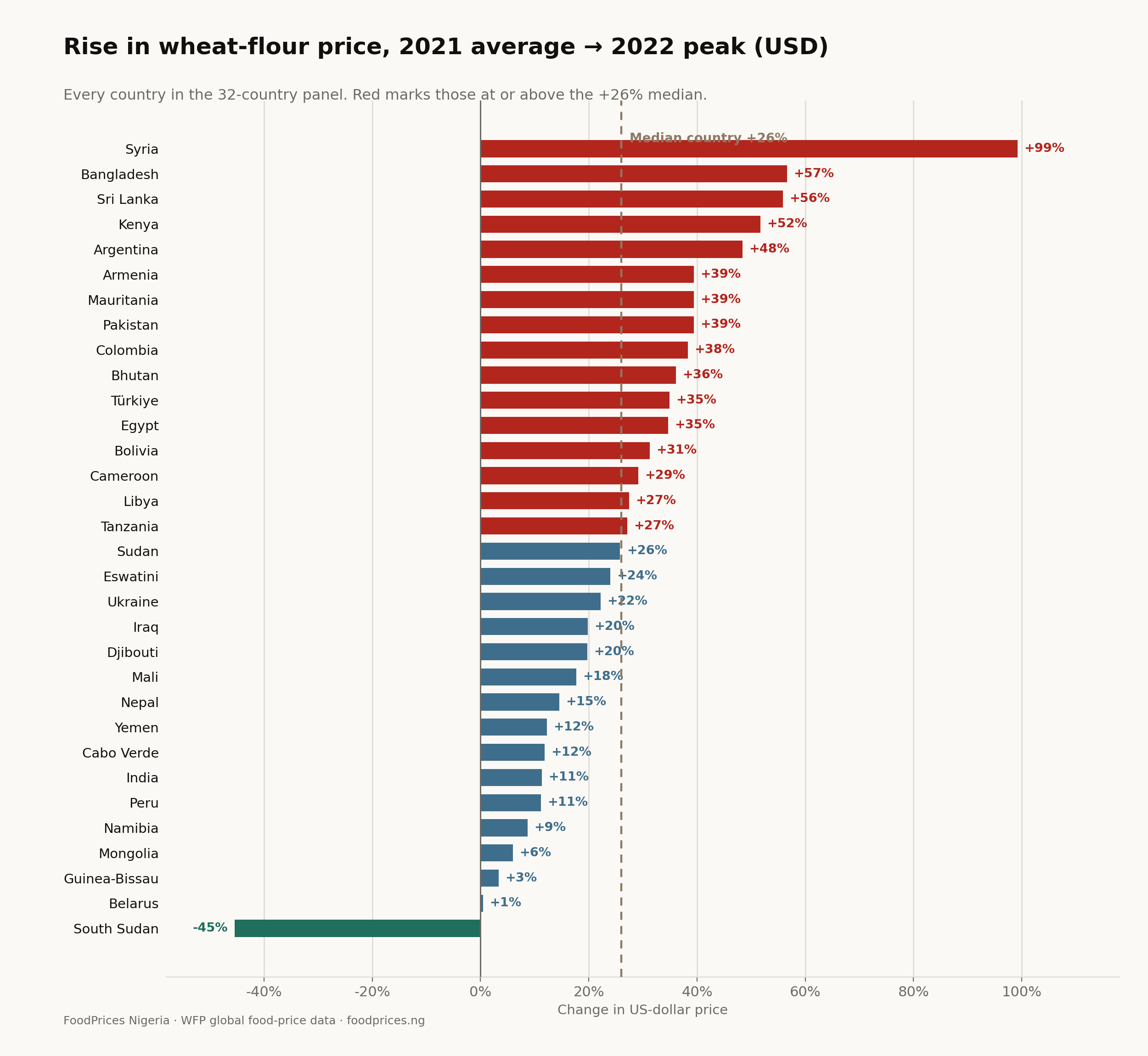
The worst hit were the countries that buy their wheat abroad, are already at war, or both. Syria's wheat flour rose 99%, Bangladesh 57%, Sri Lanka 56%, Kenya 52% and Pakistan 39%. Among the large importers Nigerian traders know from the same shipping lanes, Egypt rose 35%, Sudan 26% and Yemen 12%. Ukraine itself, whose ports were blockaded, rose 22%, below the global median, a reminder that growing the grain is no protection from the price of it.
The test that complicates the story
Here is where an honest analysis has to slow down. FoodPrices Nigeria ran a placebo test, choosing cassava flour, a local root crop grown and eaten close to home with no exposure to the Black Sea whatsoever. If the war were the whole story, cassava should have held roughly steady while wheat climbed away from it.
It did not. Cassava flour rose 24 points over the same window. When the two are compared directly in a difference-in-differences estimate clustered by country, the wheat-specific effect comes out at -9 percentage points with a p-value of 0.40, which is another way of saying no measurable difference at all.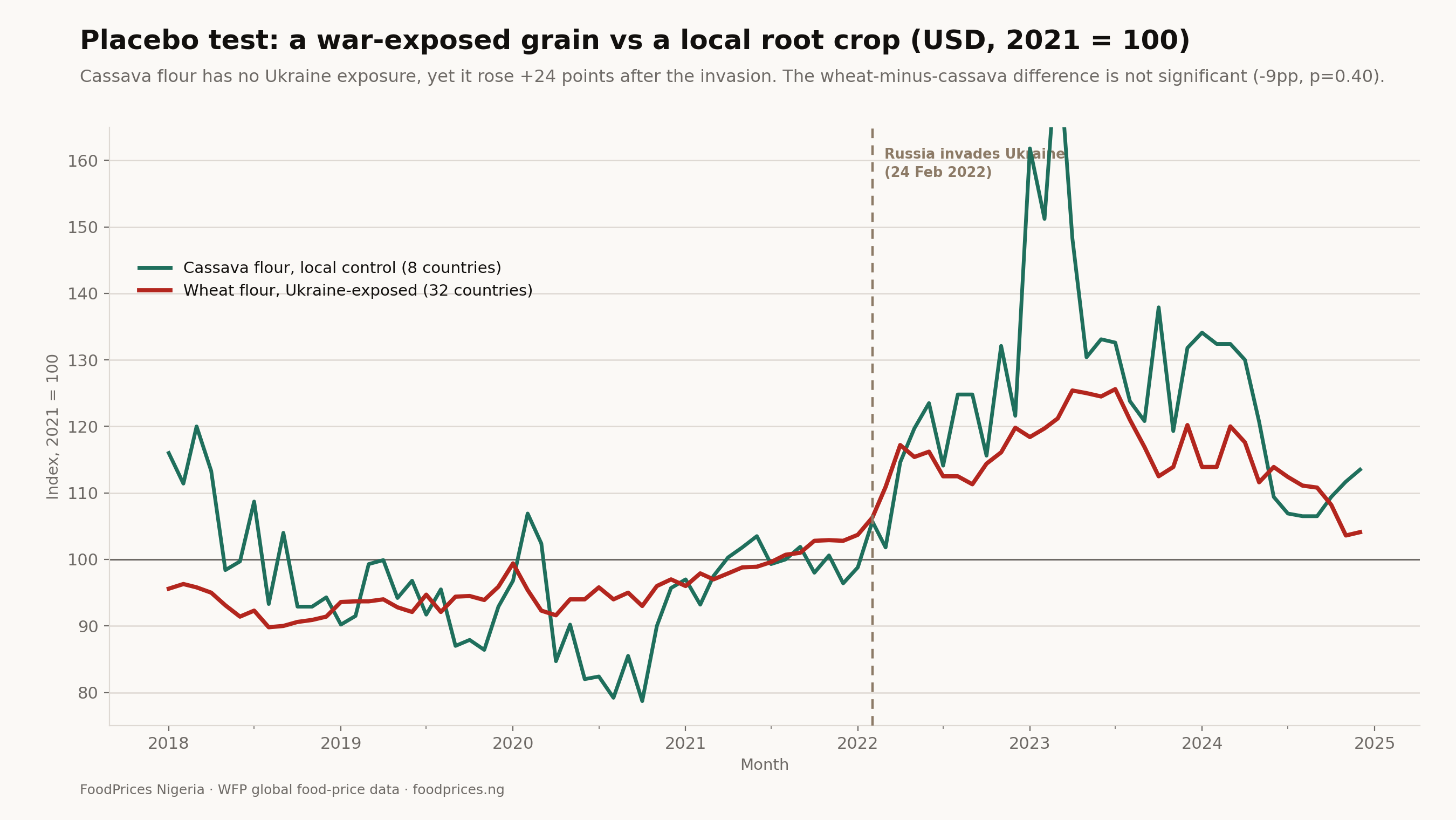 Read plainly, that means the war was a sharp and precisely timed accelerant on a fire that was already lit, not the spark. The timing evidence is strong and the level break is real, and both survive scrutiny. The broader claim, that Russia's invasion caused the food inflation of 2022 and 2023, does not survive this test, and FoodPrices Nigeria will not make it. What the evidence does support is narrower and still worth knowing: the war bit hardest where countries import their wheat and are already in conflict.
Futures peaked in weeks. Kitchens waited a year.
Traders repriced almost immediately. Global wheat futures hit their record high in March 2022, within weeks of the invasion, and by the time the Black Sea Grain Initiative was signed in Istanbul in July 2022 to let Ukrainian grain sail again, the commodity markets had already had their crisis.
Market stalls had not. The retail index measured here did not peak until July 2023, at 26% above its base, roughly a year behind the trading floor. That lag is one of the most useful things in this analysis, because it explains why households kept absorbing higher prices long after the headlines had moved on. The retail peak also landed in the same month the grain deal collapsed, after Russia declined to renew it beyond 17 July 2023, though nothing in this data can say whether the two are connected.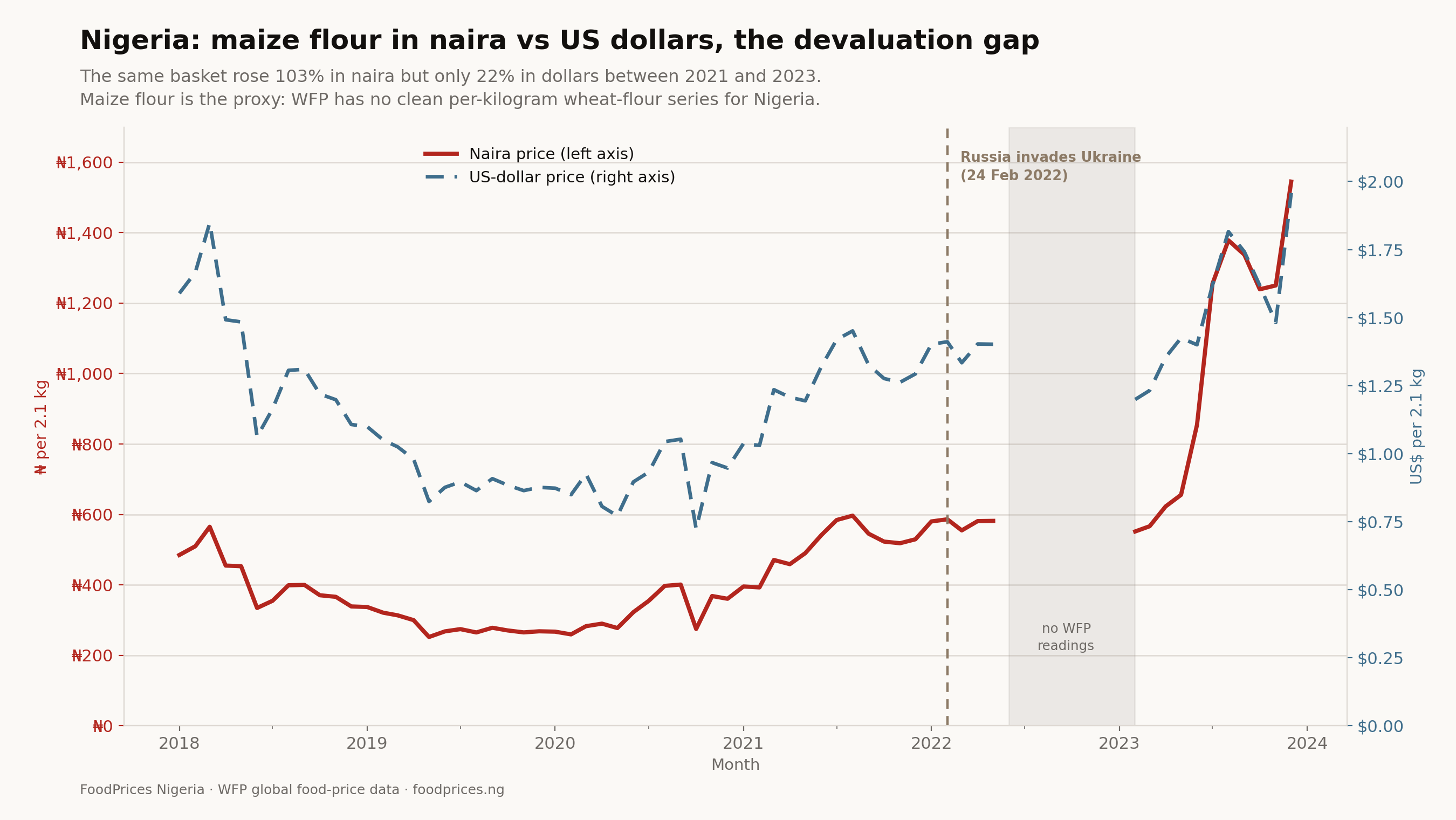 The retreat, when it came, was quicker than the climb. The index fell half-way back to its baseline within three months, with a half-life on the excess of about 9.0 months, and by December 2024 it stood just 4% above where it had been before the war.
What it meant for Nigeria
Nigeria buys nearly all its wheat abroad, so a global flour shock feeds straight into bread and semovita. WFP does not publish a clean per-kilogram wheat-flour series for Nigeria, because bread-unit data is unreliable where shrinkflation is common, so this analysis uses the dependable domestic grain proxy, maize flour in a 2.1 kilogram measure. The result reframes the whole story for a Nigerian reader.
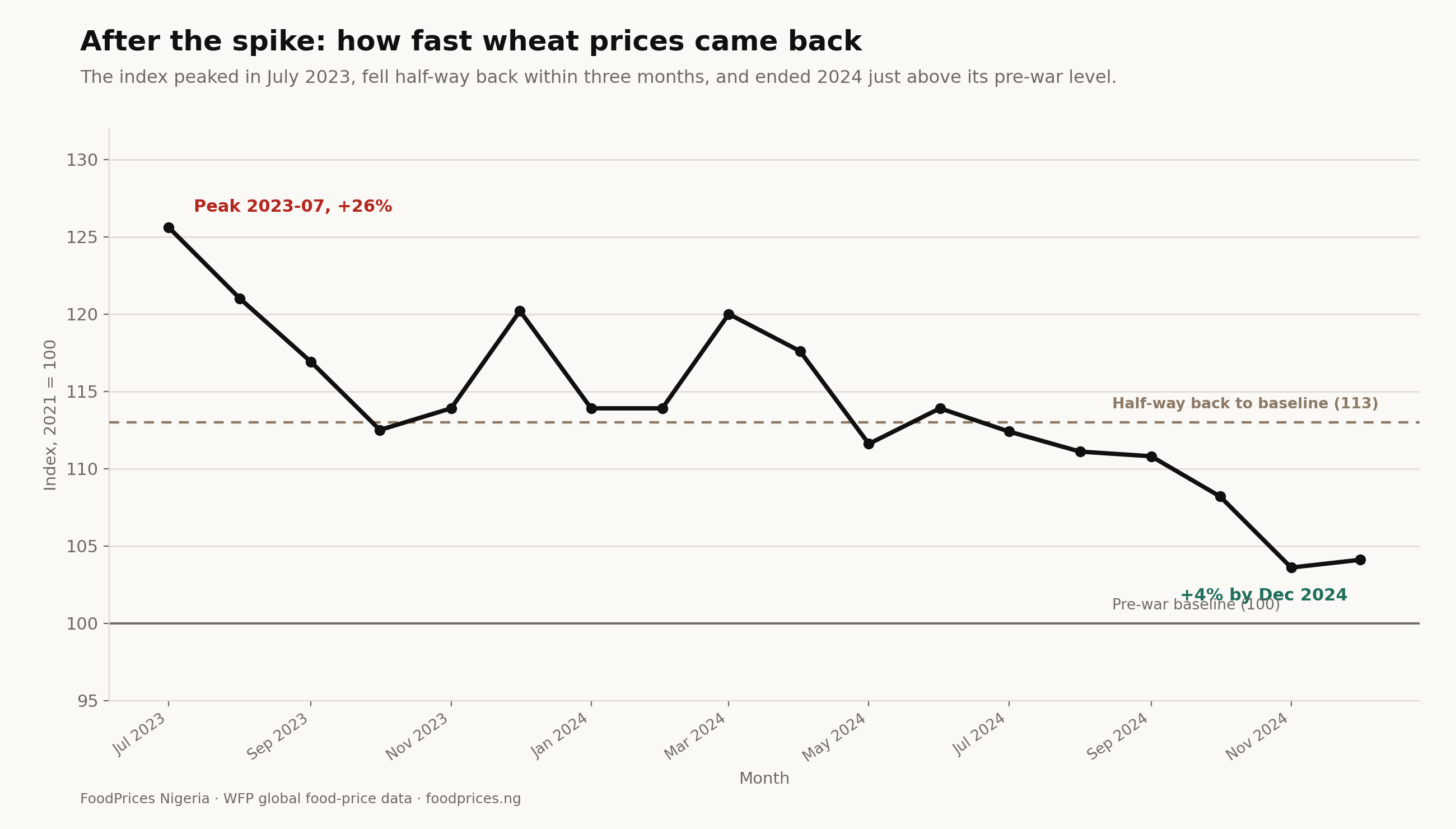
Between 2021 and 2023 that measure of maize flour went from ₦504 to ₦1,023, a rise of 103%. Priced in dollars, the same flour rose only 22%. The two lines describe identical grain in identical markets. They separate because the currency moved, not because the food did. For a Nigerian household the war was real but secondary, and the naira's collapse did more damage to the price of grain than the Black Sea ever did. That is why FoodPrices Nigeria tracks verified Lagos market prices every week in naira, the currency people actually earn, at foodprices.ng.
A few honest caveats belong with all of this. The 32 countries are those WFP prices in comparable units, not the world, and Nigeria is not among them, which is why it enters only through a proxy. Converting to dollars strips out currency noise but not macroeconomic collapse, so countries such as Syria, Argentina and Sri Lanka carry crisis effects well beyond the war. The placebo rests on a smaller and different group of eight countries, which makes it suggestive rather than conclusive and is precisely why the causal language above stays restrained. The underlying files skip 2014 to 2017, so the pre-war window runs four years rather than five. And every figure here is a monthly market median, so a single trader in a single market may tell a different story.
For the global benchmark against which national retail prices are usually read, the FAO Food Price Index remains the standard reference. For what Lagos actually pays this week, see foodprices.ng.