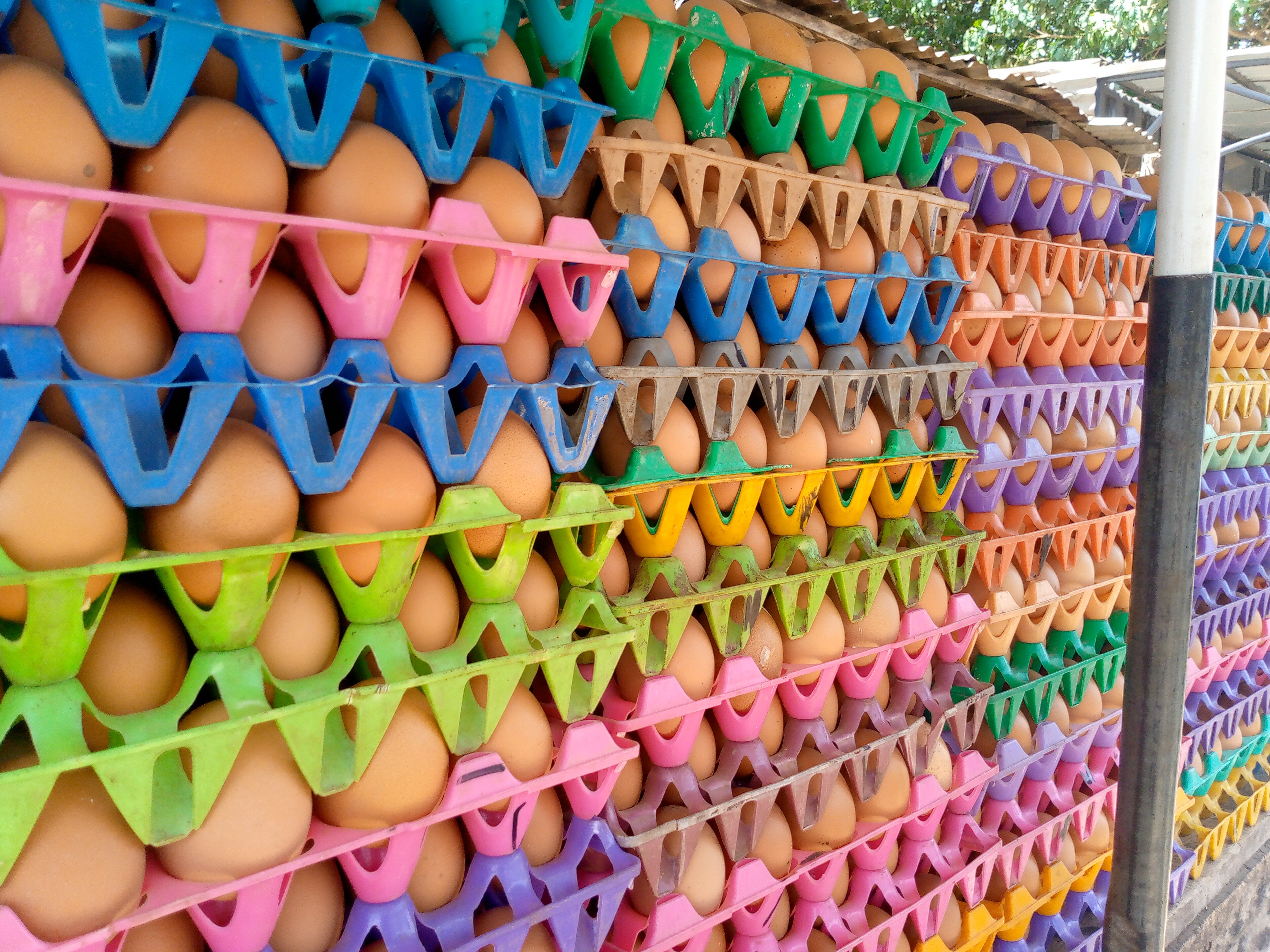
A crate of eggs costs ₦1,200 more in one Lagos market than another this week, and the two markets are not far apart in what else they sell. The Ministry of Agriculture and Food Systems market survey for the week of 17 July 2026 records Medium Sized Eggs at ₦5,300 per crate at Fresh Food Hub Mushin and ₦6,500 at Agbalata Market. Ten markets reported, and the Lagos average is ₦5,740.
The ₦5,300 Floor and a Crowded Second Tier
Fresh Food Hub Mushin holds the cheapest quote at ₦5,300, which is 7.7% below the Lagos average. Three markets share the next step at ₦5,500, namely Mushin Market, Oyingbo Market and Sabo Market Yaba, each 3.8% above the cheapest price. Agege Market and Ile-Epo Market follow at ₦5,600, then Epe Main Market at ₦5,700 and Ajah Market at ₦5,800. Eight of the ten markets surveyed price a crate between ₦5,300 and ₦5,800, a band just ₦500 wide.
Mile 12 and Agbalata Break Away at the Top
The two dearest quotes sit clear of that band. Mile 12 Market reports ₦6,400, which is 11.5% above the Lagos average and 20.8% above the cheapest quote. Agbalata Market tops the table at ₦6,500, 13.2% above the average and 22.6% above Fresh Food Hub Mushin. The full ₦1,200 spread means a household shopping at the top of the table pays for roughly a fifth of an extra crate on every purchase.
Prices Eased on the Week and the Month
Eggs moved down slightly in both short comparisons. The Lagos average fell from ₦5,790 in the prior survey to ₦5,740 this week, a 0.9% decline. Against four weeks ago, when the average stood at ₦5,770, the drop is 0.5%. The year to date picture is different. On 9 January the average was ₦5,400, so crates are 6.3% dearer now than they were in January. Recent weeks have brought mild relief on a product that is still more expensive than it was six months ago.
The Island Premium Is Almost Nothing
Ajah Market quotes ₦5,800 against a mainland average of ₦5,733, an island premium of 1.2%. Ajah is the only market on the Ajah and Lekki axis that reported a Medium Sized Eggs price this week. Eggs therefore behave very differently from garri, where the same island market carries a 70% premium. On this product a household on the island axis pays close to what the mainland pays, and the meaningful savings sit between mainland markets instead.
What the Gap Is Worth to a Household
Nigeria's minimum wage is ₦70,000 a month. Buying at Fresh Food Hub Mushin rather than Agbalata Market saves ₦1,200 on a single crate, which is 1.7% of that monthly wage. A household buying one crate a week keeps ₦4,800 across a month by holding to the cheapest verified quote, equal to 6.9% of the minimum wage. Eggs carry that weight in a Nigerian food budget because they are one of the cheapest protein sources on the market, which makes the crate price a direct input into how much protein a household can afford.
What the Data Signals for Buyers
The pattern this week rewards attention to the extremes rather than the middle. Choosing between the eight markets inside the ₦5,300 to ₦5,800 band changes little, at most ₦500 per crate. Avoiding the ₦6,400 and ₦6,500 quotes changes more. With the citywide average drifting down 0.9% on the week, the market variation of 22.6% remains the far larger number in a shopper's arithmetic.
FoodPrices Nigeria tracks Medium Sized Eggs across every reporting Lagos market each survey week so households can see where protein costs least before they buy. Live prices: foodprices.ng/real-time-prices