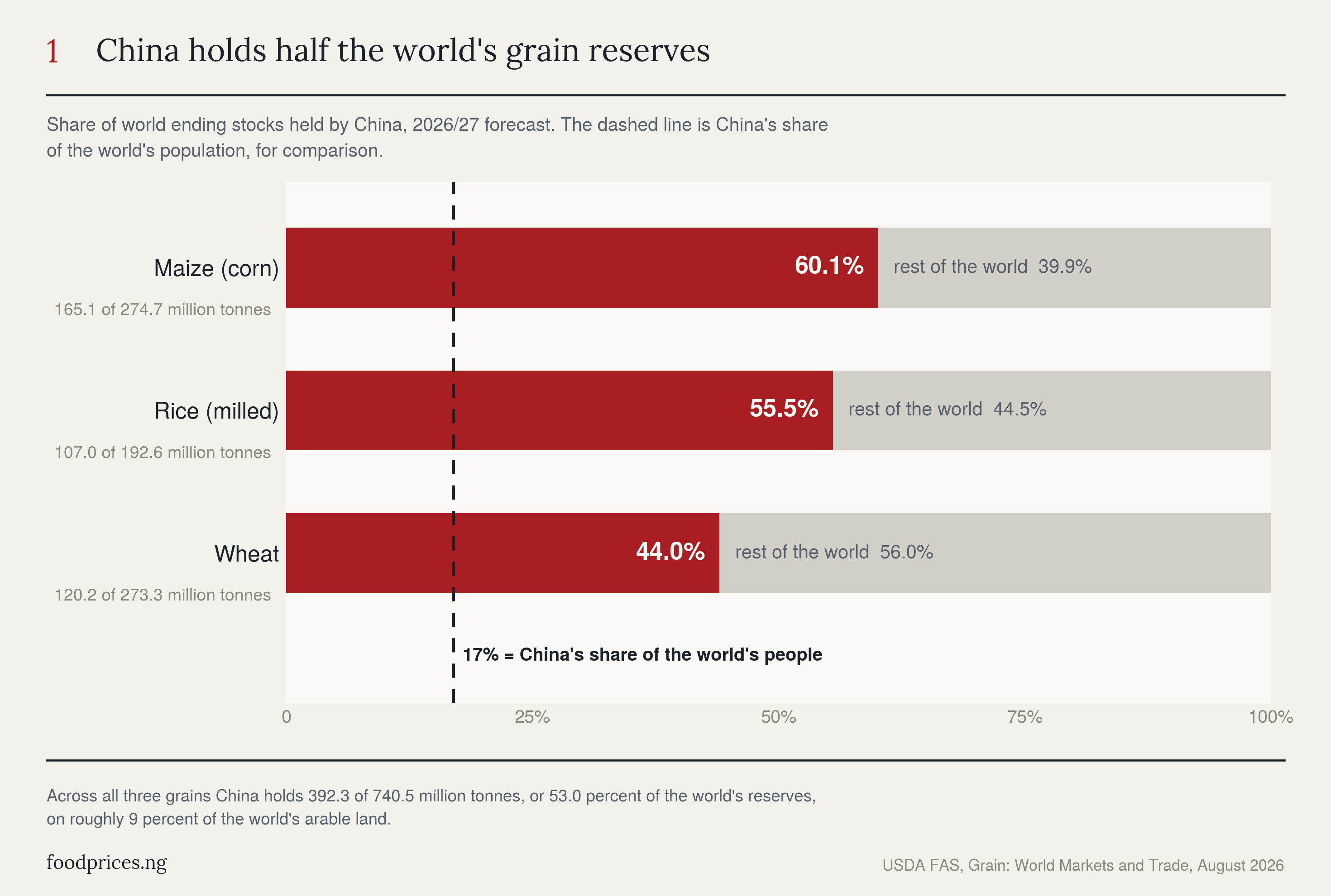
China holds 53.0% of the world's reserves of wheat, rice and maize. It has about 17% of the world's people and farms roughly 9% of its arable land.
At the same time, in the markets FoodPrices Nigeria tracks, a family in Yemen pays $10.62 for a kilogramme of cooking oil and $9.53 for a kilogramme of imported rice. A family in Sudan pays $5.78 for a kilogramme of wheat flour.
Put those two facts side by side and an accusation writes itself. It is the wrong accusation, and this article is going to spend most of its length explaining why, because the right one is more uncomfortable.
What China actually holds
The numbers come from the United States Department of Agriculture, which publishes world grain stock estimates monthly. In the August 2026 circular, forecasting the 2026/27 marketing year, China holds 120.2 million tonnes of the world's 273.3 million tonnes of wheat, which is 44.0%. It holds 107.0 of 192.6 million tonnes of milled rice, which is 55.5%. It holds 165.1 of 274.7 million tonnes of maize, which is 60.1%.
Add the three together and China sits on 392.3 of 740.5 million tonnes, or 53.0% of the reserves of the three grains that feed most of humanity.
That is the concentration. It is not disputed, it is not secret, and the USDA publishes it every month for anyone to check.
It is also recent. Twenty years ago China's holdings were a fraction of what they are now. Its maize stocks stood at roughly 37 million tonnes in 2006/07 against 165 million today, and its wheat stocks at roughly 39 million tonnes against 120 million. The world did not drift into this position. One country built the position deliberately, over two decades, while most other governments were running their own reserves down in the name of efficiency and just-in-time supply.
That second half matters as much as the first. China's share of the world's grain rose partly because China bought, and partly because everybody else stopped holding much.
The accusation, and why it fails
The obvious charge is that China's buying and hoarding drives up what everyone else pays, and that the poorest importing countries wear the cost. It is an intuitive story. It is also not what the price data shows, and saying so is the whole reason this article can be trusted on anything else.
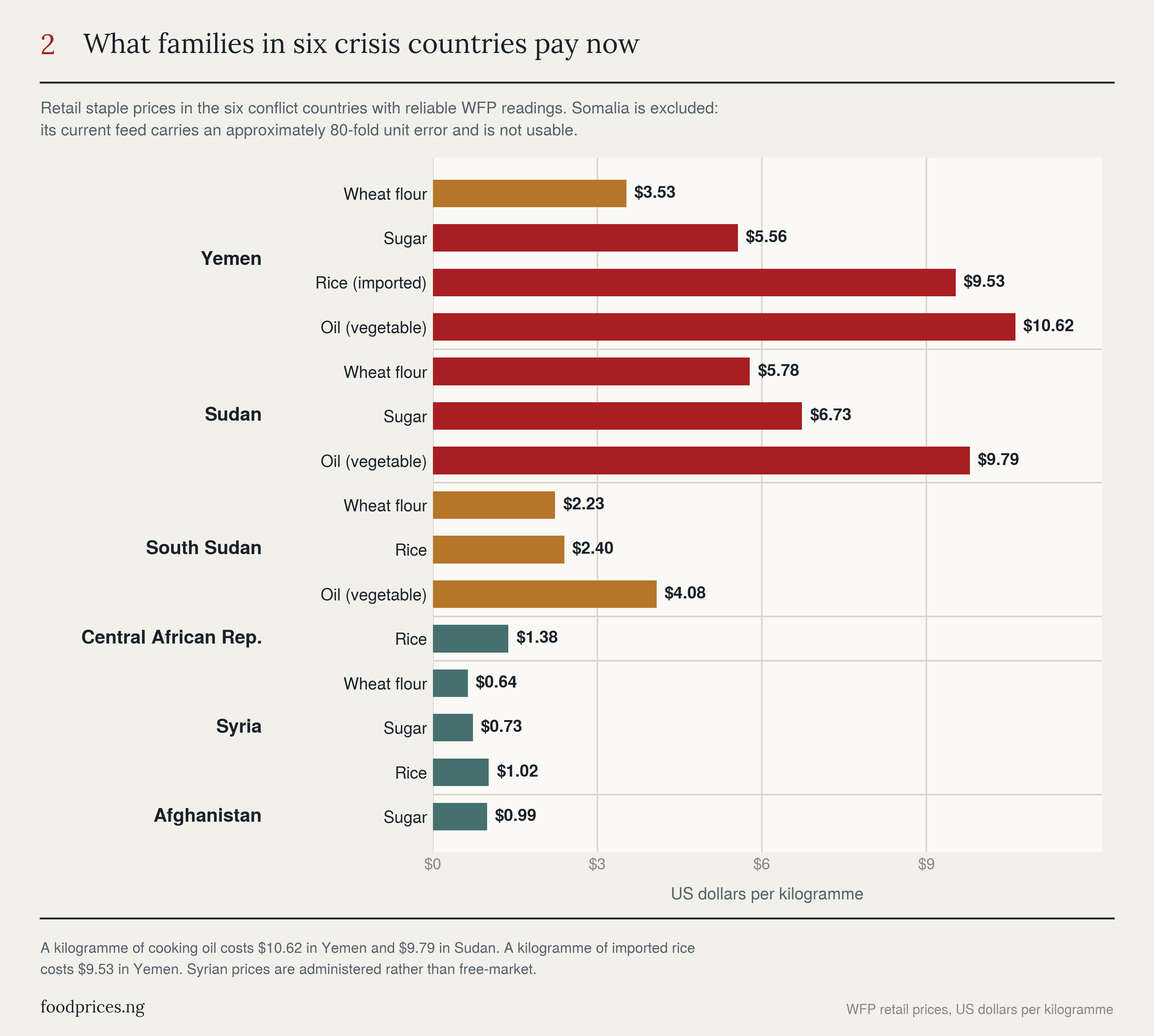
The crisis prices above are real. They are what WFP recorded in six conflict countries, and they are brutal. But look at what world prices are doing over the same period.
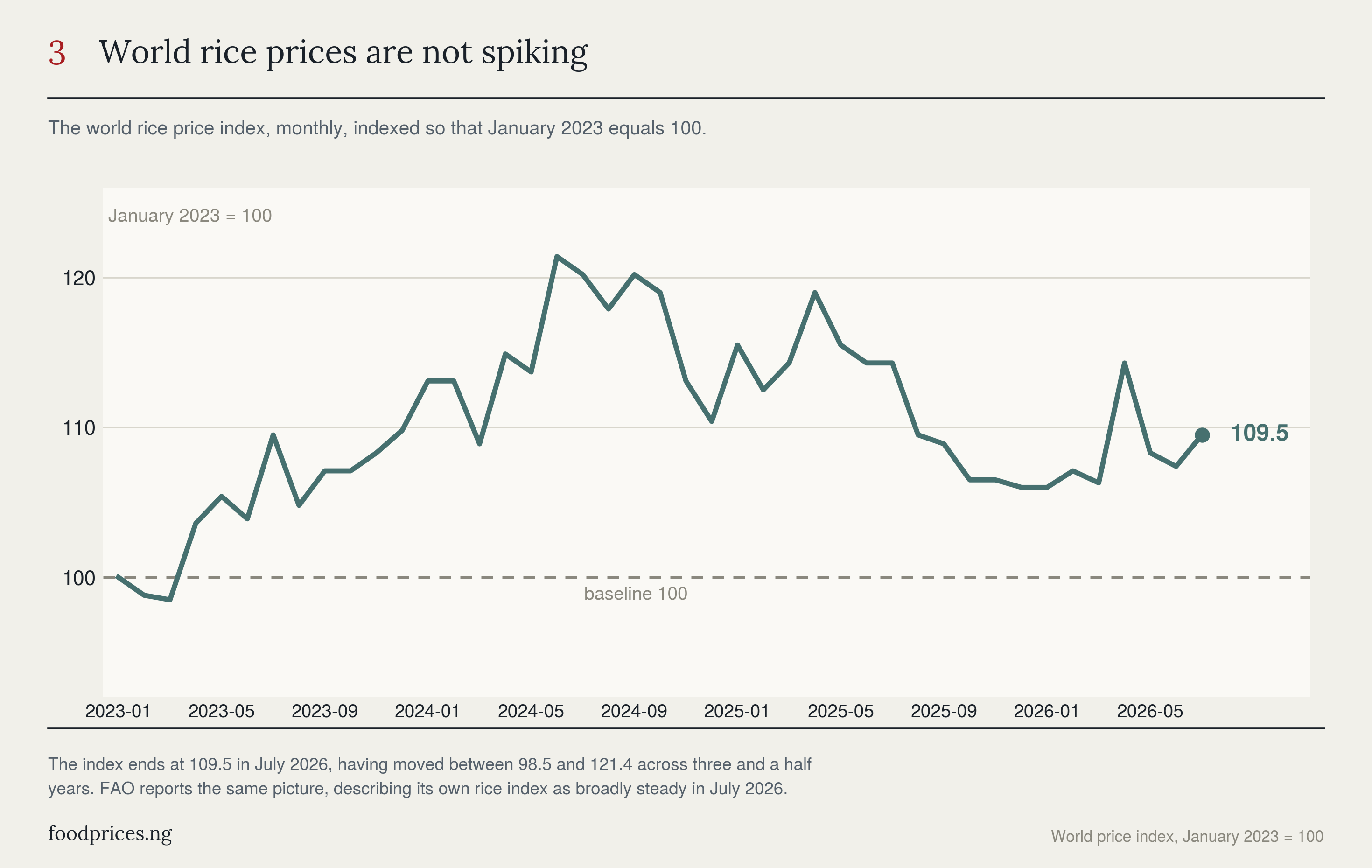
The world rice price index, the grain China holds most of, sits at 109.5 in July 2026 against a baseline of 100 in January 2023. It has moved between 98.5 and 121.4 across three and a half years. That is a market drifting, not a market under siege. The Food and Agriculture Organization describes its own rice index as broadly steady in the same month, using an entirely separate methodology.
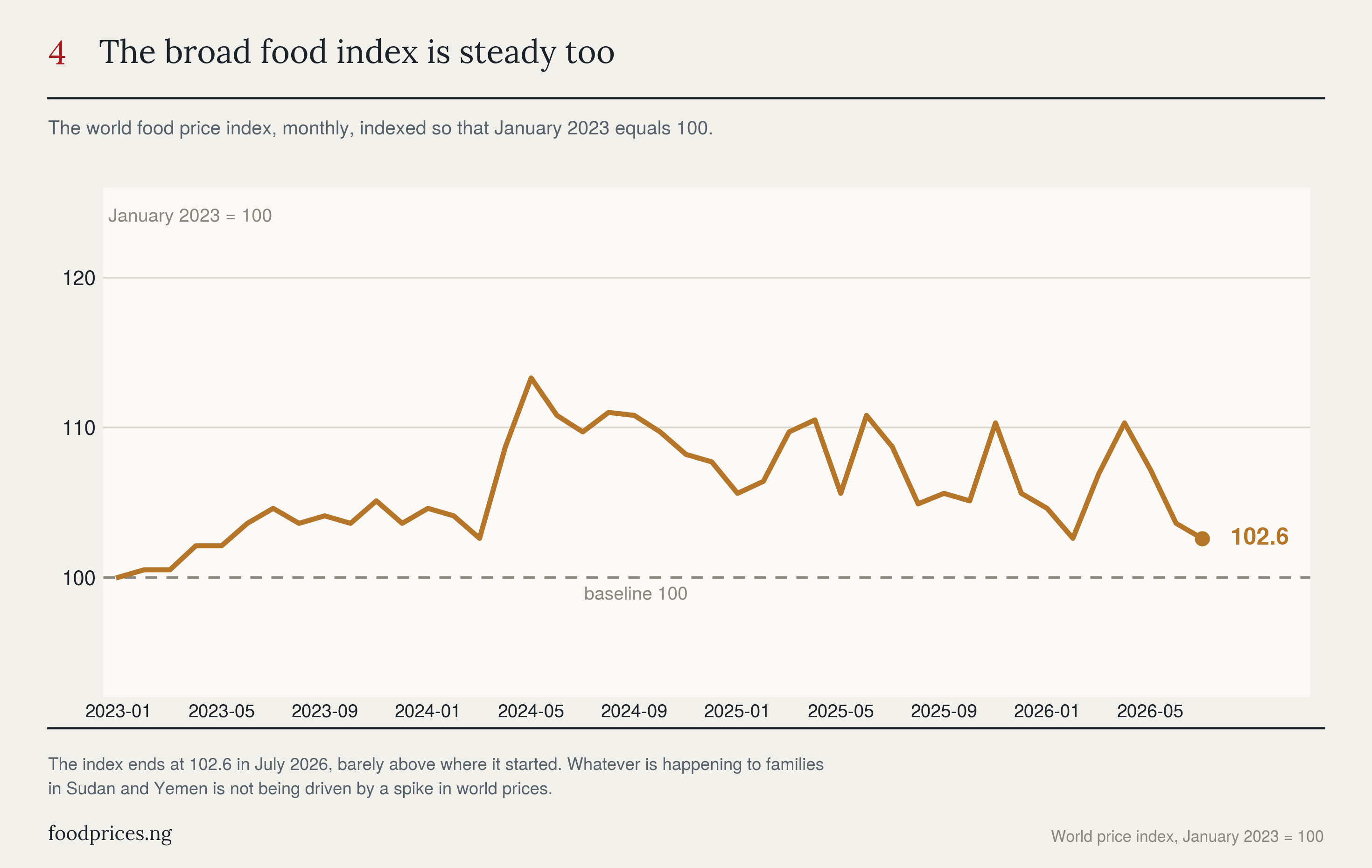
The broad food index tells the same story, ending at 102.6, barely above where it began.
So the honest conclusion is this. Yemenis are not paying $10.62 for cooking oil because China bought too much maize. They are paying it because their ports are blockaded, their currency has collapsed and their supply lines run through a war. FoodPrices Nigeria's own reporting on conflict pricing found exactly that: the premium appears in siege economies and nowhere else, and it lands hardest on goods that have to be shipped in.
Anyone who tells you the stockpile caused these prices is selling you something. There is no correlation here to point at, because the world prices did not move.
The defence, put properly
China's position also has a case that deserves to be made without caricature.
It feeds around 1.4 billion people. It carries a living memory of mass starvation, since the famine that followed the Great Leap Forward killed tens of millions within the lifetime of people still alive today. A state that has buried that many citizens for want of grain and then declines to build reserves would be behaving strangely.
Every major importer stockpiles. India holds tens of millions of tonnes. The European Union, the United States, Egypt and Algeria all carry strategic or commercial reserves. The practice is universal and the difference with China is scale, not kind.
Nor is the effect purely negative. Large reserves absorb shocks. During the pandemic and again after the invasion of Ukraine, having grain already inside the country meant China was not bidding against everyone else in a panicked market at the worst possible moment. A China with empty silos in 2022 would have been a considerably worse outcome for global prices than the China that existed.
None of this is illegal. There is no treaty capping national grain reserves, and no international body with authority to set one.
So what is the actual problem
It is not causation. It is concentration.
A reserve is only useful to the world if it can reach the world. When stocks are spread across many countries, a bad harvest in one place is met by grain moving out of another, and the buffer does its job. When more than half the buffer sits inside a single state that will release it according to its own domestic needs and its own political calendar, the rest of the world is not sharing a reserve. It is watching one.
The world's usable buffer is therefore smaller than the world's total buffer, and the gap between those two numbers is roughly the size of China's holdings. In a calm market, which is what the indices above show, that distinction costs nothing. It has never been tested by a genuine simultaneous shock.
The countries that would discover the difference first are the ones with no reserves of their own and no ability to outbid anyone. They are the countries in chart two, and they are also countries like Nigeria, which imports the wheat its bread is made from and much of its refined sugar and vegetable oil.
It is worth being precise about what a test would look like, because the last two shocks were not one. Both COVID and the invasion of Ukraine hit supply chains and one exporting region respectively, and in both cases grain still existed and still moved. A genuine test would be simultaneous harvest failure across several major exporting countries at once, the scenario climate models keep raising and the one no reserve system has faced in the modern era. In that event the question stops being what the world holds and becomes what the world can actually buy.
That is the honest version of the worry. Not that China caused a price, but that a hungry, import-dependent world has quietly built its emergency plan around a cupboard it does not control.
The verdict
Extreme concentration of grain reserves is a real systemic risk, and it can be true at the same time that no single country is to blame for any single price on any single day. Both of those statements are supported by the data here, and a reader who takes only one of them has taken the wrong half.
What follows from that is a question about the rest of the world rather than about China. If half the planet's grain buffer is committed to one country's food security, the other half has to cover everyone else, and nobody has ever checked whether it can.
How we worked it out
Two separate sources are used here and they are deliberately not mixed.
Stock figures are from the USDA Foreign Agricultural Service publication Grain: World Markets and Trade, August 2026 circular, using the 2026/27 forecast for ending stocks. These are public, published monthly, and were read directly from the source tables rather than from secondary reporting. Stocks are aggregated across differing local marketing years, so they represent a season rather than a single day.
Retail prices are World Food Programme market monitoring, converted to US dollars per kilogramme. Six conflict countries are shown. Somalia was dropped because its current feed carries an approximately eighty-fold unit error, producing impossible figures, and publishing it would have been worse than the gap. Syrian prices are administered rather than free-market and should be read as what the state charges rather than what food costs to obtain.
Price indices are indexed to January 2023 equals 100 and are not the same series as FAO's published index, which uses a 2014 to 2016 base. Where FAO is cited it is cited for direction, not for a number.
Population and arable land shares are approximate and rounded, drawn from standard international estimates against a world population of roughly 8.2 billion.
Nigerian prices are live and checkable at foodprices.ng. Analysis by FoodPrices Nigeria.
Questions readers ask
Is China hoarding the world's grain? China holds 53.0% of world wheat, rice and maize reserves with about 17% of the world's population. Whether that is hoarding or prudent national food security depends on what you think a country owes the rest of the world, but the concentration itself is a matter of published record.
Did China's stockpiling cause high food prices in poor countries? There is no evidence of it in this data. World rice and food price indices are broadly flat. The extreme prices in Yemen and Sudan track blockade, conflict and currency collapse, not global scarcity. Anyone claiming a causal link is going beyond what the numbers support.
Why does it matter if the market is calm? Because reserves exist for the moment the market stops being calm. A buffer held mostly inside one country will be released according to that country's needs first. The world's usable reserve is smaller than its total reserve, and that difference only becomes visible during a shock.
Is what China is doing illegal? No. There is no international limit on national grain reserves and no body empowered to set one. Most large importers stockpile. The difference is scale.
What does this mean for Nigeria? Nigeria imports its wheat along with much of its refined sugar and vegetable oil, and holds no comparable strategic reserve. In a calm market that costs nothing. In a simultaneous global shock, countries with no reserves and limited buying power are the ones that discover how thin the shared buffer really is.