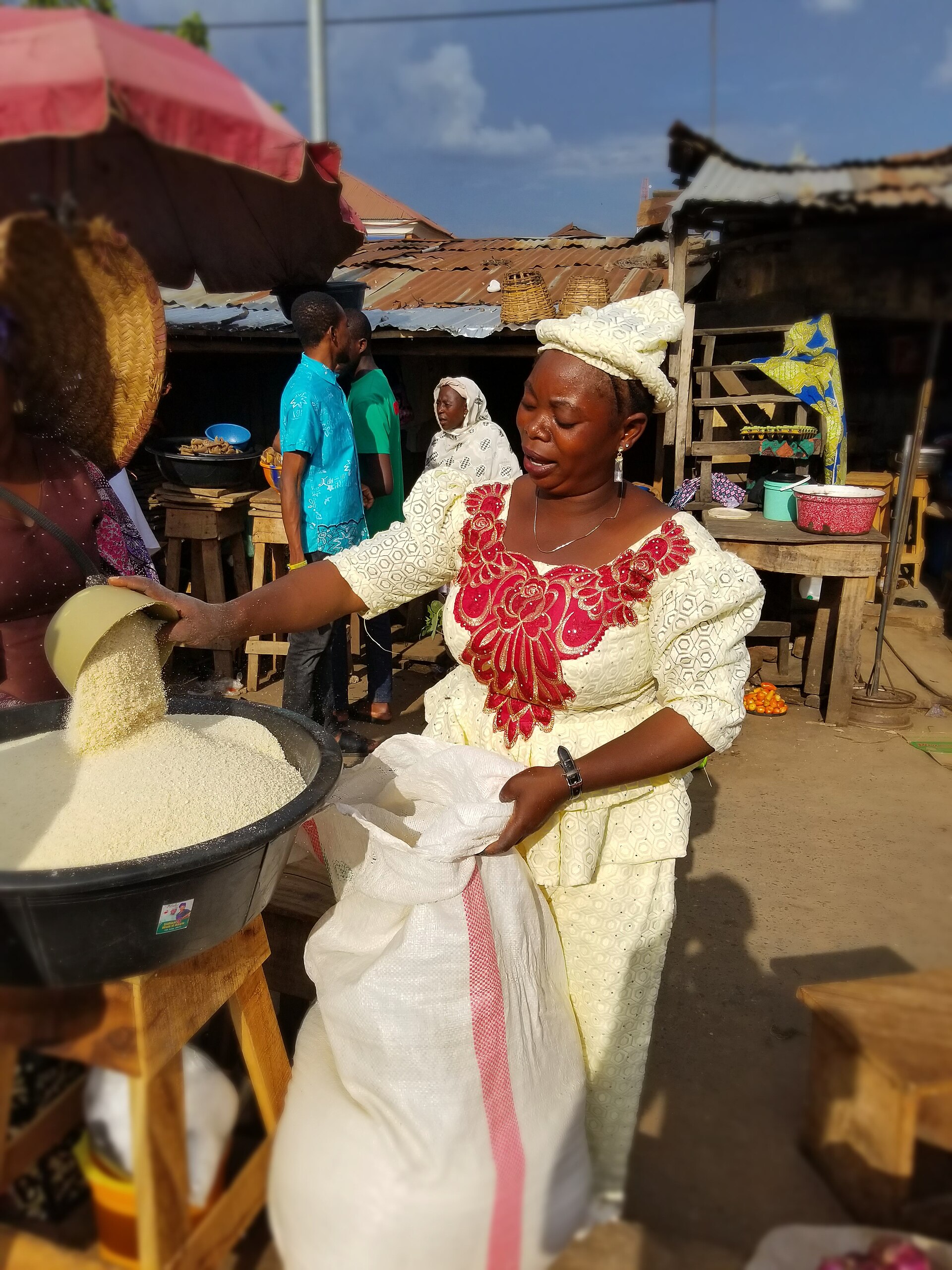
Ijebu garri is the specialty grade of the category, and this week's survey shows what that means in practice. The Ministry of Agriculture and Food Systems market survey for the week of 17 July 2026 captured Garri (Ijebu) in five markets, against ten for the yellow grade and nine for white in the same week. The Lagos average is ₦1,260 per paint.
Five Quotes, ₦400 Apart
Mile 12 Market holds the cheapest quote at ₦1,100, which is 12.7% below the average. Ile-Epo Market and Oyingbo Market both quote ₦1,200, Epe Main Market ₦1,300, and Ajah Market ₦1,500, which is 36% above Mile 12 and 19.0% above the citywide figure.
What Narrow Coverage Means for a Buyer
A grade stocked in half as many markets is a grade a household cannot reliably substitute into. The practical consequence is that the ₦400 range understates the real cost of choice, because a shopper whose nearest market does not carry Ijebu garri is not choosing between ₦1,100 and ₦1,500 but between travelling and buying a different grade. On that second option the arithmetic is close. Garri (White) averaged ₦1,267 per paint this week and Ijebu ₦1,260, a difference of 0.6%, while Garri (Yellow) averaged ₦1,505, making Ijebu 16.3% cheaper than the yellow grade.
A Steep Fall Since January, Then a Flat Month
Ijebu garri has repriced further than any other grade in the category this year, falling 37.0% from ₦2,000 on 9 January to ₦1,260. The recent picture is quieter, with the average down 6.2% from ₦1,343 four weeks ago and up 0.8% from ₦1,250 in the prior survey. The Lagos State Ministry of Agriculture and Food Systems lists Ijebu garri at ₦1,100 per paint in the July 2026 entry of its Lagos Food Price Tracker, matching the cheapest quote in the survey rather than the average. Worth noting as a discrepancy, The Nation reported in January that Ijebu garri was trading around ₦1,500 in Lagos while white and yellow held near ₦1,200, a level well below the ₦2,000 January average in this survey.
Cassava Is the Risk Ahead
The grade's raw material is under seasonal pressure. AgroNigeria reported cassava and vegetable farms in Ikorodu, Ojo, Imota and Epe left submerged after continuous rainfall, and Vanguard reported the Nigeria Hydrological Services Agency expecting flooding across about 17 states between 21 and 27 July. The National Bureau of Statistics named garri among the items lifting food inflation to 17.52% in June, as Nairametrics reported.
The Island Quote and Household Cost
Ajah Market is the only market on the Ajah and Lekki axis reporting Ijebu garri this week, and its ₦1,500 sits 25% above the mainland average of ₦1,200. Nigeria's minimum wage is ₦70,000 a month, so the ₦400 gap between Mile 12 and Ajah is 0.6% of a month's wage per paint, or ₦1,600 and 2.3% for a household buying four paints a month.
Coverage is worth watching as its own signal. A grade that appears in five markets one week and eight the next is telling a supply story before the price moves, and thin coverage tends to precede wider spreads because fewer quotes means less competitive pressure on each one. Four of the five markets reporting Ijebu garri this week price within ₦200 of each other, between ₦1,100 and ₦1,300, which suggests the mainland market for the grade is functioning normally and the single ₦1,500 quote is the exception rather than the pattern.
For households outside those five catchments, the realistic question is not where to buy Ijebu garri but whether to buy it at all this week. At a citywide average of ₦1,260 against ₦1,267 for the white grade, the premium that normally attaches to the Ijebu name has effectively disappeared, which makes substitution cheap and travel hard to justify.
FoodPrices Nigeria will keep tracking how widely each garri grade is stocked as well as what it costs. Live prices: foodprices.ng/real-time-prices