Between 2015 and 2026, the national mean retail price of yam in Nigeria went from ₦298 to ₦3,002 for a 2.5 KG measure, an increase of 907%. Across the same eleven years, the dollar price of that identical measure of yam went from $1.51 to $2.19, an increase of 45%. Both figures describe the same tuber, sold in the same markets, recorded by the same surveyors. The distance between 907% and 45% is not a story about yam. It is a story about the naira.
This feature draws on two separate datasets and credits each. The long-run history comes from the World Food Programme, published via the Humanitarian Data Exchange, which reports national mean retail prices for Nigerian food commodities as yearly averages across all of its reporting markets, in both naira and US dollars. That series is historical and dated. It runs from 2015 and ends with the 2026 yearly mean. The current figures at the end of this piece come from the Lagos State Ministry of Agriculture and Food Systems weekly market survey, compiled and published by FoodPrices Nigeria, for the week of 31 July 2026, which reports mean prices across Lagos markets in the retail containers households actually buy. The two are measured differently and should not be read as one continuous series.
The naira column shows a surge that looks like a crisis
Read on its own, the naira series reads as a decade of relentless escalation. Imported rice went from ₦560 for a 2.8 KG measure in 2015 to ₦4,182 in 2026, a rise of 647%. Palm oil went from ₦246 a litre to ₦2,437, a rise of 889%. Vegetable oil rose 387% from its 2016 base, groundnuts 353%, onions 322%, tomatoes 278%. Local rice, the commodity Nigerian policy has spent a decade trying to make abundant, rose 391%.

Even the mildest entries on the list moved hard. Sorghum, the smallest riser among the staples that report through 2026, still gained 85%. Millet gained 218%. Beans gained 179%. Nothing in the WFP series got cheaper in naira terms over the period.
That picture matches what Nigeria's official statistics have been recording. The National Bureau of Statistics reported food inflation of 20.31% year on year in July 2026, down from 26.20% in July 2025, but with the month-on-month food rate climbing to 5.56% from 3.75% in June. Nairametrics has documented that food inflation moved above the all-item rate in April 2026 for the first time in eight months, rising from 8.89% in January to 16.06% in April, and attributed the increase to staples including millet, yam flour, garri, yam tuber, beans and tomatoes. Those are the same commodities carrying the largest multi-year gains in the WFP series.
The dollar column shows something close to the opposite
Priced in US dollars, the same thirteen commodities behave nothing like a runaway market. Eight of them cost less in 2026 than at their base year. Sorghum fell 63%. Millet fell 54%. Beans fell 44%. Local rice fell 29%, tomatoes 28%, onions 17%, groundnuts 10%, vegetable oil 2%. Imported rice, the single most politically visible food in the country, rose 7% over eleven years, which works out to well under 1% a year.

Only three staples rose meaningfully in dollar terms. Yam gained 45%, palm oil gained 42%, and gari gained 30% over its shorter 2015 to 2023 window. Those three deserve separate attention, because they are the cases where something other than the exchange rate is doing work.
Same food, two currencies
Setting the two changes side by side makes the pattern hard to miss. Yam's naira price rose 907% while its dollar price rose 45%. Palm oil rose 889% in naira and 42% in dollars. Imported rice rose 647% in naira and 7% in dollars. Local rice rose 391% in naira and fell 29% in dollars. Millet rose 218% in naira and fell 54% in dollars.

A commodity that becomes scarce gets more expensive in every currency at once. A commodity whose price rises in one currency and falls in another has not become scarce. Its unit of account has shrunk. For most of the WFP basket, the second description fits better than the first.
The exchange rate history explains the mechanism. The Central Bank of Nigeria floated the official rate in June 2023, and the benchmark moved from about ₦475 to the dollar to roughly ₦750 within a day, a fall of some 37%. Legit.ng reported that the currency had lost more than 60% of its value against the dollar within weeks of the float. By 2026 the naira trades in a very different range. Vanguard reported an official Nigerian Foreign Exchange Market closing rate of about ₦1,337.29 to the dollar in late August 2026, with the parallel market near ₦1,400.
Set that against the price series and the timing lines up. The naira mean for imported rice jumped 91.8% in a single year, from ₦2,691 in 2023 to ₦5,161 in 2024. Beans jumped 173.3% across the same twelve months, millet 105.7%, yam 119.2%. In dollar terms, 2024 was not a spike year at all. Imported rice fell from $4.09 to $3.57, beans rose from $2.04 to $2.50, and millet fell from $1.40 to $1.28.
The retreat since 2024 belongs to the same story
The naira series peaked in 2024 for most of the basket and has fallen since. Imported rice is down 19.0% from its ₦5,161 peak to ₦4,182. Local rice is down 34.7%, beans down 44.1%, millet down 47.0%, sorghum down 49.9%. Three years of naira price declines in a country still reporting double-digit food inflation looks contradictory until the currency is factored in.
Yam and palm oil are the honest exceptions, and they are worth naming as such. Yam is the only staple in the set whose dollar price climbed steadily rather than cycling, from $1.51 in 2015 to $2.19 in 2026, and it kept rising in naira through 2025 while most of the basket was falling. Palm oil moved the same way, from $1.25 to $1.77. Those two are getting genuinely more expensive in real terms, which points at production, land and processing costs rather than at the exchange rate.
Rice cost most in Lagos and least in Kano
The regional breakdown for 2023 adds a second dimension that the national averages hide. That year, imported rice averaged ₦1,699 for a 2.8 KG measure in Kano, ₦1,765 in Kebbi, ₦1,860 in Zamfara and ₦1,892 in Katsina. In Lagos it averaged ₦3,014. A Lagos household paid 77% more than a Kano household for the same quantity of the same imported product, and 12.0% more than the national mean of ₦2,691.
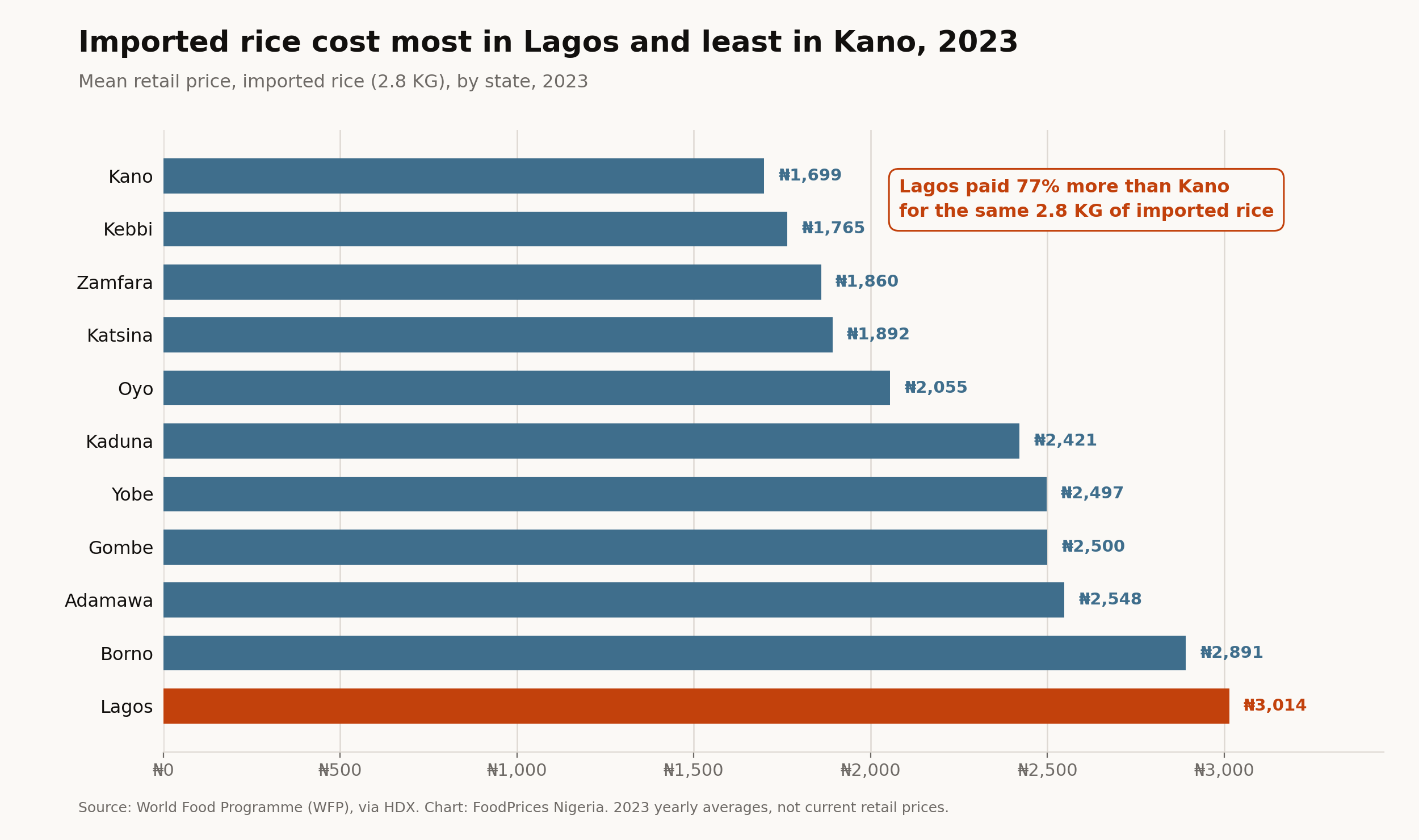
Distance and freight account for much of that gap. Pulse reported in July 2026 that moving a tonne of grain from Kano to Lagos had risen from ₦45,000 to ₦70,000 on the back of fuel and energy costs, with post-harvest losses reaching as much as 50% on some routes. Nairametrics found the same regional ordering in its May 2026 survey, where a 50kg bag ranged from ₦53,000 to ₦82,000 depending on location, with traders crediting cheaper zones to proximity to producing states such as Niger, Benue and Kogi and to fewer transport bottlenecks.
Borno sits second dearest at ₦2,891, 70.2% above Kano, which fits the same logic in reverse. Proximity to the northern production belt lowers the price, and distance or insecurity on the route raises it, whichever direction the goods travel.
What these staples cost in Lagos now
The WFP series ends on an annual average. The weekly Lagos survey picks up where it stops, at a resolution the yearly figures cannot reach. In the week of 31 July 2026, across Lagos markets, imported long grain rice averaged ₦57,188 for a 50kg bag, ₦4,589 for a paint and ₦969 for a derica, while Nigerian manufactured rice averaged ₦52,857 for the 50kg bag, putting the imported product at an 8.2% premium. Beans (Oloyin) averaged ₦5,010 a paint and ₦1,111 a derica. Garri (White) averaged ₦1,289 a paint. A medium sized yam tuber averaged ₦3,240. Those figures come from the Lagos State Ministry of Agriculture and Food Systems weekly market survey, compiled and published by FoodPrices Nigeria.
The units are the reason these two datasets have to be read side by side rather than joined. WFP's 2026 national annual mean for imported rice, ₦4,182, describes a 2.8 KG metric measure averaged across the whole country over a full year. The Lagos survey's ₦4,589 describes a paint, a retail container, in one city, in one week. The two numbers sit close together on the page and mean different things, so the comparison worth making is one of direction and level in words, not a like-for-like figure, and the weekly prices are not the next point on the WFP line.
On direction, the pattern holds. Imported long grain rice fell 5.5% in seven days, from ₦4,856 to ₦4,589 a paint, and Nigerian manufactured rice fell 3.4%, from ₦4,592 to ₦4,436. That is the same direction the WFP naira series has run since its 2024 peak, now visible week by week rather than year by year. Beans moved the other way, with the Oloyin paint up 3.7% and the Drum derica up 4.7%, and all three garri varieties held exactly flat at 0.0%.
Yam is the item worth watching most closely, because it is the one staple the WFP data marks as genuinely more expensive in real terms rather than merely in naira. It held flat on the week at ₦3,240 a tuber, and the range behind that mean runs from ₦2,300 at Epe Main Market to ₦3,500 at Mile 12 Market, a spread of 52.2% inside a single city.
That last figure closes a loop with the 2023 state data. Imported rice cost 77% more in Lagos than in Kano, which distance and freight explain. But the same imported long grain rice ranged from ₦2,500 at Fresh Food Hub Mushin to ₦5,200 at Ile-Epo Market in the same week, a spread of 108% across markets a short drive apart, where distance explains almost nothing. Dispersion between states is a logistics problem. Dispersion of that size within one city is a market information problem, and it is the reason weekly per-market tracking earns its keep alongside the national annual series.
What the long series is good for
The WFP record is too coarse for shopping decisions. It reports one number per commodity per year for the whole country, and its newest figure is a 2026 annual mean. Its value is in the comparison it makes possible. A household that watched the price of rice quadruple between 2015 and 2024 experienced a real and severe loss of purchasing power, and the dollar column does not make that loss less real. What the dollar column establishes is where the loss came from. For eleven of the thirteen staples tracked, Nigerian food did not become dramatically scarcer against world prices. Nigerian money bought less of it.
That distinction matters for policy. Harvest subsidies, import waivers and anti-hoarding enforcement all target scarcity. The WFP series suggests that for most of the basket, the binding constraint over the past decade sat in the foreign exchange market rather than on the farm, with yam and palm oil as the clearest exceptions where real costs genuinely rose. It also sets the test for the years ahead. If the naira holds near the ₦1,337 level reported in August 2026, the decade-long divergence between the naira column and the dollar column should stop widening, and naira prices should start tracking harvests again rather than the exchange rate.
FoodPrices Nigeria compiles and publishes the Lagos State Ministry of Agriculture and Food Systems weekly market survey, which tracks verified mean prices across Lagos markets every week at the resolution households actually buy, and the weekly figures above are the current answer to what the long series was measuring. Live prices: foodprices.ng/real-time-prices