Lagos food prices moved broadly lower in the week to 14 August 2026. Of the 21 product-and-unit lines tracked in the Ministry of Agriculture and Food Systems market survey, 15 recorded lower mean prices than on 7 August, five recorded increases and one was unchanged. Every figure below is a mean across Lagos markets, outlier-filtered, not the price at any single stall.
What Lagos Pays Now
A 50kg bag of Imported Rice (Long Grain) averages ₦56,250 across eight markets, Imported Rice (Short Grain) averages ₦52,550 across 10 markets, and Nigerian Manufactured Rice averages ₦52,143 across seven markets. At 25kg the means are ₦28,562, ₦26,350 and ₦26,500 respectively. A paint of Beans (Oloyin) averages ₦4,950 across 10 markets and Beans (Drum) averages ₦4,450. A paint of Garri (Yellow) averages ₦1,460, Garri (Ijebu) ₦1,260 and Garri (White) ₦1,300. A crate of Medium Sized Eggs averages ₦5,640 across 10 markets, up 0.4%, and a tuber of Medium Sized Yam averages ₦3,020.
The Only Two Increases Above 1%
Imported Rice (Short Grain) at 1 Derica rose from ₦833 to ₦861, a 3.3% increase across nine markets. Imported Rice (Long Grain) at 1 Derica rose from ₦944 to ₦969, up 2.6% across eight markets. Both are small retail measures. At bag scale the same grain moved the other way, with Long Grain 50kg down 1.2% from ₦56,938 to ₦56,250, Long Grain 25kg down 1.3% from ₦28,938 to ₦28,562 and Short Grain 25kg down 0.8% from ₦26,550 to ₦26,350. Wholesale is not the source of the Derica increase.
Yam and Beans Lead the Decline
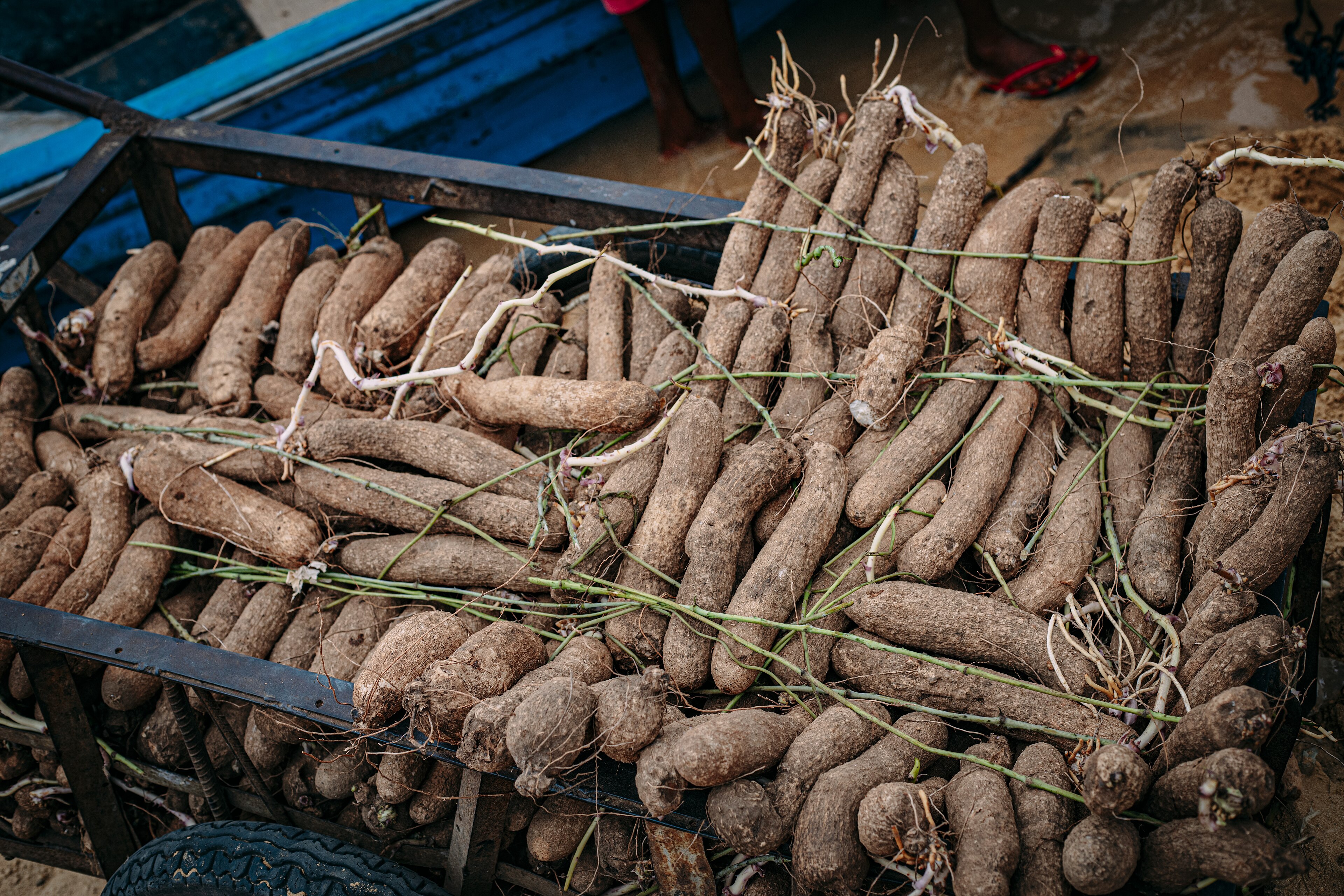
Medium Sized Yam recorded the single largest move of the week, its mean falling from ₦3,160 to ₦3,020 per tuber, a 4.4% decline measured across all 10 markets. Beans fell at every measure tracked: Drum at 1 Derica down 3.3% to ₦967, Oloyin at 1 Derica down 3.0% to ₦1,078, Oloyin at 1 Paint down 2.6% to ₦4,950 and Drum at 1 Paint down 1.4% to ₦4,450. Garri (White) at 1 Paint fell 2.3% from ₦1,330 to ₦1,300 across nine markets, and Nigerian Manufactured Rice at 1 Derica fell 2.8% from ₦883 to ₦858, though that line rests on only six markets.
The National Backdrop Points the Other Way
Nairametrics reported that food inflation reached 20.31% year-on-year in July 2026, its highest level since September 2025, even as headline inflation eased to 15.43% from 15.91% in June. Vanguard put the same figure in context, describing it as the fifth consecutive monthly rise since March 2026 and noting that the National Bureau of Statistics attributed the increase partly to changes in the average prices of rice, garri and yam. Legit.ng agreed on the headline direction, reporting the month-on-month headline rate at 1.57% in July, down from 1.66% in June. The Lagos survey for this week runs against that national picture, which is a reminder that a state-level weekly mean and a national monthly index measure different things. A Blueprint survey of Lagos markets covering January to June 2026 reached a similar conclusion about mixed movement, finding that rice, beans, garri and oils recorded varying changes shaped by transport costs and seasonal availability rather than a single trend.
What the Data Signals
Buyers purchasing at bag scale are being rewarded this week and buyers purchasing by the Derica are not. The widest cross-market gaps sit in garri and yam, where Garri (White) ranges from ₦1,000 at Oyingbo Market to ₦2,000 at Ajah Market, and a yam tuber ranges from ₦2,200 at Agege Market to ₦4,000 at Ajah Market. Location, not the week's movement, remains the largest single variable in what a Lagos household pays.
Live prices: foodprices.ng/real-time-prices