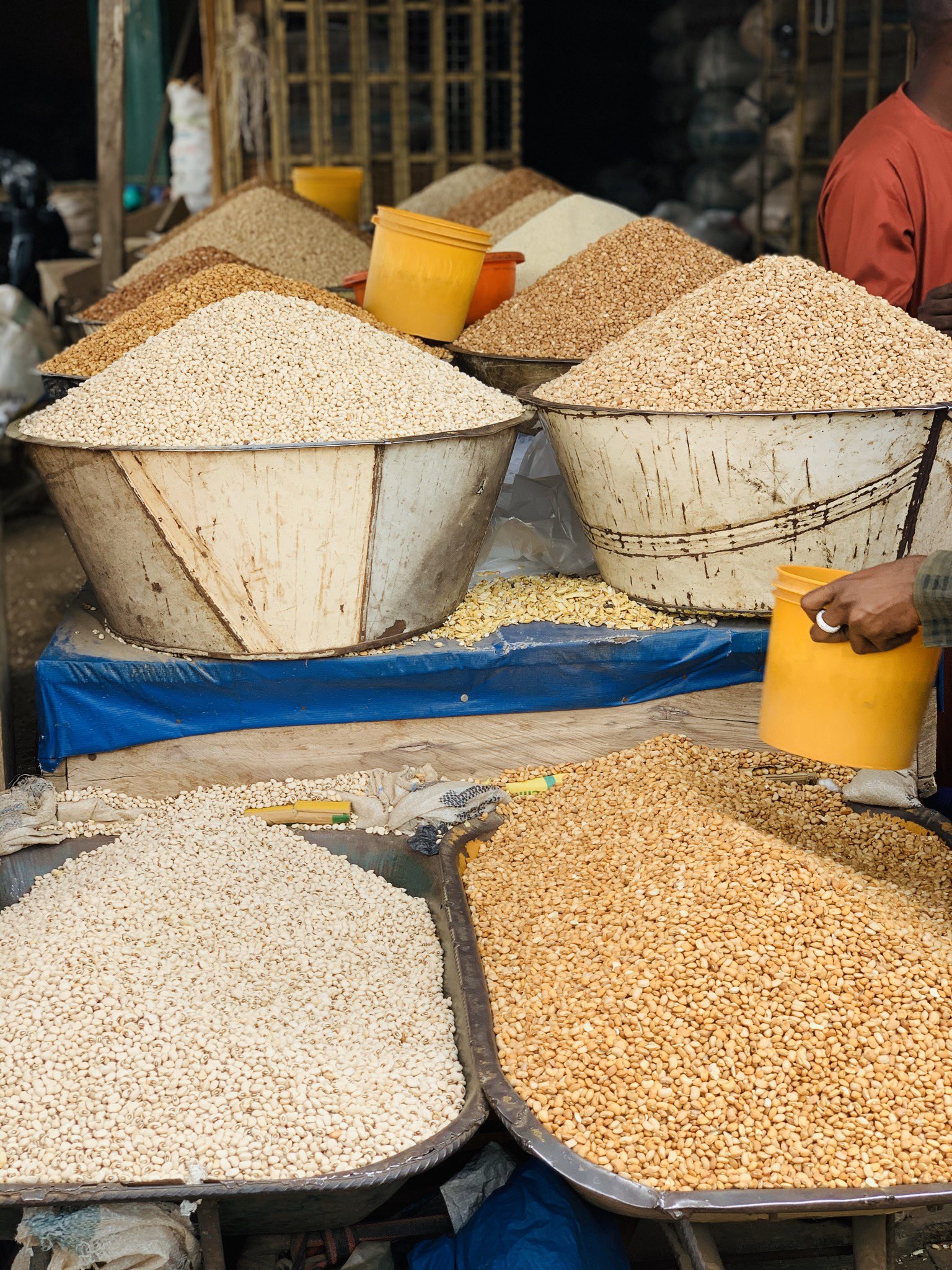
The Ministry of Agriculture and Food Systems' weekly market survey for Lagos, covering the week of 24 July 2026 and compared with 17 July 2026, shows a food basket moving in mixed directions, with rice and yam easing while garri and one beans variety pushed higher.
What Lagos Pays Now
Rice remains the largest single category tracked, and it leaned lower across almost every format this week. A derica of Imported Rice (Long Grain) had a mean price of ₦1,025 across eight markets, cheapest at ₦900 in Mushin Market and priciest at ₦1,300 in Ajah Market. The paint size of the same rice averaged ₦5,081, the 25kg bag averaged ₦28,562, and the 50kg bag averaged ₦56,938, all lower than the previous week. Imported Rice (Short Grain) also eased, with a derica averaging ₦950, a paint averaging ₦4,700, a 25kg bag averaging ₦26,722, and a 50kg bag averaging ₦53,000. Nigerian Manufactured Rice held broadly flat by comparison, with the derica and paint sizes unchanged at ₦964 and ₦4,843, the 25kg bag up marginally to ₦26,812, and the 50kg bag up slightly to ₦53,312.
Beans showed a split. A derica of Beans (Drum) rose to a mean of ₦989 across nine markets, cheapest at ₦800 in Agege Market and priciest at ₦1,200 in Ile-Epo Market, while a derica of Beans (Oloyin) fell to ₦1,056, cheapest at ₦900 in Ile-Epo Market and priciest at ₦1,300 in Ajah Market. The paint sizes of both varieties eased slightly, with Beans (Drum) averaging ₦4,256 and Beans (Oloyin) averaging ₦4,780.
Garri moved higher across all three varieties tracked. A paint of Garri (White) averaged ₦1,320 across ten markets, cheapest at ₦1,000 in Oyingbo Market and priciest at ₦2,000 in Ajah Market. Garri (Ijebu) averaged ₦1,275 across four markets, and Garri (Yellow) averaged ₦1,511 across nine markets.
Medium Sized Eggs averaged ₦5,560 per crate across ten markets, cheapest at ₦4,000 in Ile-Epo Market and priciest at ₦6,500 in Agbalata Market. Medium Sized Yam recorded the week's most dramatic move, with a mean of ₦3,055 per tuber across ten markets, cheapest at ₦2,150 in Ile-Epo Market and priciest at ₦3,500 in Mile 12 Market.
The Week's Biggest Increases
Garri (White) posted the largest mean increase of the week, rising 4.2% from ₦1,267 to ₦1,320 across ten markets. Beans (Drum) in the derica size followed with a 2.3% rise from ₦967 to ₦989 across nine markets. Garri (Ijebu) rounded out the list of moves of 1% or more, up 1.2% from ₦1,260 to ₦1,275 across four markets.
The Week's Biggest Decreases
Medium Sized Yam led all declines by a wide margin, falling 9.6% from ₦3,380 to ₦3,055 across ten markets. Imported Rice (Long Grain) recorded declines across every format tracked, down 3.8% in the 25kg bag from ₦29,688 to ₦28,562, down 3.5% in the derica from ₦1,062 to ₦1,025, and down 3.2% in the 50kg bag from ₦58,812 to ₦56,938. Medium Sized Eggs fell 3.1% from ₦5,740 to ₦5,560. Imported Rice (Short Grain) in the derica size dropped 2.8% from ₦978 to ₦950, and Beans (Oloyin) in the derica size fell 2.1% from ₦1,078 to ₦1,056. Smaller declines of 1% or more were recorded in Beans (Drum) paint, down 1.5% to ₦4,256, Imported Rice (Long Grain) paint, down 1.5% to ₦5,081, and Imported Rice (Short Grain) paint, down 1.1% to ₦4,700.
The Macro Picture
Four macroeconomic developments frame this week's numbers, and two of them happened during the survey week itself.
The naira strengthened. Daily Post, citing Central Bank of Nigeria data, reported the currency closing at ₦1,367.76 to the dollar at the official window on 23 July, an appreciation of ₦18.19 week-on-week, with a further ₦15 gain in the parallel market. External reserves stood at $52.02 billion on 23 July, up from $50.47 billion at the end of May.
The Central Bank held rates steady. The CBN's 306th Monetary Policy Committee meeting ran from 20 to 21 July, inside the survey period. Channels Television, Nairametrics and Tribune reported the Committee retaining the Monetary Policy Rate at 26.5% and the Cash Reserve Ratio at 45%. Governor Olayemi Cardoso attributed the moderation in core inflation largely to foreign exchange stability, while warning that renewed hostilities in the Middle East posed risks to energy prices and domestic inflation. BusinessDay's analysis of the decision noted reserves at $52.52 billion as of 17 July, roughly eleven months of import cover.
Import duties on rice fell. Nigeria reduced its tariff on bulk rice above 5kg from 70% to 47.5%, and on broken rice from 70% to 30%, with effect from 1 July 2026, three weeks before this survey week. Milling Middle East and Africa reported the change in April and May 2026 from fiscal policy documents seen by Platts.
Fuel prices jumped. On 22 July, Dangote Refinery raised its ex-depot petrol price by 13.02%, from ₦1,075 to ₦1,215 per litre, after a week of dollar-denominated sales. Vanguard reported that depot petrol prices rose across Lagos, Port Harcourt, Warri and Calabar by as much as ₦87 per litre on the same day, that diesel surged sharply in several locations, and that the increase tracked a crude rally which took Brent to $93.90 after briefly touching $100.
What's Driving The Moves
Read together, the macro picture explains the split in this week's basket better than any single commodity story does. Imported rice enjoys two tailwinds at once, a stronger naira and a lower tariff, and both reduce the landed cost of a dollar-priced import. Domestic staples such as garri and beans get no benefit from either, and instead face rising haulage costs. Rice falling while garri and beans rise is close to what that divergence would predict.
For rice specifically, the tariff cut and the currency move land on a market already carrying surplus stock. Platts assessments reported by Milling Middle East and Africa in November 2025 described a structural surplus in the West African corridor as India and Thailand increased shipments following record harvests, with Nigerian prices down 32% over the preceding period. Punch and BusinessDay reported in October 2025 that rice prices had crashed across Lagos markets including Oyingbo and Mile 12, two of the markets tracked here, and Premium Times reported in November 2025 that Lagos State officials were pointing to falling rice prices as evidence of an improving supply picture. Those market reports predate this survey by several months and establish the trend rather than explain this particular week, but the direction they describe is the direction the mean has continued to move.
The garri and beans increases sit inside a pattern the National Bureau of Statistics flagged in June. The NBS Consumer Price Index for June 2026, released in mid-July and covered by Vanguard, Premium Times and Leadership, showed food inflation rising to 3.75% month-on-month from 2.98% in May, even as headline inflation eased to 15.91%. Vanguard's account listed garri and cowpeas among the items driving the food index higher. That divergence, with core inflation easing on currency stability while food accelerates, is the same split visible in this week's Lagos basket.
The yam decline is harder to reconcile with recent reporting, and it runs against it. Vanguard reported in April 2026 that Lagos yam prices had risen sharply year on year and quoted a trader at Oyingbo Market expecting a further rise, possibly close to double, by August. Premium Times reported in early July 2026 that yam prices in Enugu had climbed steeply, with a medium tuber selling between ₦3,000 and ₦5,000 against ₦2,000 to ₦3,500 in May. Against that background, a 9.6% weekly fall is a departure. The most likely explanation is the timing of the new yam season, since Nigeria's harvest reaches markets from around August and early supply can move prices quickly, but no reporting to date confirms early harvest volumes have arrived in Lagos.
The egg decline is similarly at odds with the year's reporting. Nairametrics and Leadership both reported in March 2026 that farm gate prices had risen to around ₦5,500 per crate from ₦5,000 in January, driven by a shortage of day-old chicks, and The Guardian reported continued pressure in May 2026. A 3.1% weekly fall does not fit that picture, and no specific driver has been identified.
What To Watch Next
The fuel increase is the clearest identifiable pressure on the weeks ahead. It took effect on 22 July, too late to show in these means, and it raises the cost of moving food into Lagos from the producing regions. Garri, beans and yam travel further than imported rice does, so the domestic side of the basket is the more exposed. Whether the naira holds its gains will determine whether the rice declines continue to offset that.
For live, continuously updated prices across all markets in this survey, visit https://foodprices.ng/real-time-prices.