The Ministry of Agriculture and Food Systems' weekly market survey for Lagos, covering the week of 24 July 2026 and compared with 17 July 2026, shows a food basket moving in two directions at once, with imported rice easing while garri and one beans variety pushed higher.
What Lagos Pays Now
Rice remains the largest single category tracked, and it leaned lower across almost every format this week. A derica of Imported Rice (Long Grain) had a mean price of ₦1,025 across eight markets, cheapest at ₦900 in Mushin Market and priciest at ₦1,300 in Ajah Market. The paint size of the same rice averaged ₦5,081, the 25kg bag averaged ₦28,562, and the 50kg bag averaged ₦56,938, all lower than the previous week. Imported Rice (Short Grain) also eased, with a derica averaging ₦950, a paint averaging ₦4,700, a 25kg bag averaging ₦26,722, and a 50kg bag averaging ₦53,000. Nigerian Manufactured Rice held broadly flat by comparison, with the derica and paint sizes unchanged at ₦964 and ₦4,843, the 25kg bag up marginally to ₦26,812, and the 50kg bag up slightly to ₦53,312.
Beans showed a split. A derica of Beans (Drum) rose to a mean of ₦989 across nine markets, cheapest at ₦800 in Agege Market and priciest at ₦1,200 in Ile-Epo Market, while a derica of Beans (Oloyin) fell to ₦1,056, cheapest at ₦900 in Ile-Epo Market and priciest at ₦1,300 in Ajah Market. The paint sizes of both varieties eased slightly, with Beans (Drum) averaging ₦4,256 and Beans (Oloyin) averaging ₦4,780.
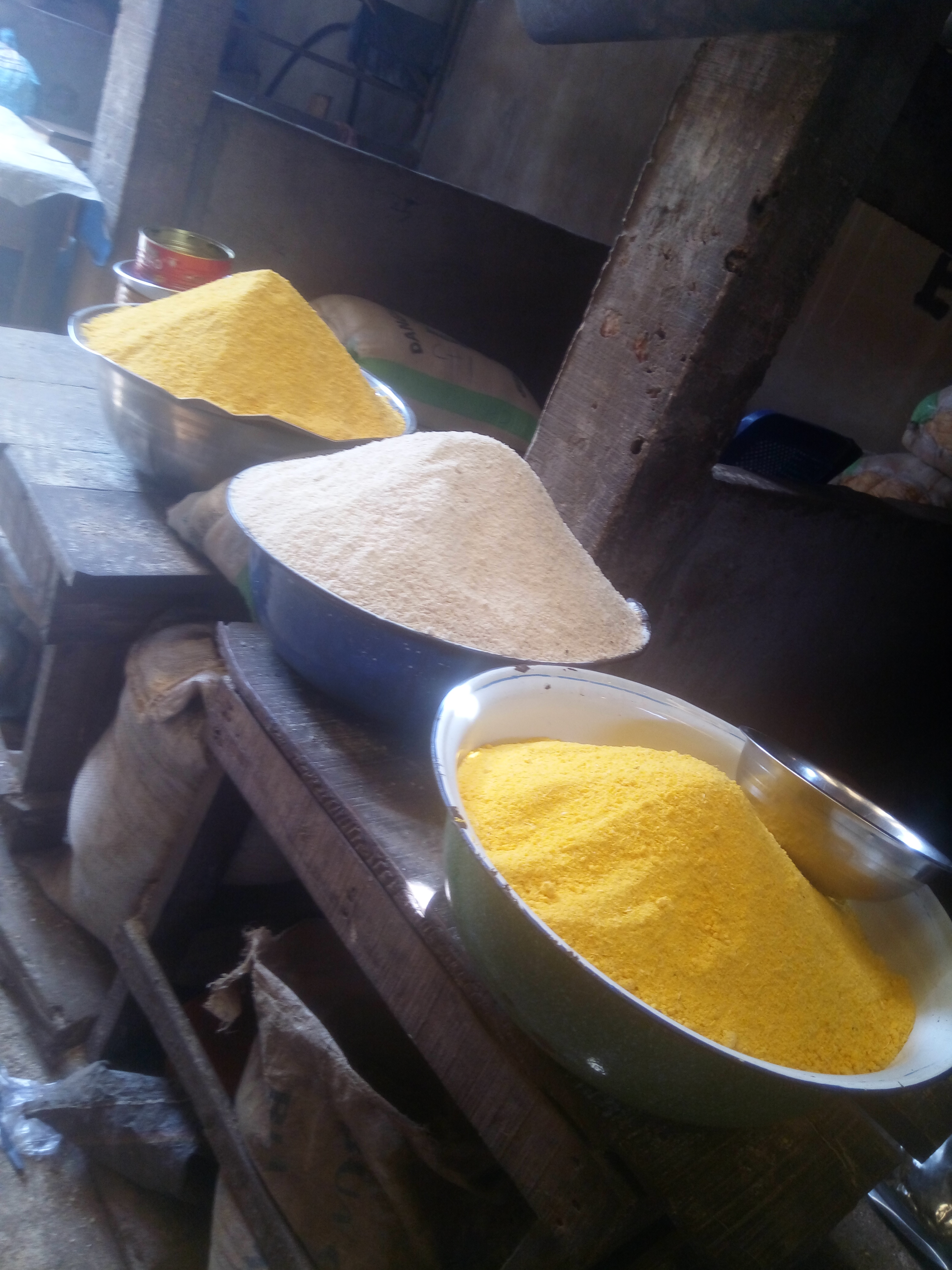
Garri moved higher across all three varieties tracked. A paint of Garri (White) averaged ₦1,320 across ten markets, cheapest at ₦1,000 in Oyingbo Market and priciest at ₦2,000 in Ajah Market. Garri (Ijebu) averaged ₦1,275 across four markets, and Garri (Yellow) averaged ₦1,511 across nine markets.
Medium Sized Eggs averaged ₦5,560 per crate across ten markets, cheapest at ₦4,000 in Ile-Epo Market and priciest at ₦6,500 in Agbalata Market. Medium Sized Yam recorded the week's most dramatic move, with a mean of ₦3,055 per tuber across ten markets, cheapest at ₦2,150 in Ile-Epo Market and priciest at ₦3,500 in Mile 12 Market.
The Week's Biggest Increases
Garri (White) posted the largest mean increase of the week, rising 4.2% from ₦1,267 to ₦1,320 across ten markets. Beans (Drum) in the derica size followed with a 2.3% rise from ₦967 to ₦989 across nine markets. Garri (Ijebu) rounded out the list of moves of 1% or more, up 1.2% from ₦1,260 to ₦1,275 across four markets.
The Week's Biggest Decreases
Medium Sized Yam led all declines by a wide margin, falling 9.6% from ₦3,380 to ₦3,055 across ten markets. Imported Rice (Long Grain) recorded declines across every format tracked, down 3.8% in the 25kg bag from ₦29,688 to ₦28,562, down 3.5% in the derica from ₦1,062 to ₦1,025, and down 3.2% in the 50kg bag from ₦58,812 to ₦56,938. Medium Sized Eggs fell 3.1% from ₦5,740 to ₦5,560. Imported Rice (Short Grain) in the derica size dropped 2.8% from ₦978 to ₦950, and Beans (Oloyin) in the derica size fell 2.1% from ₦1,078 to ₦1,056. Smaller declines of 1% or more were recorded in Beans (Drum) paint, down 1.5% to ₦4,256, Imported Rice (Long Grain) paint, down 1.5% to ₦5,081, and Imported Rice (Short Grain) paint, down 1.1% to ₦4,700.
What's Driving The Moves
The clearest way to read this week is to sort the basket by how each item reaches Lagos, because two macroeconomic events landed in the same seven days and pulled in opposite directions.
Goods arriving by sea got cheaper. Nigeria cut its import duty on bulk rice above 5kg from 70% to 47.5%, and on broken rice from 70% to 30%, with effect from 1 July 2026, three weeks before this survey period. Milling Middle East and Africa reported the change from Nigerian fiscal policy documents seen by Platts. On top of that, the naira strengthened through the survey week itself, closing at ₦1,367.76 to the dollar on Thursday 24 July against ₦1,380.10 on the Monday, a week-on-week gain of ₦18.19 at the official window according to Central Bank of Nigeria data reported by Daily Post. A lower duty and a stronger naira both reduce the landed cost of imported rice, and both showed up in the same direction this week.
Goods arriving by road got dearer. Dangote Petroleum Refinery raised its ex-depot gantry price for petrol to ₦1,215 per litre on 22 July, up from ₦1,075, an increase of 13.02% reported by Punch, and NNPC lifted its Lagos pump price to ₦1,300 per litre on 21 July, as Brent crude moved above $100 on renewed hostilities in the Middle East. Garri, beans and yam all travel into Lagos by truck from producing regions. Vanguard reported in April 2026 from Ile-Epo Market, one of the ten markets in this survey, on exactly that transmission, with a market leader describing how traders sourcing from northern and neighbouring states absorb rising haulage costs and pass them on at the stall.
The single strongest piece of evidence for this reading is inside the survey itself. Nigerian Manufactured Rice held flat this week while every format of imported rice fell. Same commodity, same markets, same seven days. The difference between them is exposure to import costs, which is precisely what the tariff cut and the naira move affected.
The monetary backdrop did not change. The Central Bank of Nigeria's Monetary Policy Committee held the policy rate at 26.5% at its 306th meeting on 20 and 21 July, with Governor Olayemi Cardoso citing heightened global uncertainty from Middle East hostilities. Headline inflation had eased marginally to 15.91% in June from 15.93% in May, but food inflation accelerated to 3.75% month on month from 2.98%, and the NBS named garri and cowpeas among the items behind that increase, which is consistent with the garri and Beans (Drum) rises recorded here.
Two moves do not fit the frame. Medium Sized Yam fell 9.6% in a week when road transport costs rose, and yam is road-hauled. Every 2026 report located has yam prices climbing, in Lagos in April and in Enugu as recently as early July. The most likely explanation is seasonal, since Nigeria's new yam harvest reaches markets from around August, but nothing yet confirms early harvest volumes have arrived in Lagos. The 3.1% egg decline is similarly unexplained, running against a year of reporting on rising farm gate prices and a day-old chick shortage. Both are flagged here rather than explained away, and both should be clearer after two more surveys.