Lagos food markets recorded their sharpest monthly price corrections in recent memory this February, with sweet potatoes plunging 81.49%, pepper (rodo) falling 68.86%, and onions dropping 54.29% in a single month — a dramatic reversal from the steady inflation that defined much of 2025.
But buried in the deflation is a warning: beans prices are surging in the opposite direction, with Oloyin beans at derica measure jumping 48.35% in February alone — the highest single-item increase on the tracker.
The February Deflation Wave
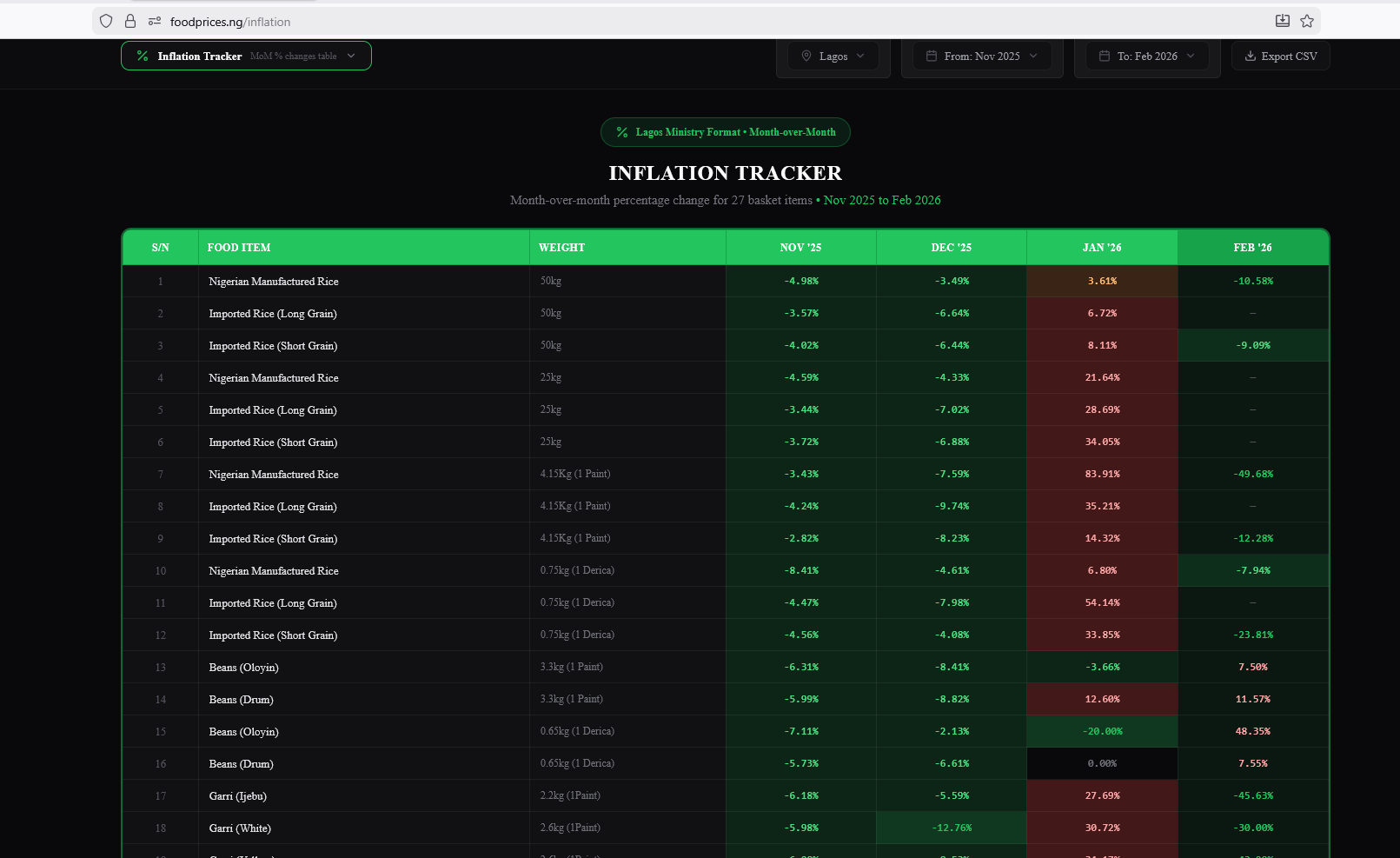
FoodPrices Nigeria's Inflation Tracker, which monitors month-over-month percentage changes for 27 basket items across Lagos markets, reveals a sweeping correction across nearly every major food category in February 2026.
Vegetables led the collapse. Tomatoes fell 51.28% after months of elevated pricing, while pepper (rodo) crashed 68.86% — erasing months of accumulated increases. Tatashe dropped a more modest 3.56%, though shombo bucked the trend with an 11.90% increase.
Tubers saw the most dramatic single drop on the entire tracker. Sweet potatoes collapsed 81.49% month-over-month after January had already seen a 204.76% year-over-year price level — suggesting the January spike was a short-lived supply shock that corrected violently in February.
Garri prices fell sharply across all three varieties. Garri Ijebu dropped 45.63%, Garri Yellow fell 43.29%, and Garri White declined 30.08% — a broad correction after January showed all three varieties trading 27–34% above their baselines.
Rice showed mixed but broadly downward movement. Nigerian Manufactured Rice at the paint measure dropped a staggering 49.68%, while 50kg bags of both Nigerian (-10.58%) and imported short grain (-9.09%) rice posted meaningful declines. Several imported rice categories showed no February data, which may indicate supply disruptions or measurement gaps.
Beans: The Outlier Going the Wrong Way
Against this backdrop of falling prices, beans emerged as the clear contrarian. Every beans measurement on the tracker posted increases in February:
Beans Oloyin (1 Derica): +48.35%
Beans Drum (1 Paint): +11.57%
Beans Oloyin (1 Paint): +7.58%
Beans Drum (1 Derica): +7.55%
This follows a pattern visible across the four-month window. While most items swung between inflation and deflation, beans have shown persistent upward pressure since December, when both varieties posted 6–8% declines at the paint level. By January, drum beans at paint measure had already climbed 12.60%, and Oloyin at derica had fallen 20% — but February's 48.35% spike at the derica level suggests tightening supply at the retail end of the market.
The divergence between paint-level and derica-level pricing is worth noting: smaller retail measures are inflating faster than bulk quantities, a pattern that typically signals supply constraints filtering down to consumers while wholesale channels still have some buffer.
Eggs Hold Steady, Yam Data Missing
Medium-sized eggs showed a modest 3.57% increase — relatively stable compared to the volatility elsewhere. Eggs had posted near-zero movement in November (0.88%) and a slight decline in December (-0.91%), suggesting this is one of the more price-stable proteins in the basket.
Medium-sized yam showed no February data after a January reading of 12.82%, a gap that may reflect seasonal transition as stored yam inventories thin before the new harvest cycle.
The Four-Month Trajectory
Zooming out across the November 2025 to February 2026 window reveals a clear pattern: January was the inflationary peak, and February brought aggressive correction.
In January, onions had surged 120.40%, sweet potatoes 204.76%, and pepper (rodo) 50.26%. Nearly every item on the tracker showed double-digit January increases. February then reversed the majority of these gains — and in many cases overcorrected.
This boom-and-bust pattern is characteristic of Nigerian food markets where supply chains are seasonal and storage infrastructure remains limited. January's post-holiday demand spike meets constrained supply; February's correction comes as new harvests enter markets and demand normalizes.
What This Means for Consumers
The headline numbers look like relief — and for many households, they are. A family buying tomatoes, garri, and sweet potatoes in February is paying dramatically less than they were in January.
But the beans signal deserves attention. As one of Nigeria's primary protein sources, rising beans prices at the retail level could offset savings elsewhere in the food basket. If the derica-level spike is a leading indicator of broader beans inflation, March could see further pressure on what many Nigerian households consider a non-negotiable staple.
For traders and market participants: The February correction creates buying opportunities in items that overcorrected, but the velocity of the drop — particularly the 81% sweet potato decline — suggests these prices may find a floor quickly as arbitrage traders respond.
For policymakers: The four-month data underscores the volatility problem. Month-over-month swings of 50–200% in either direction make planning nearly impossible for households and businesses alike. The case for better market infrastructure, cold storage, and supply chain visibility has never been clearer.
Data source: FoodPrices Nigeria Inflation Tracker — Lagos Ministry Format, Month-over-Month. Tracking 27 basket items across Lagos State markets, November 2025 to February 2026. Visit foodprices.ng/inflation for the full interactive dataset.
Tags: food-prices, inflation, lagos, markets, beans, rice, garri, vegetables, analysis