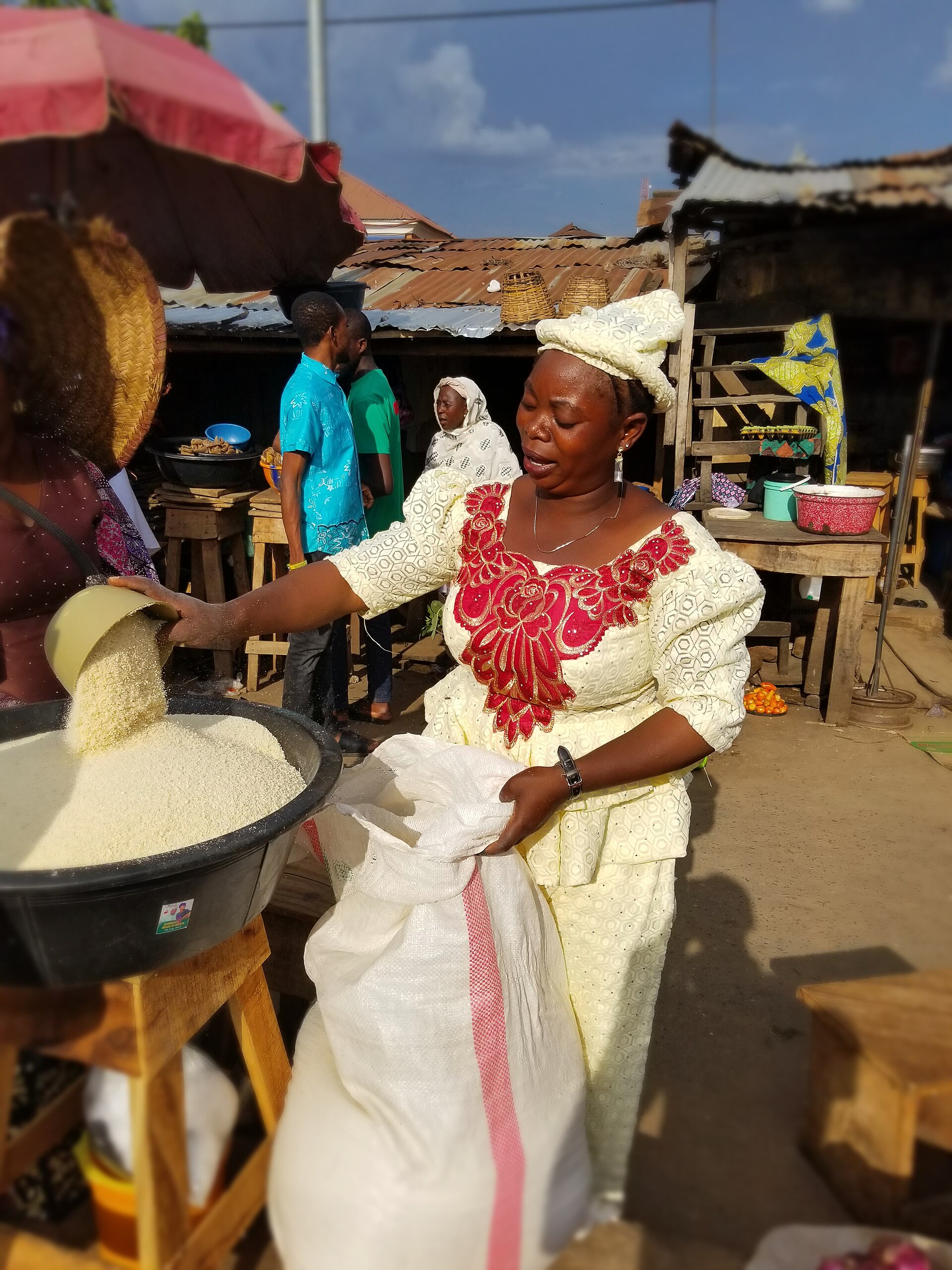
Garri (White) carries two different prices in Lagos this week, and the dividing line is the lagoon. The Ministry of Agriculture and Food Systems market survey for the week of 17 July 2026 recorded Garri (White) at ₦2,000 per paint at Ajah Market, while the mainland markets in the same survey averaged ₦1,175. That gap is a 70% premium for the same staple on the Ajah and Lekki side of the city. Nine markets reported a price this week, and the Lagos average settled at ₦1,267.
Ajah Sets the Ceiling at ₦2,000
Ajah is the only market on the island axis that returned a Garri (White) price in this survey week, so the island figure of ₦2,000 rests on that single quote. Lekki-Jakande, the other market on that axis, did not report. What the ₦2,000 does establish is how far the island sits from everything else in the survey. It stands 57.9% above the Lagos average of ₦1,267 and 53.8% above the ₦1,300 recorded at Mushin Market, Sabo Market Yaba and Agbalata Market, which are the three most expensive mainland markets on the list.
The Mainland Ladder Runs From ₦1,000 to ₦1,300
On the mainland the pricing is tight. Fresh Food Hub Mushin and Oyingbo Market both hold the floor at ₦1,000. Epe Main Market follows at ₦1,100, then Mile 12 Market and Agege Market at ₦1,200 each, before the ₦1,300 tier closes the mainland out. The entire mainland band is ₦300 wide, a 30% climb from the cheapest quote to the dearest. Crossing to Ajah adds a further ₦700 on top of that ₦1,300 ceiling, which is why the mainland average of ₦1,175 lands 7.3% below the citywide figure.
The Full Spread Is Exactly Double
Measured end to end, the survey shows a ₦1,000 spread on a product whose cheapest quote is itself ₦1,000. Ajah Market is 100% dearer than Fresh Food Hub Mushin for one paint of the same white garri. Few staples tracked in Lagos produce a clean doubling across a single week's survey, and none of the intermediate markets fill the space between ₦1,300 and ₦2,000.
Prices Are Rising Again, but From a Lower Base
The Lagos average moved from ₦1,222 in the prior survey to ₦1,267 this week, a 3.6% rise. The month is steeper. Four weeks ago the average stood at ₦1,083, so the product has gained 16.9% in roughly a month. The longer view runs the other way. On 9 January the Lagos average was ₦1,625, which puts current prices 22.1% below where the year started. Buyers watching the recent climb are still paying less than they did in January, though the trend inside the past four weeks has been consistently upward.
What the Premium Costs a Household
Nigeria's minimum wage is ₦70,000 a month. Buying a paint of Garri (White) at Fresh Food Hub Mushin rather than Ajah Market saves ₦1,000, which is 1.4% of that monthly wage on a single purchase of one of the cheapest items in the kitchen. For households on the island axis without a practical route to a mainland market, that 70% premium is not a shopping choice. It is a fixed cost of location.
The Other Garri Grades Are Closer Together
In the same survey week the Ministry of Agriculture and Food Systems recorded Garri (Ijebu) at an average of ₦1,260 per paint and Garri (Yellow) at ₦1,505, against the Garri (White) average of ₦1,267. That places the Ijebu grade 0.6% below the white average and the yellow grade 18.8% above it. Grade therefore matters less to the final price than geography does. The step from white to yellow garri costs a Lagos household less than the step from the mainland to Ajah.
FoodPrices Nigeria will keep tracking whether the island premium on garri narrows in the coming surveys or hardens into a standing feature of the market. Live prices: foodprices.ng/real-time-prices