
This has not happened. China has not blockaded Taiwan. Nothing in this article is a report of events, a prediction that they will occur, or a forecast of prices.
What follows is a scenario, the kind of exercise a war-gamer or an insurer runs. It asks a single question. If the Taiwan Strait closed, how would that reach the price of food, and roughly how much would it move?
Two kinds of number appear below and they are kept strictly apart. Prices that exist today are observed and come from World Food Programme market data. Prices after the shock are modelled, meaning FoodPrices Nigeria chose a multiplier, wrote it down in plain sight, and applied it. Those figures are illustrative. They are not predictions and nobody should trade on them.
The short answer
On the assumptions set out below, a kilogramme of rice moves from a world median of $1.19 to somewhere between $1.37 and $1.67. Imported rice moves from $0.91 to between $1.05 and $1.27. Vegetable oil moves from $2.10 to between $2.35 and $2.84.
Those are increases of roughly a tenth at the low end and up to two fifths at the high end, arriving not in the week of a blockade but over the following season.
Why a strait near Taipei touches a Nigerian plate
The chain has three links, and none of them involves a bomb landing on a farm.
The first is shipping. The Taiwan Strait is one of the busiest waterways in the world. Bloomberg's count for the first seven months of 2022 found that just under half of all container ships passed through it, and among the largest tenth of the world fleet by tonnage the figure was 88%. Closing it would not sink the world's food. It would reroute it, lengthen voyages, and above all reprice marine insurance, which is the fastest-moving cost in shipping and the one that moves before any cargo does.
The second link is fertilizer, and this is where the argument has to be careful, because the obvious version of it is wrong.
China makes roughly 30% of the world's urea. It exports only about 10% of the world's traded urea, because it consumes most of what it makes. On phosphates the pattern repeats: China supplied around 16% of world MAP exports in 2024.
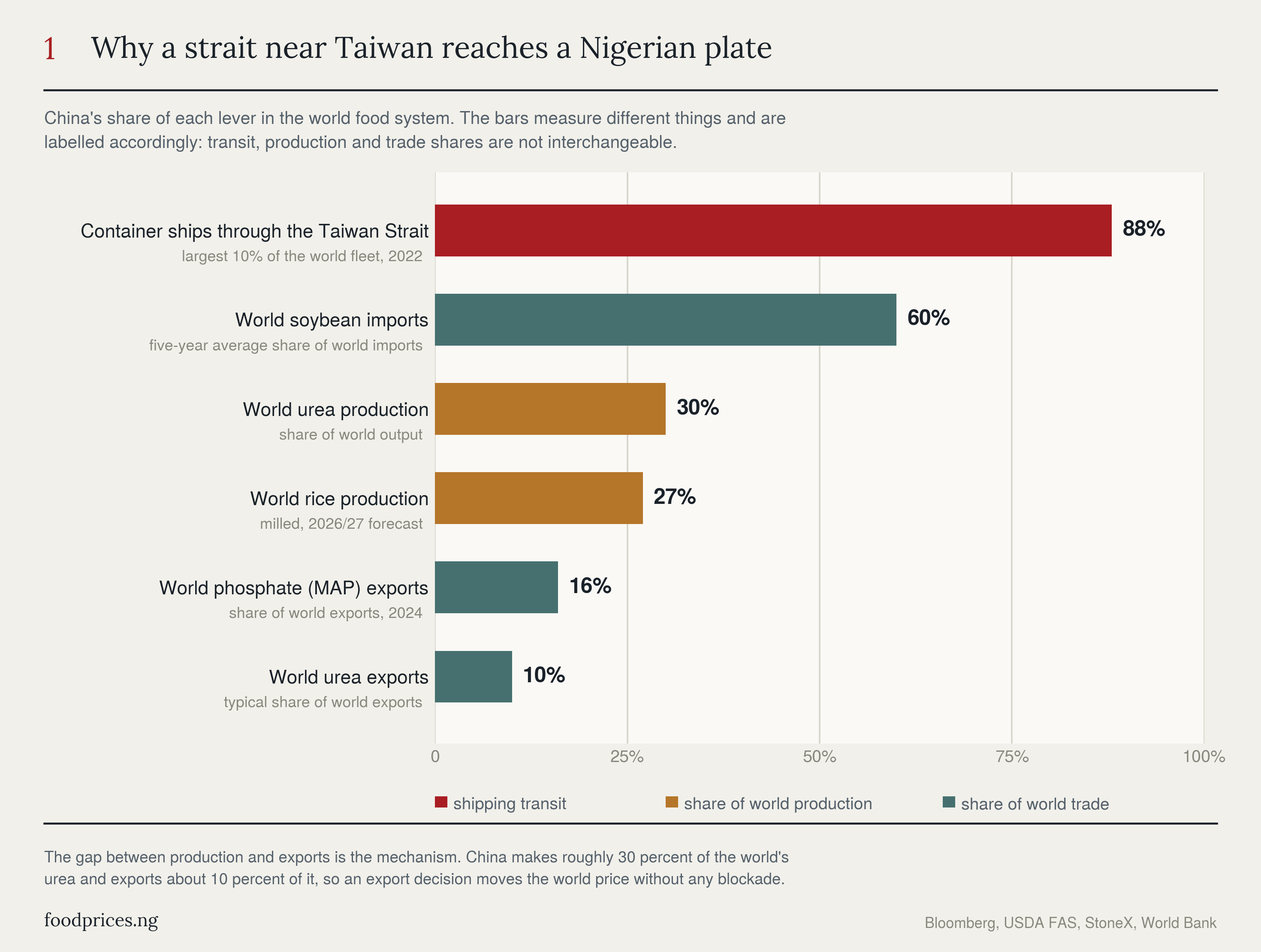
Read carelessly, those smaller export numbers look like good news. They are not, and the reason is the gap between the two figures. A country that produces a great deal and exports a little is a swing supplier, and a swing supplier moves world prices by deciding, not by running out. This has already been tested. In the first half of 2024 China's phosphate exports fell about 60% and its urea exports fell around 90%, on government policy to hold domestic prices down, and world fertilizer prices rose accordingly. No blockade was required.
Fertilizer is not next week's food. It is next season's harvest, and it is the link that reaches farmers who have never heard of the Taiwan Strait, in Nigeria as much as anywhere.
The third link is China's weight as a buyer. It takes around 60% of the world's traded soybeans and grows about 27% of the world's rice. A China cut off from its own imports does not stop eating. It bids, and it bids against everyone else.
How the shock actually travels
Oil is the transmission line. Freight rates, fertilizer manufacture and the cost of trucking grain inland all key off it.
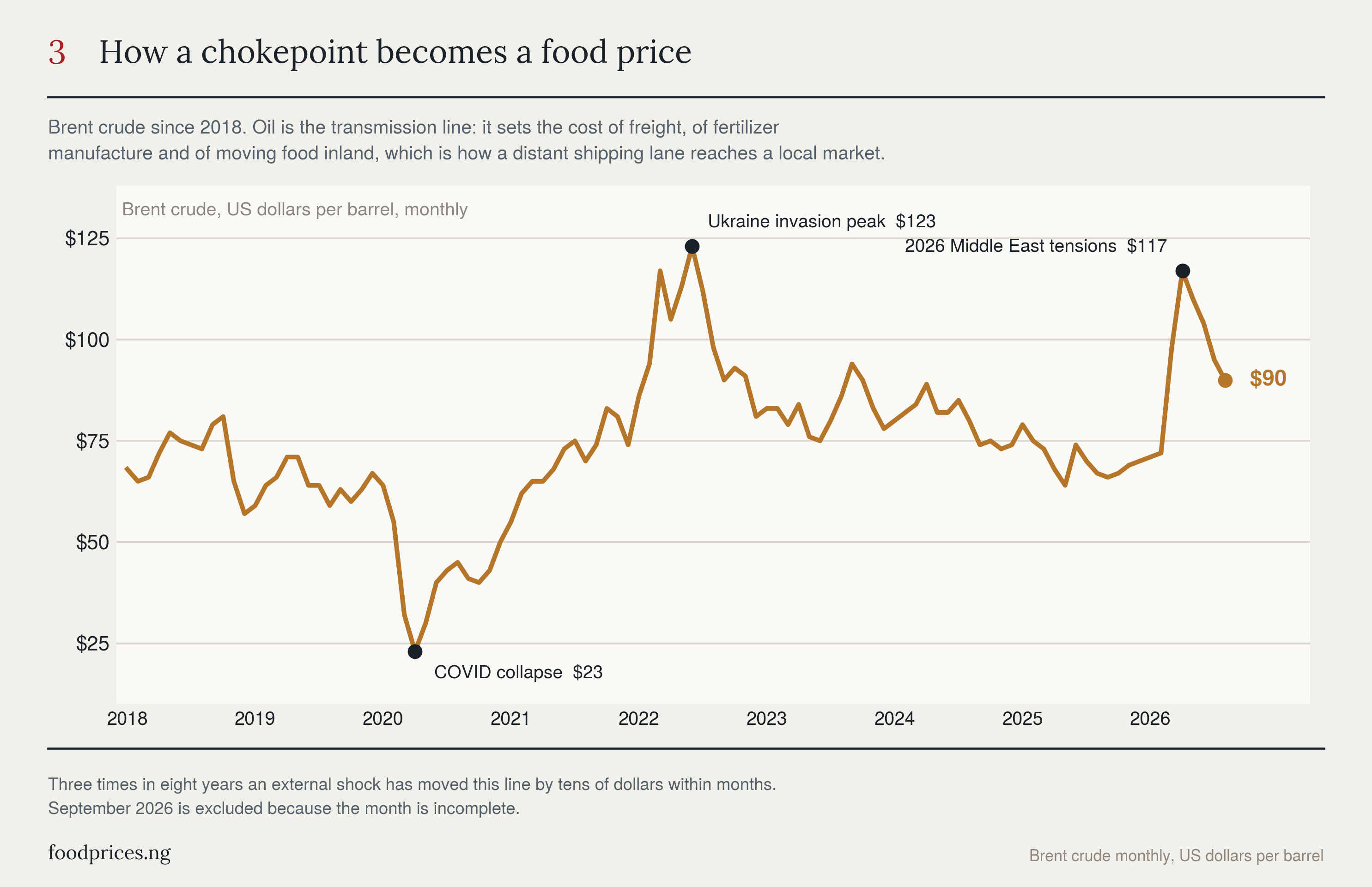
The record shows how fast this line moves. Brent fell to $23 in April 2020 when demand collapsed, reached $123 in June 2022 after the invasion of Ukraine, and touched $117 in April 2026 during Middle East tensions. Three times in eight years an external event has moved the cost of moving everything, by tens of dollars, within months.
That is the honest basis for the scenario. Not a model of Chinese naval doctrine, but an observation that chokepoint events reprice energy quickly, and food follows energy with a lag.
The starting line, and the model
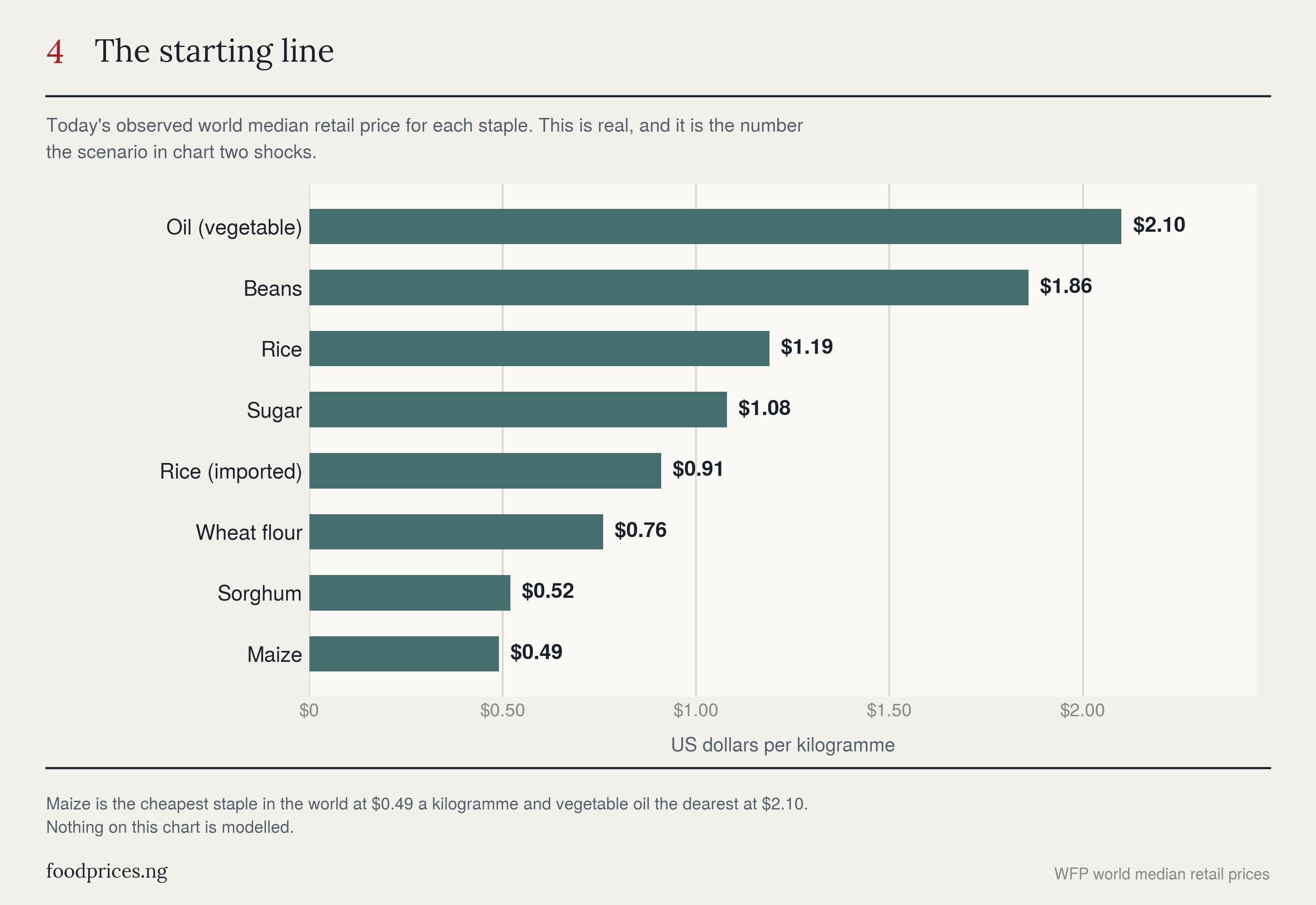
Everything above is real. Maize is the world's cheapest staple at $0.49 a kilogramme, vegetable oil the dearest at $2.10.
Now the modelled part, and the assumptions in full. Rice carries the largest band, +15% to +40%, because it is the most traded staple in this basket and the most exposed to freight and to Asian supply. Vegetable oil takes +12% to +35%, being both traded and energy-intensive to process. Grains take +10% to +30%. Sugar and beans take +8% to +25%, because more of what the world eats of them is grown near where it is eaten.
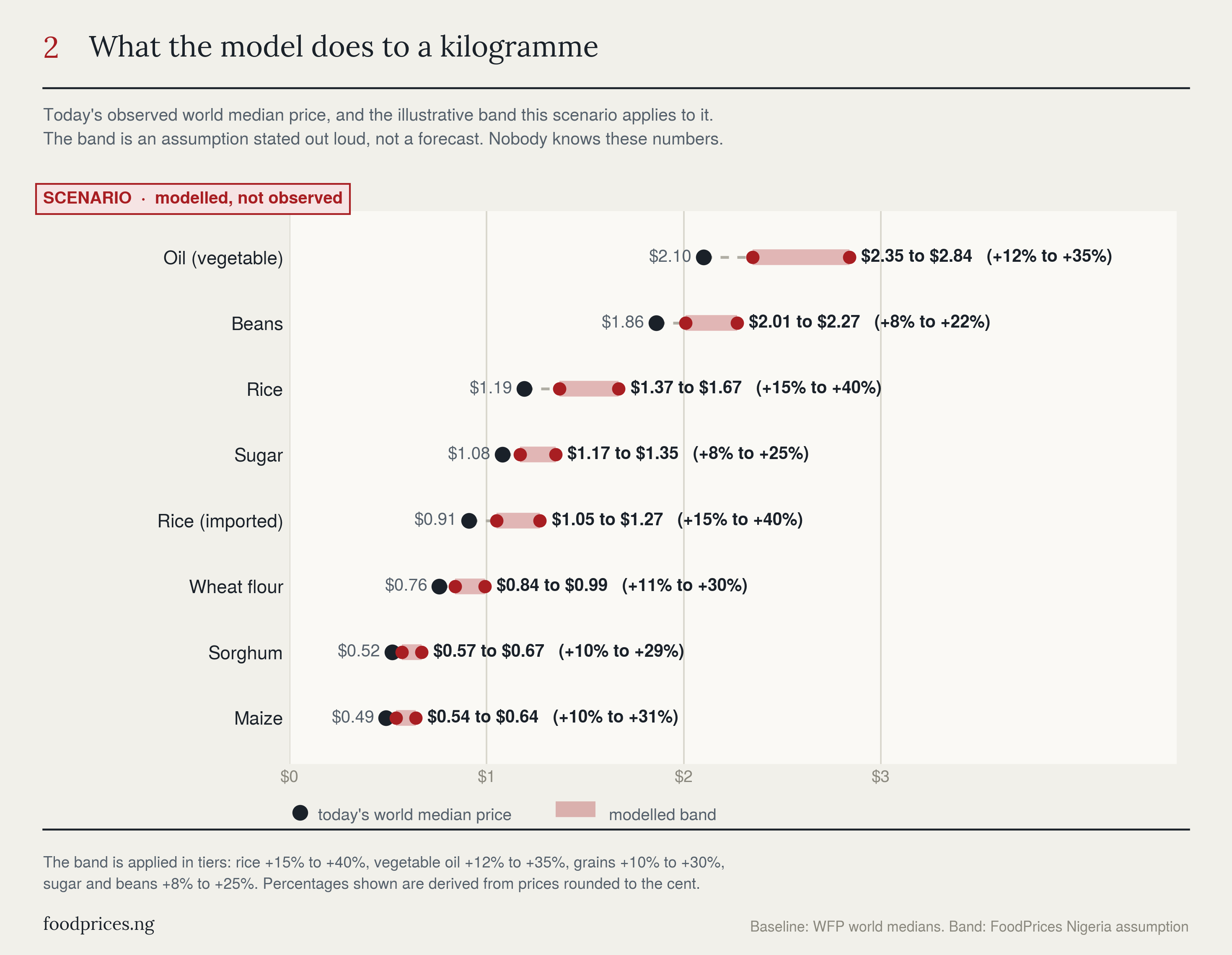
Those multipliers are judgement, not measurement. A reader who thinks rice would move less should halve the band and the article will not argue. The point of publishing the assumption is that it can be argued with.
What it would mean in West Africa
Nigeria sits in the exposed category twice over.
It imports rice, so the freight and insurance link lands directly. On the band above, a kilogramme of imported rice at a world median of $0.91 would carry between fourteen and thirty-six cents more, before any naira movement, and a currency under pressure would multiply rather than absorb that.
It also imports fertilizer and the gas-derived inputs behind it, so the second link lands a season later, on domestic maize, sorghum and rice harvests. That is the more serious of the two, because it is slower, it is harder to see coming, and it is not fixed by finding a different shipper.
What the model leaves out, and it is the big one
The largest omission is not shipping or fertilizer. It is panic.
In both 2008 and 2022, the sharpest price moves in world food markets came not from the original shock but from what governments did next. Producing countries banned exports to protect their own consumers, each ban was rational on its own, and together they removed supply from a market already short of it. India's restriction on white rice exports in 2023 lifted the world rice index to a fifteen-year high within a single month, and no ship had been blocked anywhere.
A Taiwan blockade would create exactly the conditions for that reflex. If it happened, the bands in this article would be too low, possibly by a wide margin, because the model prices a supply disruption and not a policy cascade. That is a limitation worth stating plainly rather than burying, and it is the reason the high end of each band should be read as a floor for a bad case rather than a ceiling.
What would blunt it
A scenario that only models the damage is propaganda. Three things would push the other way.
Strategic reserves would absorb the first months. India holds very large rice stocks, and China's own reserves, discussed elsewhere in this publication, are precisely the buffer a blockading country would draw on rather than release.
Suppliers would substitute. Fertilizer flows already rerouted around Chinese export controls in 2024 and 2025, towards Morocco, Saudi Arabia, Russia and Egypt at higher cost but not at zero supply. Rice exporters outside Asia would gain.
And demand destruction is real, if grim. When prices rise, poor households buy less and eat worse, which caps the price rather than the harm. A model that shows a 40% price rise is describing a market clearing, not a famine, and the two are not the same thing.
How we worked it out
Observed figures are World Food Programme world median retail prices in US dollars per kilogramme, and monthly Brent crude. September 2026 is excluded from the oil chart because the month is incomplete.
Modelled figures apply a stated percentage band to each observed baseline. There is no simulation, no elasticity estimate and no supply model behind them. They are transparent assumptions, chosen to be defensible and easy to challenge, and the same method this publication used for its Strait of Hormuz piece.
Public shares were verified before publication rather than taken from the brief. The shipping figure is Bloomberg's, for the largest tenth of the container fleet over the first seven months of 2022. Rice production is USDA's 2026/27 forecast. Soybean import share is a five-year average. The fertilizer figures were corrected during fact-checking and are discussed in the article.
Nigerian prices are live and checkable at foodprices.ng. Analysis by FoodPrices Nigeria.
Questions readers ask
Is this a prediction? No. It is a scenario. The blockade has not happened and this article does not claim it will. The modelled prices are assumptions written down openly so readers can disagree with them.
Where do the percentages come from? From us. They are judgement calls, applied in tiers: rice +15% to +40%, vegetable oil +12% to +35%, grains +10% to +30%, sugar and beans +8% to +25%. They are not derived from a supply model and should not be quoted as forecasts.
Isn't the fertilizer link weaker than people claim? On export share, yes, and this article corrected that figure rather than repeating it. China exports around 10% of the world's traded urea, not 30%. But it produces roughly 30%, and the gap is the risk: a producer that large can move world prices by changing policy, which it did in 2024.
How would Nigeria be affected? Twice. Imported rice would cost more almost immediately through freight and insurance. Domestically grown staples would cost more a season later through fertilizer. The second effect is slower and harder to see coming.
What would stop it getting worse? Strategic reserves, alternative fertilizer suppliers, and demand destruction. The last of those caps the price by making people eat less, which is not a solution so much as the shape of the damage.