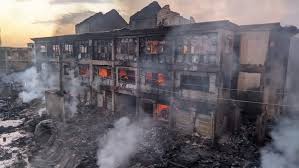
A catastrophic fire has torn through Singer Market in Kano — the biggest commodity market in Kano and northern Nigeria — destroying properties and goods estimated at over ₦5 billion, killing at least seven people, and decimating more than 1,500 shops in what market leaders are calling the worst tragedy in the market's history.
According to Channels Television, the blaze reportedly started at about 4:00 p.m. on Saturday in the Gidan Gilas section of the market and continued to burn late into the night, with emergency responders from the Kano State Fire Service, supported by the Federal Fire Service and private organisations, battling the inferno for several hours as traders scrambled to salvage their goods.
The Chairman of the Singer Market Development Association, Alhaji Junaid Zakari, speaking to the News Agency of Nigeria and in a separate exclusive interview with SolaceBase, described the devastation in stark terms. He disclosed that more than 1,500 shops, containers, and makeshift stalls used by small-scale traders were completely razed. Four multi-storey commercial buildings housing hundreds of individual businesses were gutted, and goods, equipment, and valuables were burnt beyond recovery.
"The affected area contains a large concentration of goods. Based on our preliminary assessment, over 1,500 shops and small containers were burnt. We estimate that properties worth more than ₦5 billion have been lost," Zakari told SolaceBase. He confirmed that seven people had died as of the time of reporting, with investigations ongoing into the circumstances surrounding their deaths.
BusinessDay reported that the mid-day inferno sent thick black smoke across large parts of the metropolitan city, triggering panic among traders and residents who had only recently begun recovery efforts from a previous blaze. The market serves as a major distribution centre for sugar, flour, and bottled drinks across northern Nigeria, meaning this fire represents a significant disruption to supply chains far beyond Kano.
"We just saw smoke coming from the roof. Before we could bring water, the wind pushed the fire to the next shop and everything got out of control," a trader identified as Malam Sani told BusinessDay. Another shop owner, Alhaji Isa Abubakar, told SolaceBase that he personally lost goods worth over ₦200 million.
Daily Trust noted that Singer Market (also referred to as Singa Market) is the biggest commodity market in the whole of northern Nigeria, supplying provision wares and foodstuff to most northern states and some neighbouring West and Central African countries. The destruction of large volumes of food commodities and household goods at this scale could create temporary supply shortages and price spikes in surrounding markets across the region.
Firefighters faced significant difficulty accessing the scene due to narrow passageways and dense rows of stalls, according to BusinessDay. Security operatives from the Nigeria Police and the Nigeria Security and Civil Defence Corps were deployed to maintain order and prevent looting. Preliminary indications suggest a possible electrical fault, but officials confirmed that a full investigation will commence after cooling operations are completed.
What makes this disaster particularly alarming is that it is the second major fire at the same market in less than two weeks. Channels Television reported that an earlier blaze on February 2 destroyed goods worth billions of naira along Bello Road, affecting sections including Gidan Mazaf, Gidan Taki, and Gidan Katsinawa, where large quantities of soap, detergent, and cooking oil were lost. Following that earlier disaster, political figures including Rabiu Kwankwaso and Peter Obi visited the market to express solidarity with victims.
Governor Abba Kabir Yusuf visited the scene on Saturday night while the fire was still raging and called on the Federal Government to urgently provide modern firefighting equipment, including aerial support and advanced emergency response tools. According to Voice of Nigeria, the governor described the repeated outbreaks as "a matter of national concern," given the strategic role of markets in sustaining livelihoods and supporting the country's informal economy.
President Bola Tinubu responded on Sunday, ordering a comprehensive investigation into the causes of the market fires. According to Punch, the President had earlier contacted Governor Yusuf for a situation report. Presidential media aide Bayo Onanuga stated that "the President was particularly alarmed that the latest incident came less than two weeks after another fire destroyed dozens of shops and property at the same market."
LEADERSHIP reported that the fire started at around 4:15 p.m. on Saturday evening and raged for over 18 hours, with firefighters working tirelessly throughout.
For food price watchers, the repeated destruction of critical trading infrastructure in northern Nigeria's largest commercial city is a major concern. Markets like Singer serve as critical nodes in the food distribution network, connecting producers in the North with consumers across multiple states and even neighbouring countries. When a distribution hub of this magnitude suffers consecutive disruptions, the ripple effects — from wholesale price increases to temporary shortages of staple commodities — tend to spread outward across the entire northern market system. This is a story we will continue to monitor closely as its impact on food commodity prices becomes clearer in the coming weeks.