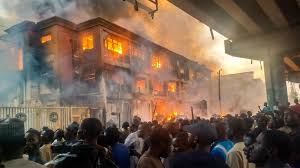
The Federal Government has announced a combined ₦8 billion relief package for traders affected by the devastating fire at Kano's Singer Market, even as the Federal Fire Service confirmed that a solar battery explosion was responsible for the inferno that destroyed properties worth over ₦5 billion, razed more than 1,500 shops, and left at least seven people missing.
Vice President Kashim Shettima, who led a high-powered Federal Government delegation to Kano on Monday, announced that President Bola Tinubu had approved ₦5 billion as direct federal intervention to support affected traders. According to Daily Post, Shettima described the fire as a "painful setback" for the business community and assured traders that the government would work with relevant agencies to prevent future occurrences. "President Bola Ahmed Tinubu has approved the sum of N5 billion to support traders affected by the Singer Market fire. The Federal Government stands with you in this moment of hardship and will continue to provide the necessary support," Shettima said during the visit.
In a related development, the All Progressives Congress governors, under the Progressive Governors' Forum (PGF), announced an additional ₦3 billion in support. According to Punch, PGF Chairman and Imo State Governor Hope Uzodimma announced the contribution alongside the Vice President. "Together, we have collectively contributed N8bn to the victims of the fire disaster," Shettima said, adding that the Federal Government stands with the affected traders in their moment of hardship.
The Kano State Government expressed appreciation for the intervention. According to PRNigeria, the State Commissioner for Information and Internal Affairs, Comrade Ibrahim Abdullahi Waiya, described the financial support as "a remarkable demonstration of empathy, national solidarity, and responsive leadership that transcends political divides." He noted that Governor Abba Kabir Yusuf's administration has assured traders and stakeholders that the funds will be managed with transparency and accountability, working closely with market unions and relevant security agencies to ensure that verified victims are the primary beneficiaries of the relief package.
The commissioner also praised the gesture from APC governors — particularly notable given that Kano has been governed by the New Nigeria People's Party (NNPP). However, the political dimension of the visit became clearer when, shortly after the market visit, Governor Yusuf was formally received into the APC fold. ThisDay reported that five APC governors — Hope Uzodimma (Imo), Nasir Idris (Kebbi), Uba Sani (Kaduna), Umar Namadi (Jigawa), and Dikko Radda (Katsina) — were present to show support. Governor Yusuf received the party's flag at a grand reception at the Sani Abacha Stadium, pledging to carry everyone along.
Meanwhile, the actual cause of the fire has now been established. According to Saga Gist, the Federal Fire Service confirmed on Monday that a solar battery explosion was responsible for the blaze. Al-Hassan Kantin, Public Relations Officer of the Kano State Command of the Federal Fire Service, disclosed this in an interview on Channels Television's 'Sunrise Daily' programme, noting that while fire outbreaks are not predictable, they are generally preventable.
This confirmation aligns with earlier eyewitness accounts. The Chairman of the Singer Market Development Association, Alhaji Junaid Zakari, had told Daily Post on Sunday that some witnesses believed the fire may have been caused by a problem with a solar power system or an electrical fault. He described the circumstances surrounding the outbreak: "The market was very crowded on Saturday, as it usually attracts many customers on weekends, especially with Ramadan approaching," he said, explaining that the fire started at a shop known as Gilas, located at a corner of the market, and spread rapidly, causing panic among traders and customers.
The scale of the destruction remains staggering. As reported in earlier coverage by SolaceBase, more than 1,500 shops, containers, and makeshift stalls were completely razed, along with four multi-storey commercial buildings housing hundreds of individual businesses. One shop owner, Alhaji Isa Abubakar, told SolaceBase that he personally lost goods worth over ₦200 million.
BusinessDay provided broader context for the economic significance of the disaster, noting that economic analysts say the destruction at Singer Market has implications beyond Kano, as the market plays a central role in the distribution of grains and other staple foods across several northern and central states. The losses are therefore likely to affect food supply chains, commodity prices, and the livelihoods of thousands of families dependent on the market. Several affected traders said they were yet to recover from a previous fire before the latest incident destroyed their shops and wiped out their remaining capital.
The previous fire, which struck the market on February 2, had already destroyed goods worth billions of naira along Bello Road, affecting sections including Gidan Mazaf, Gidan Taki, and Gidan Katsinawa. The fact that Singer Market suffered two devastating fires within two weeks prompted serious questions about market safety infrastructure. Channels Television had reported that Governor Yusuf, who visited the scene on Saturday night while the fire was still raging, called on the Federal Government to urgently provide modern firefighting equipment, including aerial support and advanced emergency response tools, describing the repeated outbreaks as "a matter of national concern."
President Tinubu, in ordering the comprehensive investigation announced last Sunday, directed that the probe examine possible electrical faults, handling and storage practices for flammable goods, the adequacy of firefighting facilities, and broader compliance with market safety standards. According to Independent Newspaper, the presidential delegation also pledged to support Kano State in facilitating the quick reopening of the market, with temporary trading arrangements and reconstruction plans being considered.
The solar battery explosion finding raises a concern that extends well beyond Singer Market. As solar energy adoption accelerates across Nigeria — driven by unreliable grid power and falling costs of solar equipment — the risk of battery-related fires in densely packed market environments deserves serious regulatory attention. Markets across the country are characterised by tightly packed stalls, narrow passageways, limited fire access points, and high concentrations of combustible goods. Without proper installation standards, maintenance protocols, and fire safety awareness around solar battery systems, other markets could face similar disasters.
Leadership reported that the Kano State Government described the combined ₦8 billion intervention as timely and compassionate, with Waiya offering prayers for divine reward for the President and the contributing governors, and for protection against future disasters.
From a food supply perspective, the implications of Singer Market's repeated destruction remain significant. As northern Nigeria's largest wholesale hub for foodstuffs and essential commodities, Singer Market functions as a critical distribution node connecting agricultural producers with consumers across multiple states and even neighbouring Sahelian countries. Punch reported that the Vice President himself acknowledged this national significance, describing the fire as not merely a loss to Kano State but to the entire federation.
The ₦8 billion relief — while substantial — represents only a fraction of the estimated total losses. With properties and goods worth over ₦5 billion destroyed in the second fire alone, and billions more lost in the February 2 incident, the full economic impact on traders, their families, and the wider supply chain will take months to fully materialise. At FoodPrices, we will be monitoring commodity prices in northern markets closely in the coming weeks to assess whether the disruption to this critical distribution hub translates into price increases for staple commodities across the region. Markets of this scale do not simply bounce back overnight, and the temporary loss of a major wholesale centre during the pre-Ramadan restocking period — when demand typically surges — could create localised price pressures even as the national inflation trend continues to ease.