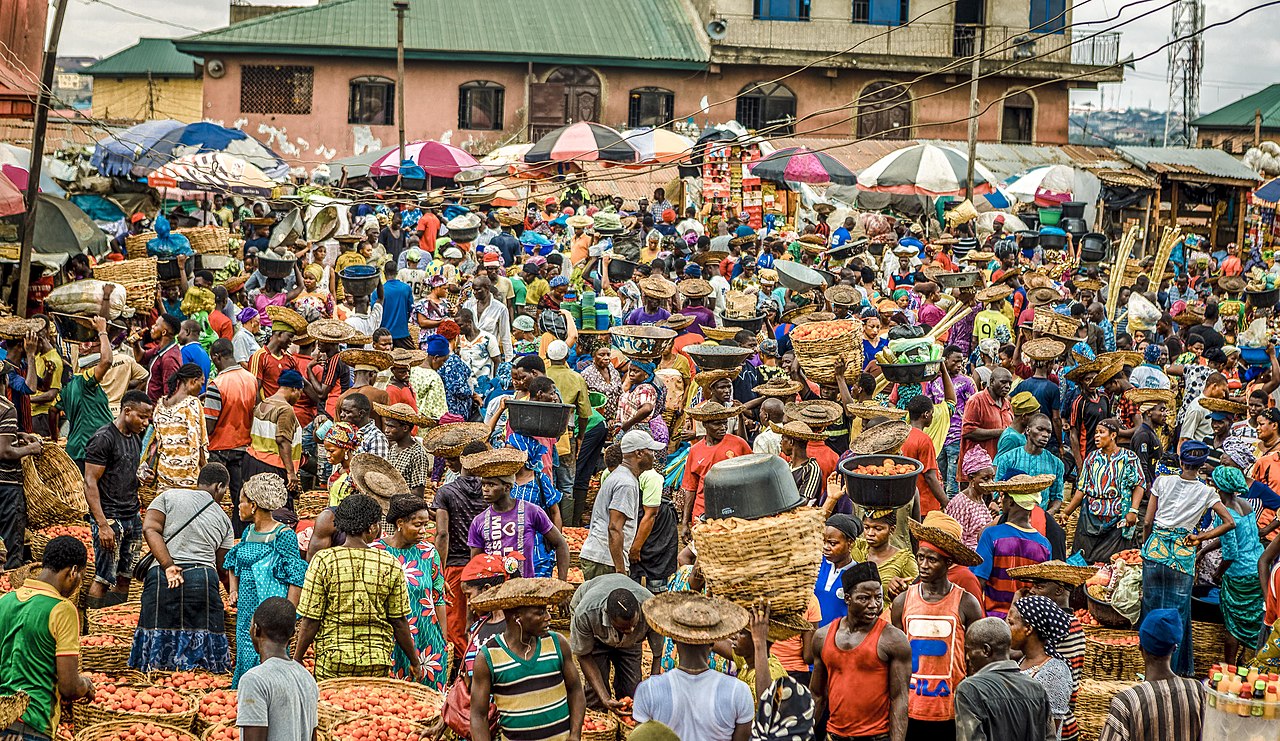
Lagos families heading to Mile 12 Market ahead of Eid al-Fitr will find meaningful relief on their core staples. Fresh price data collected by FoodPrices.ng market agents on March 19, 2026 shows a 50kg bag of Nigerian manufactured rice now selling for ₦54,000 — a 10% decline from the ₦60,000 recorded in our January survey. White garri has fallen 20% from ₦1,500 to ₦1,200 per paint bucket over the same period, and palm oil is down 15% at ₦8,500 per 5 litres. The easing comes as the Ramadan stockpiling frenzy that drove food inflation from 8.89% in January to 12.12% in February begins to unwind, though not every item is following the downward trend — medium-sized yam has surged 25% to ₦2,500 per tuber.
The rice market at Mile 12 is where households will see the most significant savings this Eid. Nigerian manufactured rice at ₦54,000 per 50kg bag sits well below the ₦61,000 Lagos average that BusinessDay's market surveys reported heading into Eid — a reflection of Mile 12's wholesale advantage as the city's largest food market. At the retail level, a paint bucket goes for ₦5,000 (down 5.7% from the prior reading) and a derica for ₦1,000. The 25kg bag sits at ₦27,000, making it the most accessible bulk option for smaller households. Tomato Aroso rice commands a premium at ₦60,000 per 50kg, ₦30,000 per 25kg, ₦5,500 per paint, and ₦1,100 per derica — roughly 10% above the standard manufactured rice across all unit sizes. For families planning Eid jollof, the manufactured rice at ₦1,080 per kilogram (based on the 50kg price) represents the best value at Mile 12 right now.
The garri story is one of sustained Q1 deflation, with a twist. Yellow garri — the most popular variety — is at ₦1,500 per paint bucket, down 25% from the ₦2,000 recorded in January. But within the latest cycle, the price actually ticked up 15.4% from its prior entry and 33.3% at the derica level (now ₦400). This suggests yellow garri may have bottomed out and is beginning to rebound, likely driven by a substitution effect: as BusinessDay reported, Ramadan bulk-buying pushed rice and beans prices higher through February, driving households to switch to garri as a cheaper carbohydrate source. That demand pressure is now appearing in the data even as other staples correct. White garri, by contrast, continues its downward slide — ₦1,200 per paint, down 20% from January's ₦1,500, with the derica at ₦300. Ijebu garri holds firm at ₦2,500 per paint and ₦500 per derica, unchanged since January. At the wholesale level, a 50kg bag of yellow garri goes for ₦18,000.
Beans prices are easing modestly at the retail level. Oloyin beans — the preferred household variety — now sells for ₦1,000 per derica, down 16.7% from the ₦1,200 recorded in December. The paint bucket holds steady at ₦4,500, and a 50kg bag costs ₦65,000. Drum beans follows a similar pattern: the derica dropped 11.1% from ₦900 to ₦800, the paint bucket remains flat at ₦4,000, and a 150kg bag goes for ₦130,000. The derica-level easing is consistent with what Nairametrics reported — increased post-festive supply in Lagos markets was putting downward pressure on beans. But the stability at the paint bucket level suggests the correction is concentrated in smaller retail quantities rather than representing a broad wholesale shift. At current prices, a Lagos household buying one paint of oloyin beans weekly spends ₦18,000 per month — 25.7% of the ₦70,000 minimum wage on beans alone.
Palm oil is delivering genuine relief. The 5-litre jerrycan dropped ₦1,500 or 15% to ₦8,500, with the 25-litre keg at ₦45,000, the big bottle at ₦3,000, and the small bottle at ₦1,500. This aligns with a broader national trend — Legit.ng reported 25-litre vegetable oil kegs falling from ₦66,000 to ₦55,000 across Lagos, making cooking oil one of the few consistent bright spots this quarter. Groundnut oil at Mile 12 maintains its typical 20-25% premium over palm oil — ₦10,500 per 5 litres, ₦52,000 per 25 litres, ₦3,500 for the big bottle, and ₦1,800 for the small bottle. The palm-to-groundnut spread has been remarkably stable throughout Q1. For households cooking Eid meals, palm oil at ₦8,500 per 5 litres is at its best price point in months.
Yam is the one staple bucking the downward trend. Medium-sized yam jumped 25% to ₦2,500 per tuber, meaning a family buying five tubers for the week now spends ₦12,500 — up from ₦10,000 just days ago. Sweet potato is equally steep: ₦37,000 per bag and ₦9,500 per quarter bag. For a household earning the ₦70,000 minimum wage, a single bag of sweet potato consumes 52.9% of monthly income. The yam price increase is seasonal — March sits at the tail end of the old harvest cycle, with new yam season still months away — but combined with the Eid demand spike, it is squeezing budgets at the worst possible time. Households with flexibility should consider garri or rice as their primary carbohydrate this week and delay yam purchases where possible.
The yam flour market illustrates the stark cost gap facing Lagos consumers. Yam flour amala — the premium variant prized for its smooth texture — commands ₦8,000 per paint bucket, ₦25,000 per garawa, ₦35,000 per fashola, and ₦350,000 per 100kg. Yam flour lafu, the more affordable alternative, sits at ₦1,500 per paint, ₦4,000 per garawa, ₦4,500 per fashola, and ₦12,000 per 50kg bag. The price ratio between amala and lafu is 5.3:1 at the paint-bucket level. Both are experiencing the same upstream supply constraints pushing fresh yam prices higher, but lafu benefits from a broader raw material base. For cost-conscious households, switching from amala to lafu saves ₦6,500 per paint bucket — enough to buy a derica of oloyin beans and a derica of rice with change to spare.
The vegetable section collected today covers shade-level pricing — the small retail quantities that most daily shoppers buy at Mile 12. Tomatoes, pepper (rodo), local tatashe, local shombo, and onions all trade at a uniform ₦1,000 per big shade and ₦500 per small shade. This pricing uniformity is characteristic of the shade-seller segment at Mile 12, where traders standardise around these price points and adjust the quantity of produce in each shade to absorb wholesale price changes rather than changing the sticker price. It means the real inflation signal for shade buyers is not the price but the volume — whether you get three tomatoes or five for your ₦500 shade.
The broader macroeconomic context gives these numbers weight. Nigeria's headline inflation eased to 15.06% in February 2026 — the eleventh consecutive year-on-year decline, now 11.21 percentage points below February 2025's 26.27%. But the month-on-month figure swung from -2.88% in January to +2.01% in February, driven almost entirely by Ramadan-related food stockpiling. Beans, yam flour, cassava, crayfish, and cowpeas were cited by the NBS as the main drivers of the monthly reversal. The Central Bank cut its policy rate by 50 basis points to 26.50% earlier this year on the back of moderating inflation, and faces a delicate decision at its late-March MPC meeting. Our Mile 12 data suggests the Ramadan spike is transitory — staple prices are correcting — but rising fuel costs and the FAO's projection that 34.7 million Nigerians could face food insecurity by mid-2026 remain structural concerns.
Fuel is the variable that could reverse these gains. With petrol prices approaching ₦1,200 per litre amid the US-Iran tensions disrupting global oil markets, transportation costs from northern farming regions to Lagos markets are climbing. Mile 12 traders told Nairametrics that reduced inflows from northern farms and higher logistics costs were already pushing pepper and tomato prices higher in February. The north-south haulage corridor — from Benue, Niger, and Kaduna states down to Lagos — is the supply chain artery for most of what Mile 12 sells, and every naira increase in diesel or petrol translates directly to higher produce prices at the market gate. If fuel prices sustain above ₦1,200, the current staple price relief could prove short-lived.
For Lagos households planning Eid celebrations, today's Mile 12 data points to a clear shopping strategy. Rice and garri should be priority purchases now: Nigerian manufactured rice at ₦54,000 per 50kg bag and white garri at ₦1,200 per paint bucket are at their best prices since our tracking began at this market. Palm oil at ₦8,500 per 5 litres is another smart buy, down 15% and falling. Beans at the derica level (₦800-₦1,000) offer modest value but aren't showing the dramatic declines seen in rice and garri. Avoid stocking up on yam at current prices — the 25% spike is seasonal and should ease as new supply comes online. And for cooking oil, choose palm oil over groundnut oil unless the recipe specifically calls for it — at ₦8,500 vs ₦10,500 per 5 litres, palm oil saves ₦2,000 per jerrycan with no difference for most Nigerian cooking.
FoodPrices.ng tracks verified prices across Lagos markets through a network of trained market agents. This report is based on 50 price data points collected at Mile 12 Market on March 19, 2026, covering six product categories: grains (beans, garri, rice), oils (palm oil, groundnut oil), tubers (yam, sweet potato), flours (yam flour amala, yam flour lafu), and vegetables (tomatoes, pepper, tatashe, shombo, onions in shade units). All prices quoted are actual transaction prices observed by our agents at the market, not estimates or projections. Visit foodprices.ng for live price dashboards, historical trends, and market-by-market comparisons across Lagos State.
Key Findings
- Nigerian manufactured rice at ₦54,000/50kg bag — down 10% from ₦60,000 in January and below the ₦61,000 Lagos average reported elsewhere
- White garri drops 20% to ₦1,200/paint since January; yellow garri down 25% from Jan but showing signs of a short-term rebound (+15.4% vs prior reading)
- Palm oil 5L falls 15% to ₦8,500 — the best price point in months
- Beans ease at derica level (oloyin -16.7%, drum -11.1%) but flat at paint bucket level
- Medium-sized yam surges 25% to ₦2,500/tuber on seasonal supply tightness; sweet potato at ₦37,000/bag consumes 52.9% of minimum wage
- Yam flour amala-to-lafu price ratio at 5.3:1 — switching saves ₦6,500 per paint bucket
Data Methodology
Data sourced from FoodPrices.ng verified market agent reports at Mile 12 Market, Lagos State. 50 price data points collected on March 19, 2026 across 6 product categories. Price changes calculated against December 2025 / January 2026 baseline data from the same market. Macroeconomic context cross-referenced with NBS February 2026 CPI report and third-party market surveys from BusinessDay, Nairametrics, Legit.ng, allAfrica, and Daily Trust.