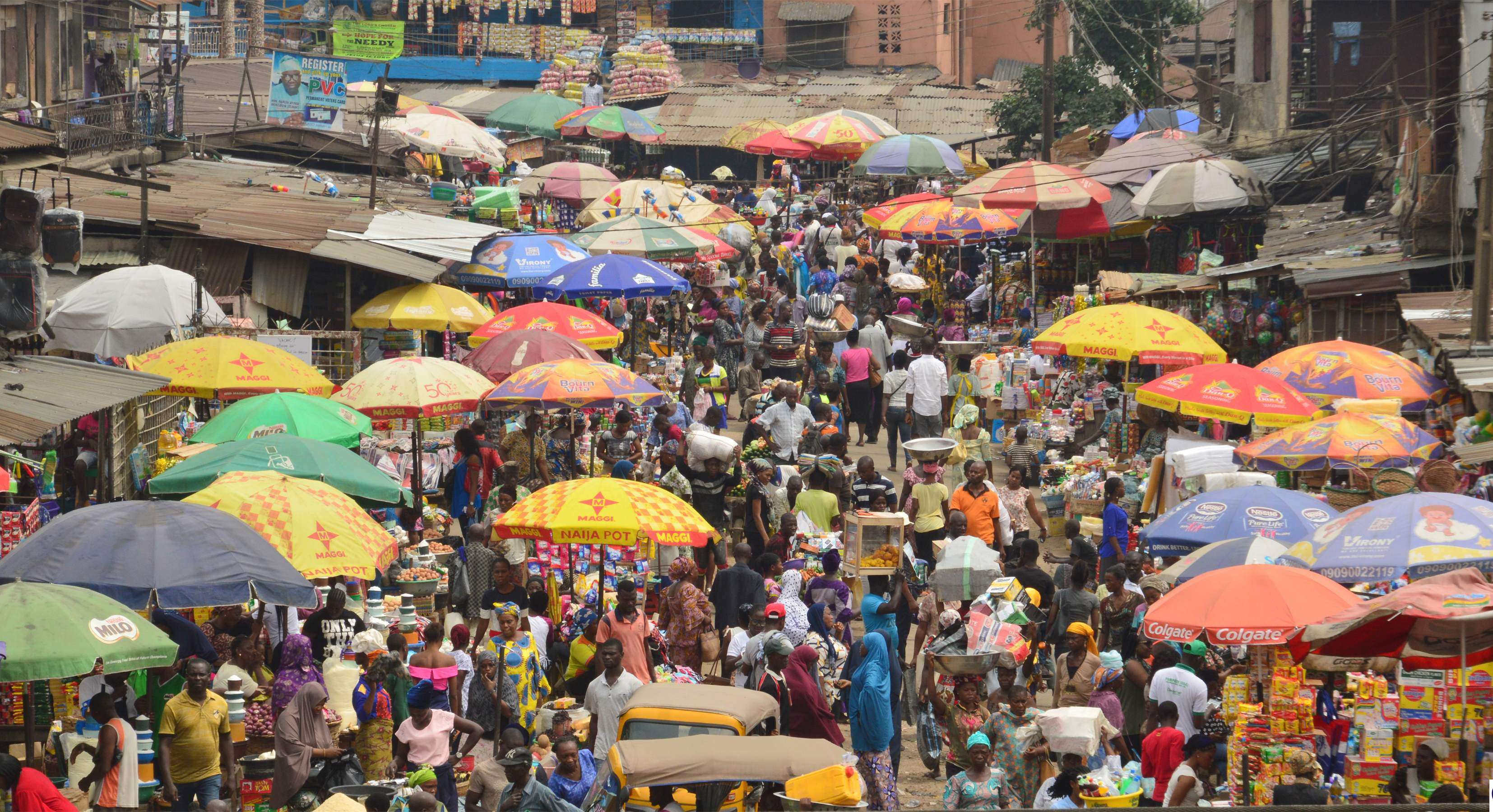
If you live in Mushin, Surulere, Yaba, or Idi-Araba and you've been making the trip to Mile 12 for cheaper food prices, you can stop. FoodPrices.ng market representative checked 24 key staple prices at Mushin Market on Sallah day — March 20, 2026 — and every single item matched Mile 12 to the exact naira. Rice, beans, and vegetables: identical at both markets. The data confirms that Mushin is pricing at the wholesale floor, giving mainland Lagos families access to Mile 12-level prices without the commute to Ketu. And while Mushin and Mile 12 converge, both sit dramatically below what Lekki and Island markets are charging — oloyin beans at ₦65,000 per 50kg at Mushin is ₦9,000 cheaper than Ajah and ₦12,000 cheaper than Jakande.
Rice: ₦54,000 for Nigerian manufactured, ₦60,000 for Aroso. Nigerian manufactured rice at Mushin sells for ₦54,000 per 50kg bag, ₦27,000 per 25kg, ₦5,000 per paint, and ₦1,000 per derica. Tomato Aroso rice sits at ₦60,000 per 50kg, ₦30,000 per 25kg, ₦5,500 per paint, and ₦1,100 per derica. Every single price point — all eight — matches Mile 12 exactly. For the average Lagos household, this is the key finding: you don't need to go to Mile 12 for cheap rice. Mushin is the same. The ₦54,000 per 50kg for Nigerian manufactured rice works out to ₦1,080 per kilogram — the cheapest rice per kilo in our multi-market survey. Ajah's cheapest comparable option (imported short grain at ₦63,000/50kg) is 16.7% more expensive. Jakande's cheapest (Pretty Lady at ₦54,000) matches the price but requires a trip to Lekki. For mainland families, Mushin is the closest point of access to wholesale-floor rice pricing.
Beans: ₦65,000 oloyin, ₦4,000 drum — the mainland baseline. Oloyin beans at ₦65,000 per 50kg bag, ₦4,500 per paint, and ₦1,000 per derica. Drum beans at ₦130,000 per 150kg bag, ₦4,000 per paint, and ₦800 per derica. Again, every number matches Mile 12. The mainland beans price cluster — Mile 12, Mushin, and Sabo Yaba (which had oloyin at ₦60,000 per 50kg, even cheaper) — sits as a bloc against the Lekki corridor's higher prices. Ajah's oloyin at ₦74,000/50kg is ₦9,000 (13.8%) above Mushin. Jakande's at ₦77,000 is ₦12,000 (18.5%) above. At the paint bucket level, Ajah and Jakande both charge ₦5,500 for oloyin — ₦1,000 above Mushin's ₦4,500. A family buying one paint of oloyin beans weekly saves ₦4,000 per month shopping at Mushin versus Ajah. Drum beans is even starker: Ajah's ₦5,000 per paint versus Mushin's ₦4,000 is a 25% premium — ₦4,000 per month for a weekly buyer.
Vegetables: ₦1,000 per shade — the mainland advantage in full. Every vegetable checked at Mushin today holds at ₦1,000 per big shade and ₦500 per small shade. Tomatoes, pepper (rodo), local tatashe, local shombo, and onions — all at the same price, all matching Mile 12 and Oshodi. This is where the mainland-versus-Lekki gap becomes extraordinary. At Jakande, every one of these items costs ₦4,000 per paint bucket — four times the big shade price at Mushin (though the paint bucket holds more product than a shade). At Ajah, it's ₦6,000 per paint — six times the Mushin shade. Onions at Ajah hit ₦6,500 per paint. The shade-to-paint volume ratio means the per-kilo comparison isn't perfectly 1:6, but even adjusting for volume, Mushin vegetable shoppers are paying a fraction of what Lekki residents pay. For daily shoppers who buy a big shade of tomatoes, a big shade of pepper, and a big shade of onions, the total at Mushin is ₦3,000 — a practical baseline for a single pot of stew.
Mushin vs every other market — the full scorecard. On all 24 items collected today, Mushin matches Mile 12 at 100% of comparable price points. Against the Lekki corridor, the savings stack up fast. On a hypothetical monthly basket of one 50kg bag of rice, one 50kg bag of beans, and weekly vegetables, the numbers tell the story. At Mushin: rice ₦54,000 + beans ₦65,000 + weekly shade vegetables (₦3,000 × 4 weeks = ₦12,000) = ₦131,000. At Ajah: rice ₦63,000 (cheapest) + beans ₦74,000 + weekly paint vegetables (₦24,500 × 4 = ₦98,000) = ₦235,000. That is a ₦104,000 monthly difference — the equivalent of 1.5 minimum wages — on the same three categories of food. Even accounting for different unit sizes between shades and paints, the directional savings are massive.
The price convergence between Mushin and Mile 12 isn't coincidental — it reflects shared infrastructure. Both markets sit on the mainland's north-south food supply corridor. Trucks arriving from Benue, Niger, Kaduna, and Jos reach Mile 12 first, but the produce redistributes quickly to Mushin, Daleko, and Oyingbo through a dense network of wholesalers and intermediaries operating on tight margins. The result is that by the time food reaches Mushin, the price has barely moved from the Mile 12 first-sale level. This is fundamentally different from the Lekki axis, where produce must travel an additional 20-35 kilometres along the congested Lekki-Epe Expressway, accumulating fuel costs, tolls, and handling margins at every stop. As BusinessDay reported, rising fuel costs are pushing petrol toward ₦1,200 per litre — which widens the Lekki premium while leaving the Mile 12-to-Mushin spread untouched.
Nigeria's food inflation jumped to 12.12% in February after Ramadan stockpiling reversed months of disinflation. But the NBS headline number masks the reality that inflation is experienced differently depending on where you shop. A Mushin family buying rice at ₦54,000 and vegetables at ₦1,000 per shade is living in a different cost-of-living reality than an Ajah family paying ₦63,000 for rice and ₦6,000 for tomatoes. The 12.12% national food inflation figure captures neither this geographic dispersion nor the fact that some staples (rice) are deflating rapidly while others (beans) are climbing. This is precisely what FoodPrices.ng exists to track — not what inflation is nationally, but what your specific market is charging for the food you actually buy.
The bottom line for mainland families. If you're within reach of Mushin Market — Mushin, Surulere, Yaba, Ebute Metta, Idi-Araba, Isolo — your local market is pricing at the wholesale floor on every staple we checked today. Nigerian manufactured rice at ₦54,000/50kg and ₦5,000/paint. Tomato Aroso at ₦60,000/50kg. Oloyin beans at ₦65,000/50kg and ₦4,500/paint. Drum beans at ₦4,000/paint. Every vegetable at ₦1,000 per big shade. There is no price advantage to travelling to Mile 12 for these items. Save the transport fare, skip the Ketu traffic, and spend that time with your family this Sallah. The prices are the same.
FoodPrices.ng tracks verified prices across Lagos markets through a network of trained market representative. This report is based on 24 price data points freshly collected at Mushin Market on March 20, 2026 (Sallah day), covering rice (Nigerian manufactured, Tomato Aroso — 4 sizes each), beans (oloyin — 3 sizes, drum — 3 sizes), and vegetables (tomatoes, pepper, tatashe, shombo, onions — big and small shade). Cross-market comparisons reference same-day data from Mile 12, Ajah, Jakande, Oshodi, and Sabo Yaba. Visit foodprices.ng for live price dashboards and market-by-market comparisons across Lagos State.
Key Findings
- Mushin matches Mile 12 on all 24 items checked — 100% price convergence between Lagos's two largest mainland markets
- Nigerian manufactured rice at ₦54,000/50kg (₦1,080/kg) is the cheapest rice in the multi-market survey
- Oloyin beans at ₦65,000/50kg is ₦9,000 below Ajah (₦74,000) and ₦12,000 below Jakande (₦77,000)
- Vegetables at ₦1,000/big shade vs Ajah's ₦6,000/paint — mainland shoppers pay a fraction of Lekki prices
- A basic monthly basket (rice + beans + vegetables) costs roughly ₦131,000 at Mushin vs ₦235,000 at Ajah — a ₦104,000 gap
- Mushin serves Surulere, Yaba, Ebute Metta, Idi-Araba, and Isolo at wholesale-floor pricing with no need to travel to Mile 12
Data Methodology
Data sourced from FoodPrices.ng verified market agent reports at Mushin Market, Lagos State. 24 price data points collected on March 20, 2026 (Eid al-Fitr). Cross-market comparisons reference data from Mile 12, Ajah, Jakande, Oshodi, and Sabo Yaba collected within the same 24-hour window. Macroeconomic context from NBS February 2026 CPI report and BusinessDay.