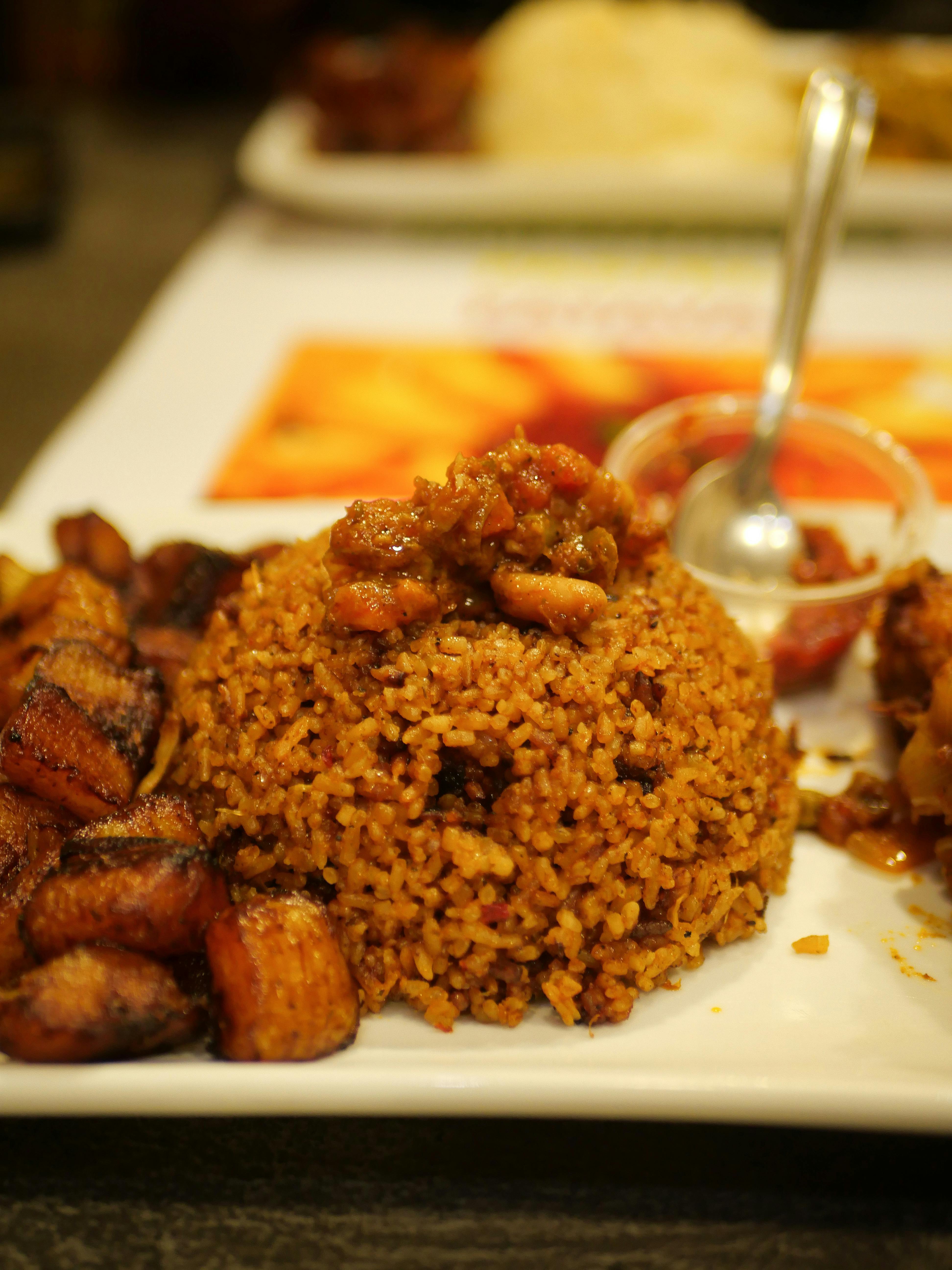
Cooking Nigeria's beloved Jollof Rice for a family of six now costs ₦9,710 at Oyingbo Market — that's ₦1,618 per serving, according to FoodPrices.ng market data spanning 18 Lagos markets. This represents a substantial 14.4% of the monthly minimum wage (₦70,000) for just one meal preparation. The dish requires six core tracked ingredients — rice, tomatoes, tatashe, scotch bonnet pepper, vegetable oil, and eggs — plus additional seasonings estimated at ₦1,200 for onions, Maggi cubes, curry powder, thyme, bay leaves, garlic, ginger, tomato paste, and butter. At current pricing, a family cooking this iconic dish twice weekly would spend ₦19,420 monthly — consuming 27.7% of minimum wage income on a single meal type alone.
Rice dominates the cost structure at ₦3,000 for three derica measures, claiming 31% of the total tracked ingredient cost of ₦8,510. At ₦1,000 per derica, this imported short-grain rice reflects the persistent impact of naira devaluation on Nigeria's most consumed grain. Tomatoes follow at ₦1,500 (15% of tracked costs), requiring half a paint bucket priced at ₦3,000 per full paint at Oyingbo Market. Red bell peppers (tatashe) contribute ₦1,350 (14%), calculated from 30% of a ₦4,500 paint bucket — notably sourced from Sabo Market Yaba via FoodPrices.ng cross-market pricing, as Oyingbo lacked tatashe data at the time of calculation. Eggs add ₦1,160 (12%) for six pieces, representing one-fifth of a ₦5,800 crate. Vegetable oil costs ₦900 (9%) for the required 300ml from a ₦3,000 litre bottle, while scotch bonnet peppers round out the tracked ingredients at ₦600 (6%) for 15% of a ₦4,000 paint bucket.
The rice component alone underscores broader macroeconomic pressures facing Nigerian consumers. Imported varieties command premium prices due to foreign exchange volatility and import duties, with the ₦1,000 per derica rate at Oyingbo reflecting approximately twice the cost of local alternatives. Yet imported short-grain rice remains the variety of choice for Jollof preparation due to its cooking characteristics and consumer preference. Local rice alternatives typically cost 20-30% less but require longer cooking times and different preparation techniques that many households haven't adopted. The vegetable components — tomatoes, peppers, and seasonings — collectively account for 35% of total costs, underscoring how fresh produce inflation directly compounds household meal expenses beyond the grain base.
Cross-market analysis across Lagos reveals extraordinary pricing disparities that demand strategic shopping. Epe Main Market offers the cheapest Jollof Rice preparation at ₦8,190 total (₦1,365 per serving), while Ketu Market sits at the opposite extreme at ₦15,200 (₦2,533 per serving) — a staggering ₦7,010 gap representing an 85.6% premium, according to FoodPrices.ng verified market agent reports. Shopping at Epe instead of Ketu saves enough per cooking session to prepare the dish nearly one additional time. Eredo Market ranks second-cheapest at ₦9,410, followed by Oyingbo at ₦9,710, making these three markets the most economical options for budget-conscious families preparing this staple.
Geographic price clustering reveals a clear pattern: the most affordable markets — Epe Main Market (₦8,190), Eredo Market (₦9,410), and Oyingbo Market (₦9,710) — are peripheral and wholesale-oriented locations. Mid-range pricing appears at Jakande Market (₦10,285) and Mojoda Market (₦11,860), markets that balance wholesale access with retail foot traffic. The most expensive tier includes established retail-heavy markets like Oshodi Market (₦14,800) and Ketu Market (₦15,200), where higher overhead, transportation premiums, and concentrated demand push ingredient costs well above state averages. This pattern holds consistently across ingredient categories, suggesting structural market positioning rather than temporary supply fluctuations.
Per-serving economics demonstrate that home cooking remains significantly more affordable than dining out, despite rising ingredient costs. At ₦1,618 per plate using Oyingbo Market prices, home-prepared Jollof Rice saves 24-73% compared to commercial alternatives. Mid-range restaurants price comparable servings at ₦2,000-3,500, making home cooking 24-54% cheaper. Upscale establishments charging ₦4,000-6,000 per plate make domestic preparation 60-73% more economical. Even compared to local buka operators at ₦800-1,200 per plate — whose portions are typically smaller — home cooking delivers more food per naira when accounting for serving size, with each home plate containing a more generous portion than the typical commercial serving.
Weekly and monthly projections reveal the cumulative weight of this single dish on household budgets. Twice-weekly Jollof Rice preparation at Oyingbo prices costs ₦19,420 monthly — 27.7% of the ₦70,000 minimum wage. For households earning ₦150,000 monthly, the same frequency still consumes 13% of earnings. Choosing the cheapest market (Epe at ₦16,380 monthly) still takes 23.4% of minimum wage, while the most expensive option (Ketu at ₦30,400 monthly) exceeds 43% — making regular Jollof Rice preparation financially prohibitive for low-income families. These figures explain why many Nigerian households increasingly limit elaborate rice-based dishes to weekends and special occasions, rotating toward more economical staples during weekdays.
Substitution strategies offer meaningful savings without fundamentally compromising the dish. Replacing imported rice with local varieties saves ₦600-900 per batch (a 20-30% reduction on rice costs), though cooking time increases by 15-20 minutes. Switching from vegetable oil to palm oil reduces oil costs by approximately ₦300 per batch — a 33% saving that also adds traditional Jollof flavour profiles many households prefer. Using fewer eggs or substituting dried fish saves ₦400-600 per preparation. Buying tomatoes in bulk during peak harvest season (November-March) and processing into paste can reduce year-round tomato costs by 25-35%. Implementing all substitutions could reduce total meal cost from ₦9,710 to approximately ₦7,500, saving over ₦2,200 per preparation or ₦17,600 monthly for families cooking twice weekly.
Scaling analysis reveals substantial economies of scale that larger families and community groups can exploit. Cooking for four people costs approximately ₦7,800 (₦1,950 per serving), while preparing for eight brings the total to around ₦11,200 (₦1,400 per serving) — a 28% per-serving reduction. Cooking for 12 people reduces the per-serving cost to approximately ₦1,200, representing a 38% saving versus four-person batches. These efficiencies stem from fixed costs in oil usage, seasoning quantities, and cooking fuel that don't scale proportionally with batch size. Larger families inherently benefit from this dynamic, and community cooking arrangements or neighbourhood bulk-preparation cooperatives could unlock significant savings for smaller households willing to coordinate.
Historical context frames these costs within Nigeria's accelerating food inflation trajectory. While specific historical pricing for this exact recipe configuration is not yet tracked over a full year, National Bureau of Statistics food inflation data shows persistent double-digit year-on-year increases, with food CPI surging past 35% in late 2023. This trajectory suggests the current ₦9,710 preparation likely cost 25-35% less twelve months ago — placing the equivalent cost at roughly ₦7,200-7,800. Rice prices have been particularly affected by foreign exchange pressures, border policy adjustments, and global commodity market volatility. Import-dependent ingredients including rice and vegetable oil face compounding pressure from naira devaluation and international supply chain disruptions that show no near-term signs of abating.
Consumer strategy optimization can significantly reduce preparation costs through tactical purchasing. Shopping early morning (6-8 AM) at wholesale markets like Mile 12 or Oyingbo often yields 10-15% price advantages before retail markups set in. Purchasing rice in 50kg bags rather than per-derica portions reduces per-kilogram costs by 20-25%, though this requires ₦35,000-45,000 upfront capital and adequate storage — a barrier for many households. Buying non-perishable seasonings (Maggi cubes, curry, thyme) in bulk reduces per-usage costs by 40-50% compared to small sachet purchases. For fresh produce, purchasing tomatoes and peppers on wholesale market days (typically Monday and Thursday at Mile 12) provides the freshest stock at the lowest prices, with savings of 15-25% versus weekend retail purchases.
Comparative meal economics positions Jollof Rice in the middle tier of Nigerian staple dishes. Rice and stew prepared separately costs approximately ₦1,400-1,800 per serving, while fried rice typically runs ₦1,800-2,200 due to additional vegetable requirements. Beans and plantain combinations at ₦800-1,200 per serving offer 30-50% savings over Jollof Rice, making them the most economical protein-rich alternative. Garri and soup preparations range ₦600-1,000 per serving — the most budget-friendly option for households stretching limited food budgets. Among rice-based dishes specifically, Jollof occupies the middle ground: more expensive than plain rice combinations but cheaper than fried rice, making it the go-to celebratory option that balances cost with culinary satisfaction.
The forward-looking outlook suggests continued upward pressure on Jollof Rice costs through the remainder of 2026. Rice prices face persistent headwinds from import dependency, forex instability, and global supply uncertainty. Tomato and pepper prices typically spike 40-60% during off-peak months (April-August) before retreating during harvest seasons, meaning the current pricing window represents mid-range rather than peak costs. Fuel subsidy removal continues to add transportation premiums across all ingredient categories, disproportionately affecting markets distant from production zones. Climate variability impacting northern grain production and southern vegetable yields adds further unpredictability to household food budgets.
At ₦9,710 for a six-serving preparation, Jollof Rice remains a significant household investment that rewards strategic planning. The 85.6% price gap between Epe Main Market and Ketu Market — a ₦7,010 difference on a single meal — demonstrates that market selection alone can deliver transformative savings. Combined with substitution strategies (15-25% savings), bulk purchasing (20-25% on staples), and seasonal timing (25-35% on produce), an optimised approach could reduce the effective cost to ₦6,500-7,500 per preparation. As FoodPrices.ng continues tracking these dynamics across Lagos State and beyond, the data increasingly shows that informed shopping is no longer optional for Nigerian families — it is an essential household financial strategy.
Data sourced from FoodPrices.ng market agent reports and direct access to sellers across 18 markets in Lagos State, covering 6 core ingredient categories. Prices collected within the last 21 days from primary market sources and cross-referenced with alternative market pricing where primary market data was unavailable. All calculations based on latest available data points per market per product, with miscellaneous ingredient costs (onions, seasoning cubes, spices, and aromatics) estimated at ₦1,200 based on current retail pricing for typical seasoning requirements.