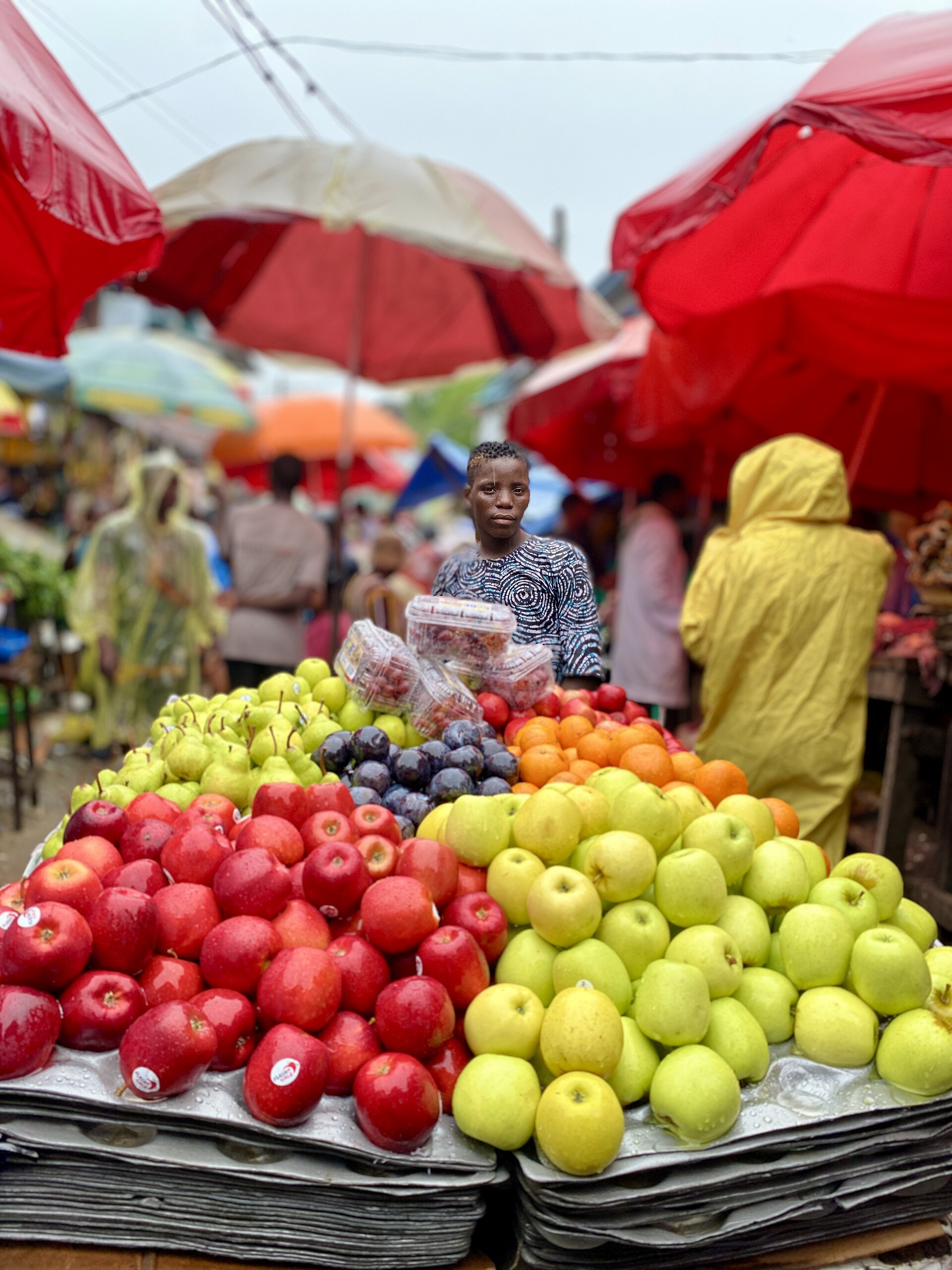
On Sallah morning, FoodPrices.ng market representative walked Ajah Market and priced 46 items across grains, cooking oils, and vegetables. The snapshot captures five rice brands, two bean varieties, five alternative grains, eight cooking oil prices, and five vegetable items — all collected on March 20, 2026, the day Lagos celebrated Eid al-Fitr. We then compared every price against data our representative collected at Mile 12, Jakande, Mushin, and Sabo Yaba within the same 24-hour window. The result is a market where imported long grain rice costs ₦73,000 per 50kg bag, vegetables are the most expensive in Lagos at ₦6,000 per paint, and palm oil carries a 22% premium over Mile 12 — but where white maize at ₦45,000 per 50kg is the cheapest grain you'll find anywhere on the Lekki axis.
Rice: 5 brands, ₦63,000 to ₦76,000. Ajah's rice section today covers five brands at every retail and wholesale unit. Imported short grain is the most affordable at ₦63,000 per 50kg bag, ₦5,000 per paint, and ₦1,200 per derica. Imported long grain and My Choice (short grain) both sit at ₦73,000 per 50kg, ₦6,500 per paint, and ₦1,300 per derica. My Food commands the top end at ₦76,000 per 50kg, ₦7,000 per paint, and ₦1,400 per derica. The ₦13,000 spread between imported short grain and My Food — a 20.6% gap — is the brand premium Ajah shoppers face on the same shelf. For context, Nigerian manufactured rice at Mile 12 and Mushin sits at ₦54,000 per 50kg, meaning even Ajah's cheapest rice option (imported short grain at ₦63,000) carries a ₦9,000 premium over the mainland's standard bag. Sabo Yaba offers imported short grain at ₦55,000 — ₦8,000 below Ajah's price for the same product. A household buying one 50kg bag monthly at Ajah instead of Sabo Yaba loses ₦96,000 per year on rice alone.
Beans: Oloyin at ₦74,000, Drum at ₦5,000 per paint. Oloyin beans at ₦74,000 per 50kg bag is the headline beans price — ₦9,000 (13.8%) above Mile 12 and Mushin's ₦65,000, and ₦14,000 (23.3%) above Sabo Yaba's ₦60,000, the cheapest in our survey. At the paint bucket level, oloyin at ₦5,500 matches Jakande but sits ₦1,000 above the mainland cluster of ₦4,500 (Mile 12 and Mushin). The derica at ₦1,200 is ₦200 above the mainland's ₦1,000. Drum beans retail at ₦5,000 per paint and ₦1,000 per derica — 25% above Mile 12, Mushin, and Sabo's uniform ₦4,000 and ₦800 respectively. The 100kg drum bag at ₦150,000 (₦1,500/kg) is a bulk option for the Ajah-Sangotedo-Ibeju corridor's growing population. At current prices, a household buying one paint of oloyin weekly at Ajah spends ₦22,000 per month on beans — ₦4,000 more than the same household would spend at Mile 12, and ₦48,000 more per year.
Grains most Lagos shoppers don't know about. Ajah stocks a grain range that sets it apart from most suburban Lagos markets. Corn, guinea corn, and millet all trade at an identical price band: ₦53,000 per 50kg bag, ₦2,500 per paint, ₦600 per derica. These three cereals — staples in northern Nigeria — offer serious value as carbohydrate alternatives for Lagos families. White maize is even cheaper: ₦45,000 per 50kg bag, ₦2,000 per paint, ₦600 per derica — the lowest-priced grain in the entire market. A paint of white maize at ₦2,000 is 64% cheaper than a paint of imported short grain rice at ₦5,000, and 71% cheaper than a paint of My Food at ₦7,000. Soya beans at ₦95,000 per 50kg, ₦5,000 per paint, and ₦1,000 per derica sits at the premium end — above even oloyin beans in per-kilo cost. For Ajah families looking to stretch their food budget, the grain section is an underutilised resource: corn at ₦2,500 per paint makes pap, ogi, and tuwo at a fraction of the cost of rice-based meals.
Cooking oil: The ₦10,000 palm oil premium. Palm oil at Ajah runs ₦1,700 per small bottle, ₦3,400 per big bottle, ₦10,200 per 5L, and ₦55,000 per 25L keg. That 25L keg is ₦10,000 (22.2%) above Mile 12's ₦45,000 — the steepest single-item premium in our Ajah-vs-Mile 12 comparison. At the 5L level, it's ₦10,200 versus ₦8,500 at Mile 12 — a ₦1,700 gap (20%). The big bottle at ₦3,400 is 13.3% above Mile 12's ₦3,000, and the small bottle at ₦1,700 is 13.3% above ₦1,500. Groundnut oil tells a different story: ₦54,000 per 25L at Ajah versus ₦52,000 at Mile 12 is just a 3.8% gap, and the small bottle at ₦1,800 matches Mile 12 exactly. The 5L at ₦10,800 and big bottle at ₦3,600 carry only 2.9% and 2.9% premiums respectively. The pattern is clear: palm oil carries a heavy location premium at Ajah, but groundnut oil is nearly at parity with the mainland. For Ajah shoppers, groundnut oil is the smarter buy relative to its Mile 12 price — or switch to palm oil only when you can source it from a mainland market.
Vegetables: ₦6,000 across the board. Every vegetable collected today at Ajah from Mallam Abdullahi's stall carries the highest paint-bucket price in our 6-market survey. Tomatoes: ₦6,000 per paint. Pepper (rodo): ₦6,000. Local tatashe: ₦6,000. Local shombo: ₦6,000. Onions: ₦6,500. Compare this to Jakande — just 20 minutes closer to Mile 12 — where every vegetable trades at ₦4,000 per paint and onions at ₦3,500. That's a 50% premium on pepper, tomatoes, tatashe, and shombo, and an 86% premium on onions, just for shopping at Ajah instead of Jakande. At mainland markets — Mile 12, Mushin, Oshodi — the big shade goes for ₦1,000 and small shade for ₦500. A household buying one paint each of tomatoes, pepper, tatashe, and onions weekly at Ajah spends ₦100,000 monthly on vegetables alone. The same basket at Jakande: ₦62,000. That ₦38,000 monthly gap — ₦456,000 annually — could fund seven bags of imported short grain rice.
The Ajah price map: Where it's cheaper and where it's not. Today's 46 data points draw a clear picture of Ajah's pricing DNA. The market charges a premium on three categories: vegetables (50-86% above Jakande), palm oil (13-22% above Mile 12), and beans (14-25% above mainland markets). Rice carries a moderate premium driven by brand — imported short grain at ₦63,000 is 17% above Mile 12's manufactured rice at ₦54,000, but Ajah offers brand diversity (5 options) that Mile 12's single manufactured rice doesn't match. Groundnut oil is essentially at mainland parity (3-4% premium). And the alternative grains — corn, guinea corn, millet, white maize — offer value that mainland markets don't typically stock at the retail level, giving Ajah an unexpected edge for households willing to diversify beyond rice.
The price dispersion reflects Ajah's position at the end of the Lekki-Epe Expressway. Produce that flows through Mile 12 from northern states — beans, tomatoes, pepper, palm oil — accumulates transport and intermediary margins across 30+ kilometres before reaching Ajah. Rice, distributed through formal brand networks, absorbs logistics more efficiently, which is why the rice premium is lower than the vegetable premium. And the alternative grains may benefit from shorter supply chains or direct-from-producer relationships that bypass the Mile 12 wholesale system entirely. As BusinessDay reported, rising fuel costs amid the US-Iran tensions are pushing petrol toward ₦1,200 per litre — every naira increase in diesel widens the gap between Mile 12 and Ajah further.
Shopping strategy for Ajah residents. Buy at Ajah: alternative grains (white maize at ₦2,000/paint, corn and millet at ₦2,500/paint are cheaper carbohydrates than rice), groundnut oil (small bottle at ₦1,800 matches Mile 12), and imported short grain rice (₦63,000/50kg if you need Lekki convenience). Buy at Jakande instead: all vegetables — the ₦2,000-per-paint saving on each item adds to ₦38,000/month for a household buying weekly. Worth a mainland trip for: palm oil 25L (saves ₦10,000 at Mile 12), oloyin beans 50kg (saves ₦9,000 at Mile 12, ₦14,000 at Sabo Yaba), and Nigerian manufactured rice (₦54,000 at Mile 12 vs ₦63,000+ at Ajah). The data is live at foodprices.ng — compare any item, any market, any day.
FoodPrices.ng tracks verified prices across Lagos markets through a network of trained market representative. This report is based on 46 price data points collected at Ajah Market on March 20, 2026 (Sallah day), covering grains (5 rice brands, 2 bean varieties, corn, guinea corn, millet, soya beans, white maize), oils (palm oil and groundnut oil at 4 sizes each), and vegetables (tomatoes, pepper, tatashe, shombo, onions). Cross-market comparisons reference same-day data from Mile 12, Mushin, Oshodi, Sabo Yaba, and Jakande. Visit foodprices.ng for the full dataset.
Key Findings
- 5 rice brands span ₦63,000-₦76,000/50kg — even the cheapest (imported short grain) is ₦9,000 above Mile 12's ₦54,000
- Vegetables at ₦6,000/paint are the most expensive in Lagos — 50% above Jakande (₦4,000) and 86% above Jakande for onions (₦6,500 vs ₦3,500)
- Oloyin beans at ₦74,000/50kg is ₦14,000 above Sabo Yaba's ₦60,000 — the widest beans gap in our multi-market data
- Palm oil 25L at ₦55,000 carries a 22% markup over Mile 12, but groundnut oil at ₦54,000 is near parity (+3.8%)
- White maize at ₦45,000/50kg and ₦2,000/paint is the cheapest grain in the market — 64% below imported short grain rice per paint
- Monthly vegetable basket: ₦100,000 at Ajah vs ₦62,000 at Jakande — a ₦456,000 annual gap
Data Methodology
Data sourced from FoodPrices.ng verified market agent reports at Ajah Market, Lagos State. 46 price data points collected on March 20, 2026 (Eid al-Fitr). Cross-market comparisons reference data from Mile 12, Mushin, Oshodi, Sabo Yaba, and Jakande collected within the same 24-hour window. Macroeconomic context from NBS February 2026 CPI report and BusinessDay.