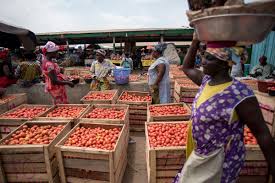
On February 14, 2026, a truck carrying 18 Ghanaian tomato traders was ambushed by Islamist militants in Titao, a town in northern Burkina Faso that has become a flashpoint for jihadist violence in the Sahel. According to Graphic Online (February 16, 2026), Interior Minister Muntaka Mohammed Mubarak confirmed that the attackers separated passengers by gender and shot the men on sight. Seven men were killed immediately. An eighth victim later died of injuries, bringing the confirmed death toll to eight Ghanaian nationals, as confirmed by the Ministry of Foreign Affairs through GBC Ghana Online (February 19, 2026). Three survivors with critical injuries were evacuated by Ghana Air Force aircraft to the 37 Military Hospital in Accra on February 17.
The attack was not a one-off tragedy. It exposed a structural vulnerability that has persisted for decades: Ghana's dependence on Burkina Faso for tomatoes — a dependency that now costs the country GHS 5.7 billion annually. According to the Chamber of Agribusiness Ghana (CAG) (February 16, 2026), that figure encompasses GHS 650–760 million in direct import costs, GHS 180–220 million in lost tax revenue, GHS 175–250 million in post-harvest spoilage, and a staggering GHS 4.5 billion in wages that flow to foreign producers instead of Ghanaian workers. The losses represent 1.2 percent of GDP.
Ghana is the world's second-largest importer of tomato paste — behind only Germany — yet only seven percent of the tomatoes it processes are domestically grown, according to the CAG (February 16, 2026). The rest is imported bulk paste that is repackaged for the local market. Annual national demand stands at roughly 800,000 metric tonnes, while domestic production ranges between 370,000 and 420,000 metric tonnes, according to the Peasant Farmers Association of Ghana (PFAG) (February 19, 2026).
The killings have accelerated the government's response. Deputy Minister for Food and Agriculture John Dumelo announced on February 17 through The Herald Ghana that Ghana is on track for full-scale domestic tomato production by the end of 2026. Trials are currently underway at the Tono Irrigation Scheme in the north, operating under the West Africa Food System Resilience Programme, with approximately 50 to 60 acres under cultivation. Similar trials are running at Akomadan in the Ashanti Region, where multiple varieties are being tested for adaptability and yield.
Speaking on Joy FM's Super Morning Show on February 18, as reported by MyJoyOnline, Dumelo set a target of 200,000 to 300,000 metric tonnes of dry-season production within two to three years. He acknowledged this would not achieve self-sufficiency but said the immediate goal is to reduce tomato imports by 20 to 30 percent within two years. The government is distributing solar-powered boreholes to selected farmers and has redistributed over 1,000 water pumps seized from illegal mining operations to farming communities.
Dumelo expressed confidence that within five to six years, Ghana could eliminate tomato imports from Burkina Faso entirely. "I can assure you that if we continue as we are doing now in terms of the trials and the research and everything we are undertaking, I should think that in about five or six years we should stop the total importation of tomatoes from Burkina Faso and neighbouring countries," he told Adom Online (February 18, 2026).
Meanwhile, the Chamber of Agribusiness unveiled a National Tomato Production Strategy (2026–2030) requiring GHS 3.2 billion in investment but projecting annual economic gains exceeding GHS 5 billion by 2030. The strategy targets reducing tomato paste imports from over $100 million to $20 million, increasing local processing from 7 percent to 85 percent, and establishing 50 cold storage facilities with 150,000 metric tonne capacity. Construction of the first 10 cold storage units is planned for Q2 2026.
At Techiman Central Market — the hub of Ghana's cross-border tomato trade — market leaders described the risks of continued trade with Burkina Faso as "unbearable." Comfort Aframah, Patron of the Techiman Tomato Traders Association, told GBC Ghana Online: "If farmers in Ghana could farm all year round, there would be no need for these perilous journeys."
The parallels to Nigeria's own food security challenges are unmistakable. Both countries face massive import dependency for basic commodities, both lose billions annually to inadequate domestic processing infrastructure, and both are racing to build irrigation systems that can extend production beyond the rainy season. Ghana's tragedy illustrates, in the starkest terms, that food import dependency is not merely an economic problem — it is, increasingly, a security one.