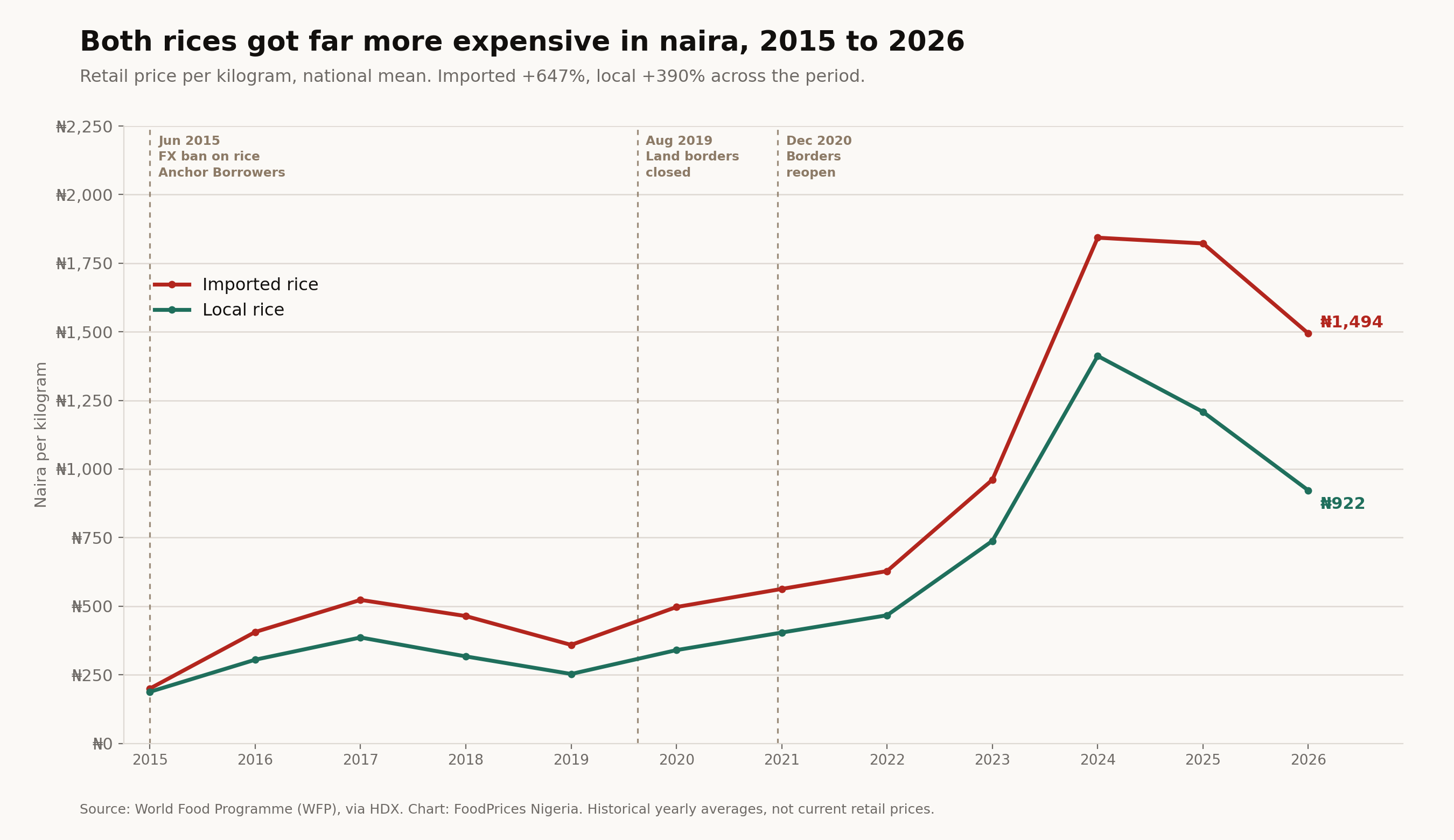
In 2015, the year Nigeria began its campaign to replace imported rice with the local crop, a kilogram of imported rice cost ₦200 and a kilogram of local rice cost ₦188. Imported carried a premium of 6%. By 2026 imported cost ₦1,494 a kilogram and local cost ₦922, a premium of 62%. Judged on the question the policy actually asked, whether Nigerian rice could out-compete the foreign product on price, the answer is yes, and the margin is not small.
Judged on the question households were asking, whether rice would become affordable, the answer is no. Local rice rose 390% in naira across those eleven years. Both statements are true at once, and the distance between them is the story.
The history comes from the World Food Programme, published via the Humanitarian Data Exchange, which reports national mean retail prices as yearly averages, normalised here to naira per kilogram so that imported rice sold in 2.8 KG measures and local rice sold in 2.7 KG measures compare fairly. That analysis is historical and dated, running 2015 to 2026. The current prices come from the Lagos State Ministry of Agriculture and Food Systems weekly market survey, compiled and published by FoodPrices Nigeria, for the week of 31 July 2026, and every one of them links to its live page so readers can check the figure themselves.
What the policy actually was
On 23 June 2015 the Central Bank of Nigeria issued a circular excluding 41 items, rice among them, from access to foreign exchange in the official market, a measure the bank itself describes as the precursor to the Anchor Borrowers Programme and the rice revolution it was meant to trigger. Importers were pushed to the parallel market for dollars. The Anchor Borrowers Programme followed in November 2015, lending to smallholder farmers through anchor processors.
Then came the blunt instrument. Nigeria closed its land borders to goods in August 2019 to stop rice and other commodities being smuggled in through Benin and Niger, and reopened four crossings in December 2020, with the finance minister stating that the ban on importing rice and poultry remained in force regardless.
Relatively, it worked
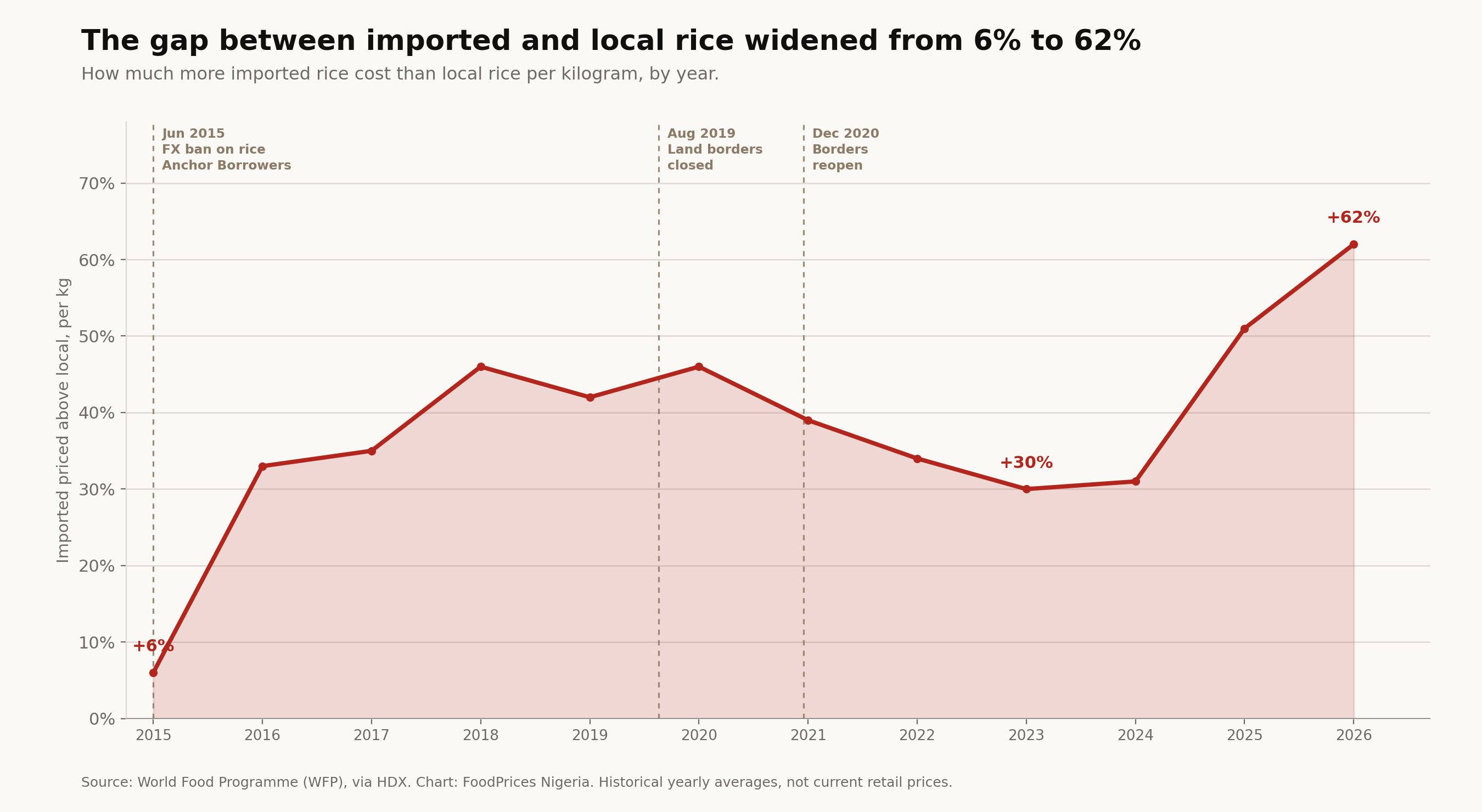
The premium is the clearest evidence in the dataset. Imported rice went from 6% above local in 2015 to 33% in 2016 and 46% by 2018. It narrowed through the border closure years to a low of 30% in 2023, then widened sharply to 51% in 2025 and 62% in 2026.
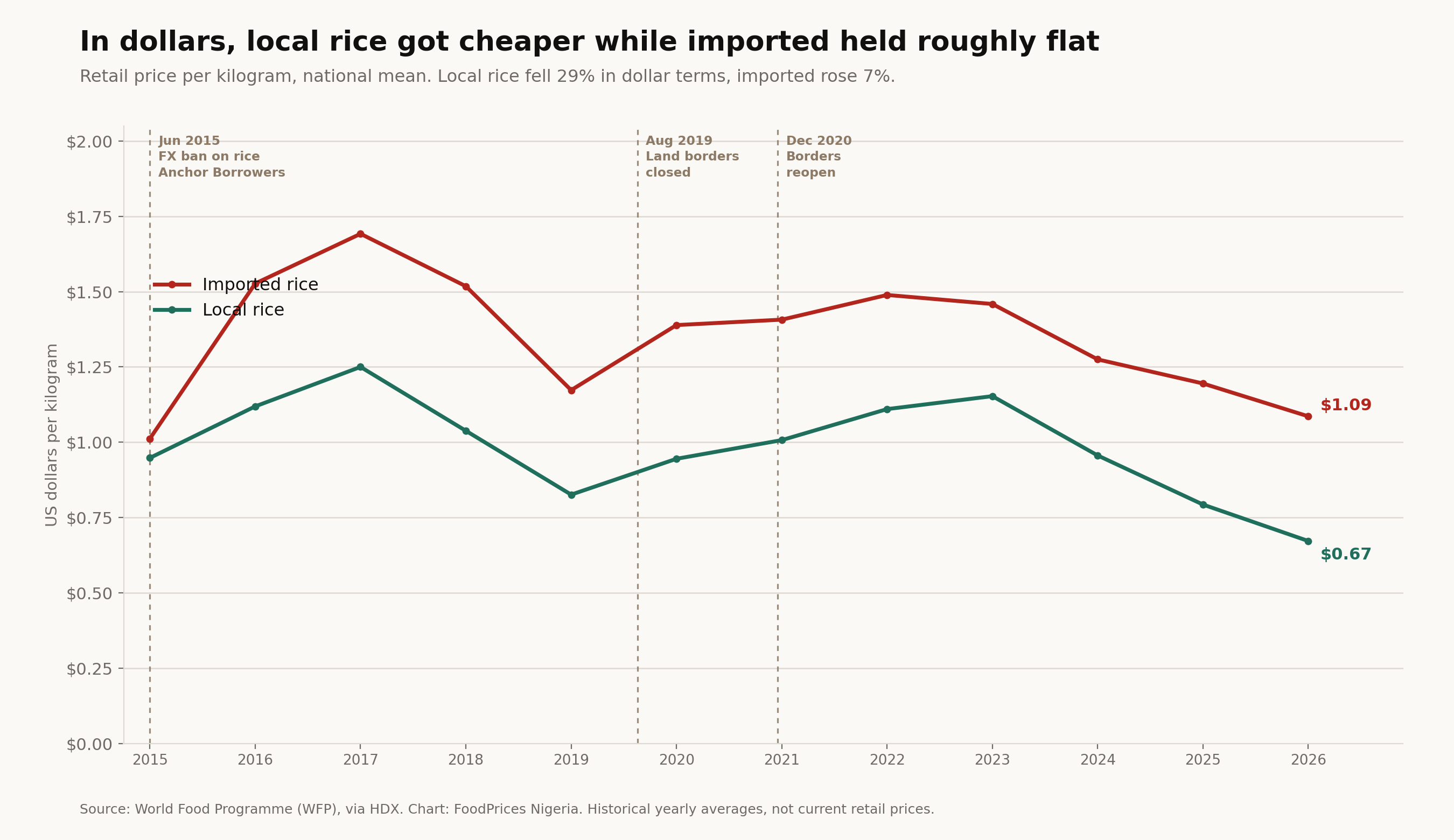
The dollar series makes the same point in real terms and takes the currency out of the argument. Local rice fell from $0.95 a kilogram in 2015 to $0.67 in 2026, a decline of 29%. Imported rice went from $1.01 to $1.09, a rise of 7%. Measured against world prices, Nigerian rice genuinely became cheaper while the imported product did not.
That is what successful import substitution looks like in price data. Whether the policy caused it is a question the price series cannot settle, and the production evidence is mixed. The Central Bank's own rice page puts production at 7.0 million tonnes against consumption demand of 10.5 million, a deficit of 2.5 million tonnes. The United States Department of Agriculture reported in March 2026 that roughly 60% of Nigerian mills were not operating, and forecast consumption of 9 million tonnes for the 2026/27 marketing year, an increase it attributed partly to informal imports pushing domestic prices down. A policy that makes local rice relatively cheaper while more than half the milling capacity stands idle is not a straightforward success.
Absolutely, it did not
Set the naira chart beside the dollar chart and the celebration ends. Imported rice rose from ₦200 a kilogram to ₦1,494, an increase of 647%. Local rice rose from ₦188 to ₦922, an increase of 390%. A household that switched to local rice in 2015 and stayed loyal for eleven years still watched its rice bill multiply almost five times over.
The relative win was real and it was swamped. Local rice becoming 29% cheaper in dollars did nothing for a household that earns and spends in naira, because the currency those wages are paid in lost far more ground than the rice gained. The binding constraint on rice affordability over the decade sat in the foreign exchange market rather than in the paddy fields.
The border closure fares worst under scrutiny. BusinessDay reported that after more than two years the closure had failed to stop foreign rice entering the country, with smugglers simply using new and costlier routes, and noted that food inflation stood at 13.17% when the policy began in August 2019 and 17.2% by March 2022. The price data agrees on the narrow point. The premium did not widen during the closure years, it narrowed, from 46% in 2020 to 30% in 2023. The period when imported rice was hardest to bring in legally is the period when it drew closest to local rice on price.
What Lagos pays now, and how to check it
In the week of 31 July 2026, a 50kg bag of Imported Rice (Long Grain) averaged ₦57,188 across Lagos markets, which works out to ₦1,144 a kilogram. A 50kg bag of Imported Rice (Short Grain) averaged ₦53,100, or ₦1,062 a kilogram, and a 50kg bag of Nigerian Manufactured Rice averaged ₦52,857, or ₦1,057 a kilogram. In smaller containers the same three products ran to ₦4,589 a paint and ₦969 a derica for imported long grain, ₦4,606 a paint for imported short grain, and ₦4,436 a paint for the Nigerian product.
Set the per kilogram figures against the WFP series and the comparison is instructive rather than continuous. WFP's 2026 national annual mean was about ₦1,494 a kilogram for imported rice; the current Lagos price works out to about ₦1,144. The current figure sits below the annual one, which fits a year in which naira rice prices have been falling, since an annual mean averages in the more expensive early months. The two are not the same measurement. One is a national average across a full year in small retail measures, the other is a single week in one city derived from a 50kg bag, and bulk containers and small measures do not price the same per kilogram. Direction and level can be compared in words. The current price is not the next point on the WFP line and should not be plotted as one.
The premium depends on which local rice
There is a nuance the national series hides. WFP's generic local rice sits 62% below imported. FoodPrices' branded Nigerian manufactured rice sits about 8% below imported long grain in Lagos right now, at ₦1,057 a kilogram against ₦1,144, and only 0.5% below imported short grain. Those are not contradictory readings, they are different products wearing the same label.
The literature explains why. Research published in the Journal of Agricultural and Applied Economics found that higher rates of broken grains in Nigerian local rice cause consumers to discount the price, and that poor milling technology concentrated in the small and medium mills handling about 80% of domestic milling is what degrades that quality. Cheap unbranded local rice and branded, properly milled Nigerian rice are separated by grade, and the 62% national premium is largely a statement about the former. Buyers of the latter face a much narrower gap, which means the affordability case for switching to local rice is far weaker at the quality end of the market than the headline suggests.
Where the weekly data earns its keep
National annual averages cannot show what happens next. In that same week, the identical 50kg bag of imported long grain rice ranged from ₦53,000 at Agbalata Market to ₦60,000 at Ajah Market and ₦60,000 at Mushin Market. That is ₦7,000, a spread of 13%, for the same product in the same city in the same seven days.
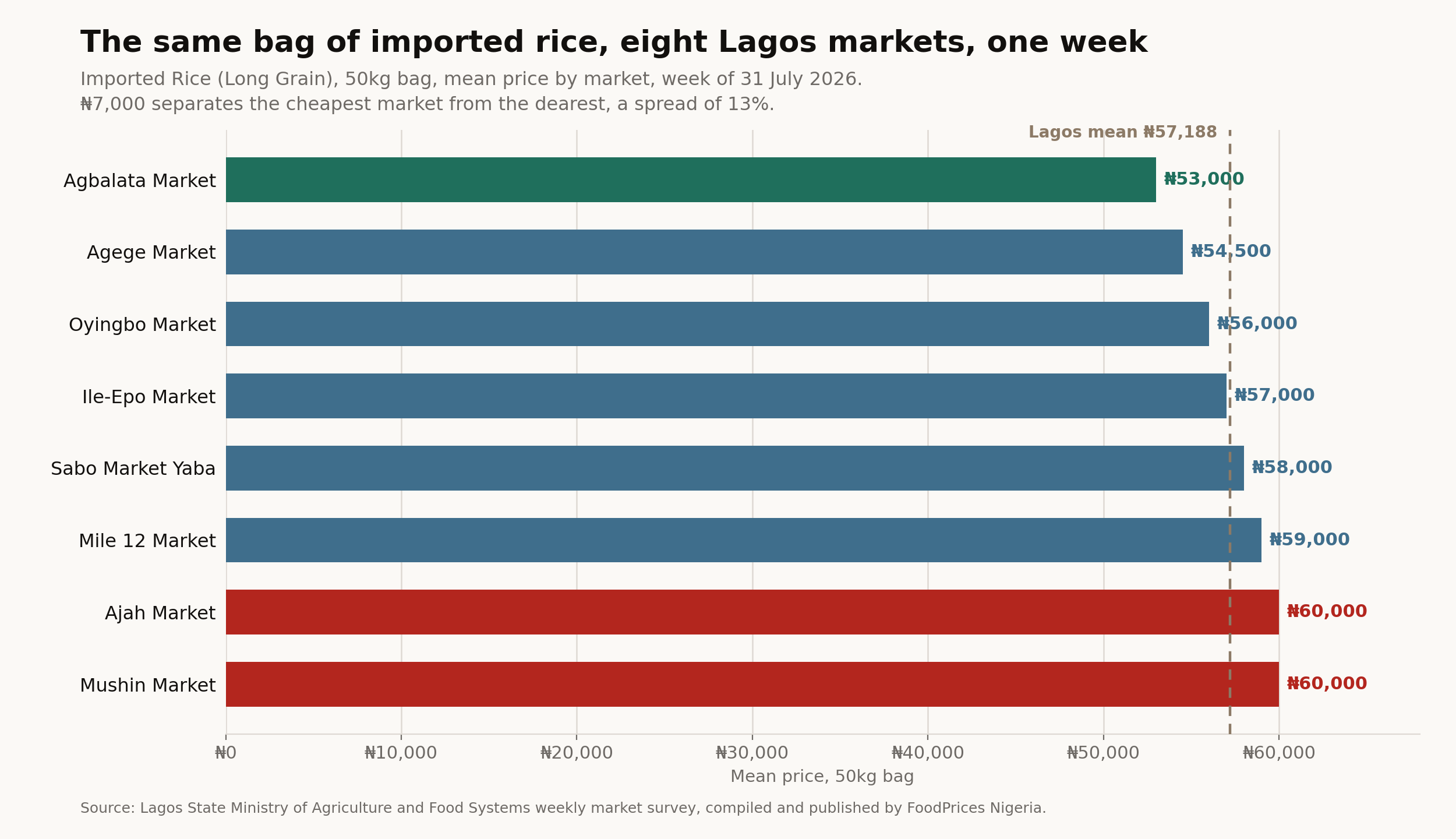
Between the two extremes sat Agege Market at ₦54,500, Oyingbo Market at ₦56,000, Ile-Epo Market at ₦57,000, Sabo Market Yaba at ₦58,000 and Mile 12 Market at ₦59,000.
Freight explains little of this. These are eight markets inside one metropolitan area, drawing on the same ports and the same wholesale channels, and the difference between the cheapest and the dearest is worth ₦140 a kilogram, more than the entire 8% gap between imported and Nigerian manufactured rice. What separates them is closer to retail positioning, rent, turnover and how much a given market can charge its customers. A shopper who buys imported rice at Agbalata rather than Ajah saves more than a shopper who switches from imported to Nigerian manufactured rice at a single market. That is a finding a national annual average cannot produce, and it is the reason weekly market-level tracking sits alongside the long series rather than beneath it.
The honest verdict
Nigeria's rice policy achieved the thing it was designed to achieve and failed at the thing people wanted from it. Local rice did become more competitive, decisively so in dollar terms, and a 62% premium on imported rice is a real reversal of the near parity of 2015. That is the case for the defence and it rests on real numbers.
The case against is that competitiveness was never the point for households. Rice at ₦922 a kilogram is not affordable rice, it is merely less unaffordable than the alternative, and the 390% naira increase behind that figure is the number families actually lived through. A policy can win its own argument and still lose the outcome that matters, and that is roughly where a decade of rice intervention has landed.
Every current price in this article can be checked at its source. Live prices: foodprices.ng/real-time-prices