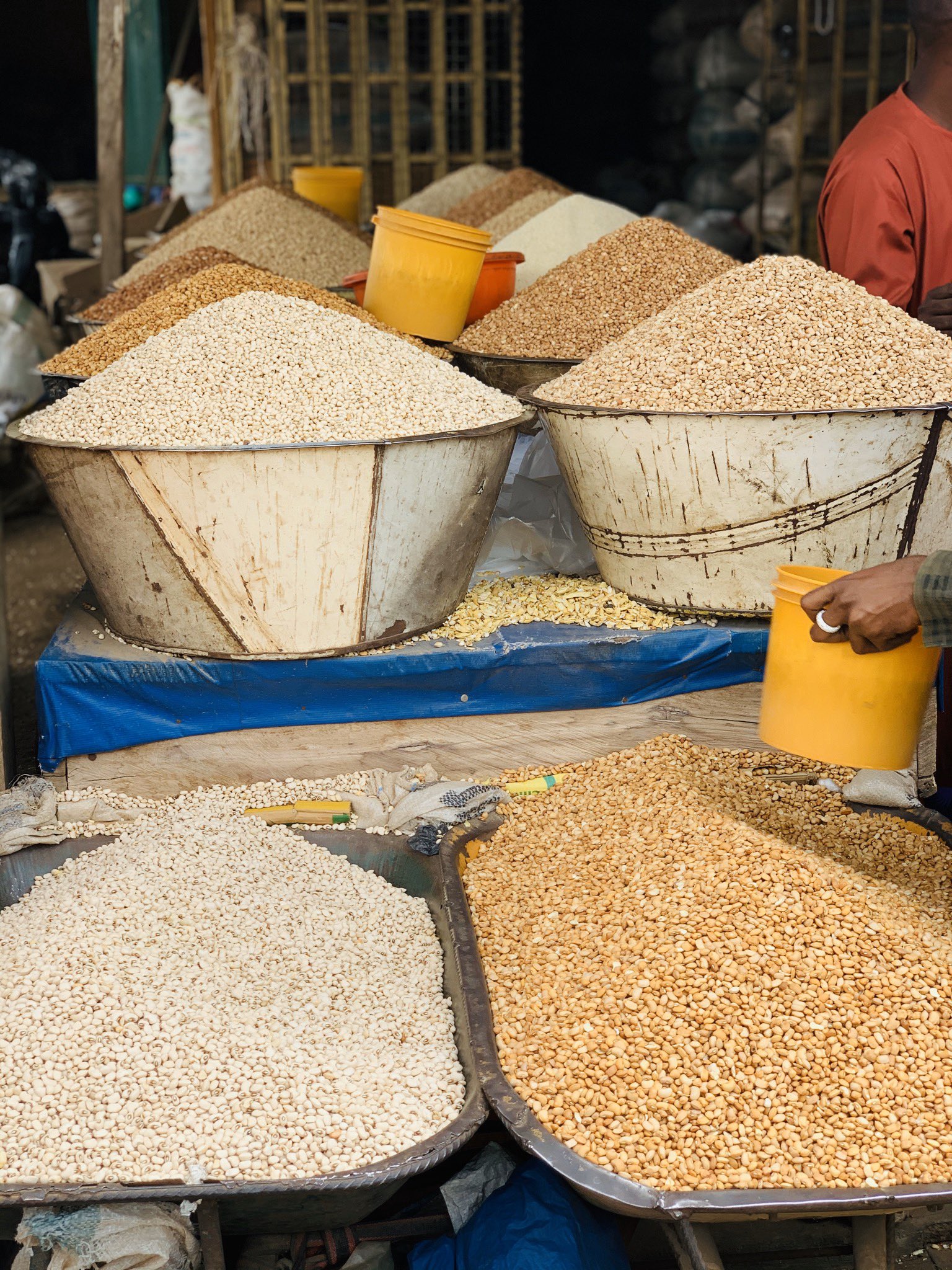
Beans are the clearest mover at Agege Market so far this year. A 50kg bag of Beans (Drum) sat at N48,000 in the week of January 26 and stayed there through the weeks of February 16 and February 23. By the week of April 6 the same bag had reached N70,000, settling at N65,000 in the week of April 13. That is a rise of N17,000, or 35.4 percent, from the February baseline. Beans (Oloyin) of the same weight tracked the identical path, from N48,000 to N65,000 over the same weeks, which points to a category-wide shift rather than a single variety getting tight.
The move matters for households that buy beans in bulk and for traders who resell by the derica. At Agege the derica price of Beans (Drum) rose from N700 in late January to N950 by April, so the pressure passed through to small-measure buyers as well. Anyone planning a bulk purchase can track the live figure on the Agege Market page before heading out.
Grains did not all move in one direction. A 25kg bag of Imported Rice (Short Grain) eased from N35,000 in the week of January 26 to N27,000 by the week of April 13, a fall of N8,000 or 22.9 percent. That divergence, beans rising while imported rice softens, is the kind of split that rewards shoppers who compare staples rather than assuming everything is climbing together. The price comparison tool makes that side by side check straightforward.
White garri offered the steadiest reading in the basket. A 50kg bag held at exactly N20,000 in every week it was captured, from January 19 through April 13. Yellow garri of the same weight moved from N20,000 to N23,000 across the period, though that comparison spans different capture weeks and reads better as a market-level observation than a confirmed single-seller jump. Tomatoes by the big basket climbed from N40,000 in late January to N50,000 by the week of March 16.
The beans story sits within a wider season. The Food and Agriculture Organization monitors how harvest timing and storage shape legume supply across West Africa, while the National Bureau of Statistics publishes the food inflation series that captures how these market moves feed into the cost of living. For households, the practical takeaway is to lock in beans where the bag is cheapest and to keep watching the rice spread. Live prices for every product tracked here are on the Agege Market real-time page.