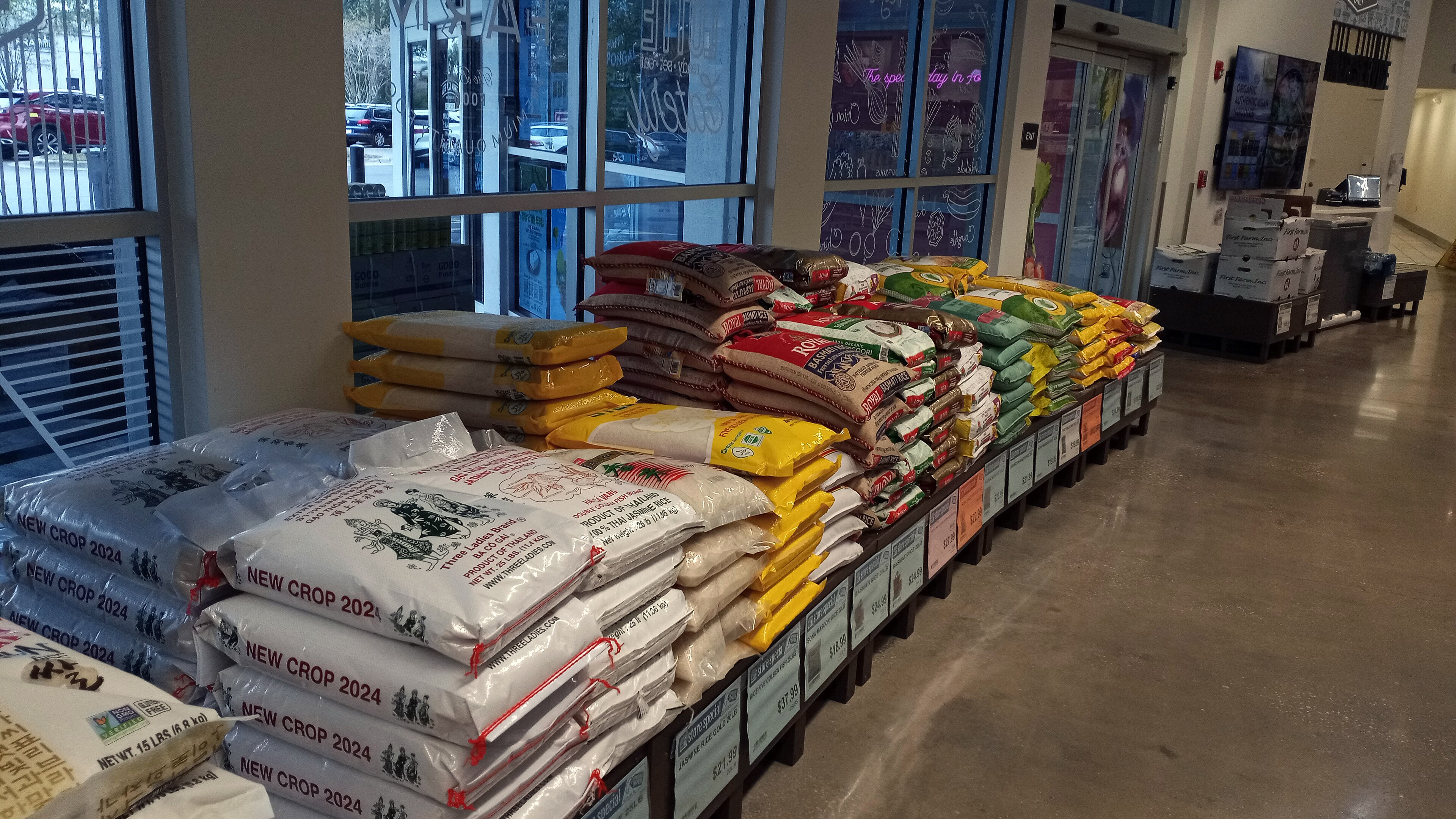
Bulk buying is the cheapest way to eat rice in Lagos, and it is the option fewest households can take. The Ministry of Agriculture and Food Systems market survey for the week of 17 July 2026 puts Imported Rice (Short Grain) at a Lagos average of ₦53,100 per 50kg bag across ten markets. Against a national minimum wage of ₦70,000 a month, a single bag consumes 75.9% of that wage in one transaction.
The Capital Barrier, Not the Price, Is the Obstacle
The bag is good value on its own terms. At the citywide average it costs the equivalent of about eleven paint measures of the same rice, which the survey prices at ₦4,839 each. The household that can find ₦53,100 at once therefore buys more rice per naira than the household buying a paint at a time. What separates the two is not knowledge of the market but access to a lump sum, and the wage backdrop is not improving. Politics Nigeria reported the Chief of Staff to the President, Femi Gbajabiamila, describing the ₦70,000 wage as no longer capable of meeting the economic demands facing citizens.
Ten Markets Within ₦5,000
Agege Market holds the cheapest bag at ₦51,000, which is 72.9% of a monthly minimum wage. Mushin Market, Agbalata Market and Sabo Market Yaba quote ₦52,000, while Oyingbo Market, Ile-Epo Market and Fresh Food Hub Mushin sit at ₦53,000. Mile 12 Market quotes ₦54,000, Ajah Market ₦55,000 and Epe Main Market ₦56,000, which is 80% of a monthly minimum wage. The ₦5,000 spread is 10% end to end, and the saving from choosing Agege over Epe equals 7.1% of the monthly wage.
The Direction Is Genuinely Favourable
The bag has been getting cheaper. The average fell 1.8% from ₦54,100 in the prior survey, sits 1.7% below the level of four weeks ago and has dropped 6.3% from ₦56,688 on 9 January. Duty changes explain much of that slope. Ripples Nigeria reported the duty on bulk rice almost halved to 47.5% from 70% under the 2026 Fiscal Policy Measures, with broken rice cut to 30%, and The ICIR placed that inside a revised schedule covering 127 tariff lines. Punch reported the Nigeria Customs Service rolling out the amended schedules to importers and licensed agents.
One Discrepancy Worth Noting
The Lagos State Ministry of Agriculture and Food Systems also publishes a Lagos Food Price Tracker, whose July 2026 entry lists imported short grain rice at ₦55,000 for a 50kg bag, about 3.6% above the ₦53,100 survey average. On imported long grain the two align almost exactly, with the tracker at ₦60,000 against a survey average of ₦59,938. The gap on short grain most likely reflects a single reference price against an outlier-filtered average drawn across ten markets.
Ajah Market, the only market on the Ajah and Lekki axis reporting this size, sits 4% above the mainland average of ₦52,889. The Bulk Discount Is Real but Conditional
Bag size rewards scale in a way smaller units do not. Two 25kg bags of imported short grain cost ₦53,800 at the citywide average against ₦53,100 for a single 50kg bag, a penalty of 1.3% for splitting the purchase. Against other grades the 50kg short grain bag remains the cheapest bulk option in the survey, with Nigerian Manufactured Rice at ₦53,250 and Imported Rice (Long Grain) at ₦59,938, the latter 12.9% dearer. Every one of those figures sits above two thirds of a monthly minimum wage.
FoodPrices Nigeria will keep tracking what a bag costs and what share of a wage it takes. Live prices: foodprices.ng/real-time-prices